Take the stress
out of probate.
Get your free, personalised probate checklist in just 2 minutes. Clear next steps, practical guidance, and no account needed.
Review us on TrustpilotPlain English, not legal advice.
Prefer it organised online? The Secure Workspace keeps every task, document and deadline in one place. £9.99, Starter Pack included.
See the Workspace →Free guide · England & Wales
The first two weeks after a death
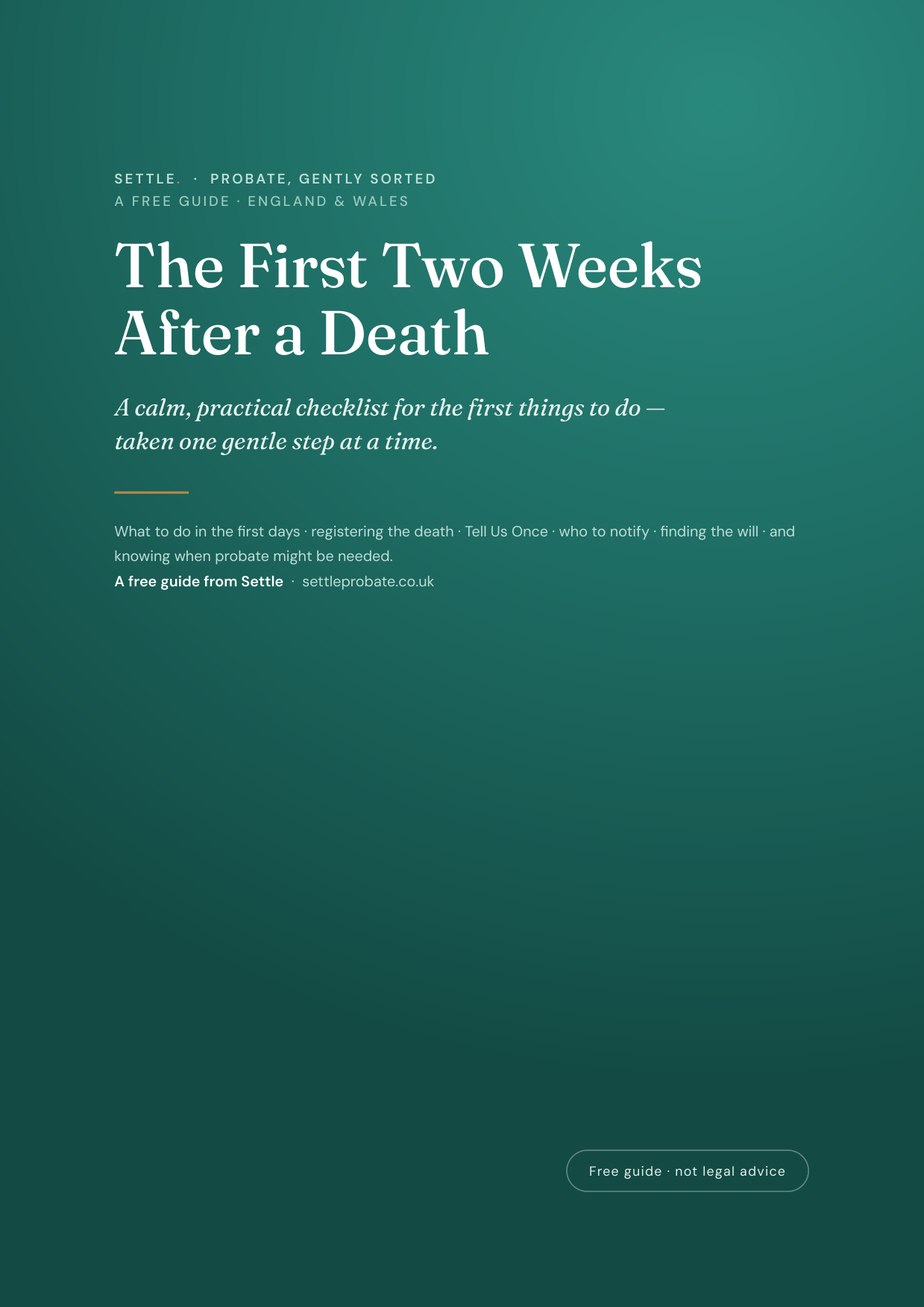
Not sure what to do first? Get our free checklist covering the immediate steps, from registering the death to notifying the right organisations.
Get my free guide →Free PDF, sent to your email. Separate from the paid Starter Pack.
Two ways to do probate yourself
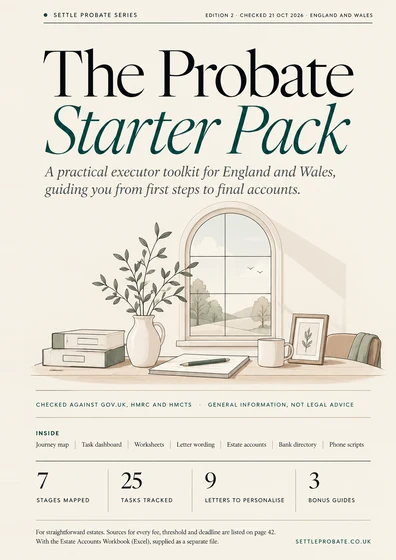

Starter Pack
£4.99
A 44-page printable toolkit to get organised and start probate yourself.
- 25-step executor checklist
- 9 ready-to-personalise letters
- Excel estate accounts workbook
Instant download · 30-day full refund
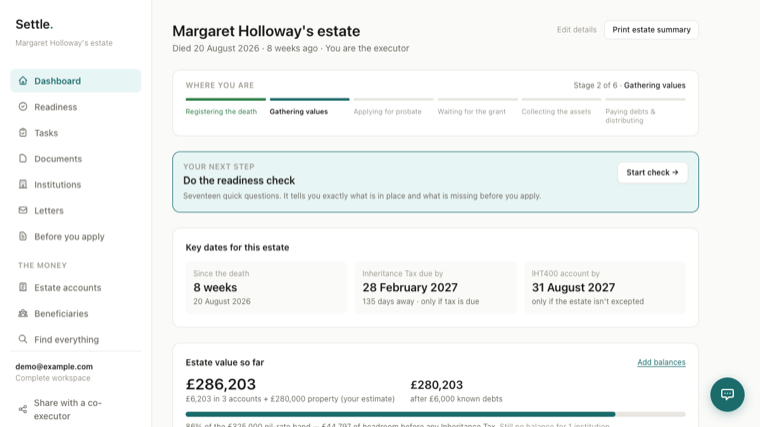
Secure Workspace
£9.99
Keep every probate task, document and deadline organised online.
- Your own secure probate Workspace
- Track tasks, organisations and deadlines
- Starter Pack included
One-off · no subscription · 30-day full refund
Start with the Pack and upgrade any time for £4.99.
✓ England & Wales · ✓ Checked against GOV.UK · ✓ 30-day money-back guarantee · Not legal advice
Instructing a solicitor
£1,500 – £10,000+
For complex estates, overseas assets, trusts or disputes — usually the right call.
Probate guides: plain English, no jargon
Everything an executor needs to know, updated July 2026.
What is Probate?
Probate is the legal process of administering a person's estate after they die. Learn what it means, when it's required, and how it works.
6 min readDo I Need Probate?
Not every estate requires probate. Find out when a Grant of Probate is required, bank thresholds, and which assets pass automatically.
7 min readHow to Apply for Probate
Step-by-step guide to applying for probate online or by post. PA1P and PA1A forms, documents needed, fees, and timelines.
8 min readExecutor Duties Explained
As executor you have legal responsibilities and potential personal liability. Everything you must do from death through to final distribution.
8 min readHow Much Does Probate Cost?
The court fee is £526 for estates over £5,000. Sealed copies are £2 each with the application. Full breakdown of every cost and a comparison of DIY vs professional probate.
6 min readProbate Checklist for Executors
A complete step-by-step probate checklist for executors in England and Wales — from registering the death to final distribution, in the right order.
8 min readHow Long Does Probate Take?
GOV.UK says probate is usually granted within 12 weeks of applying. Full estate administration typically takes 6–18 months. What affects the timeline.
5 min readCan I Do Probate Without a Solicitor?
Many executors handle straightforward probate themselves. This guide explains when DIY is suitable, the steps involved, and when professional help may be worth it.
7 min readClosing Bank Accounts After Death
How to notify banks, documents needed, bank thresholds for releasing funds without probate, joint accounts, and bereavement contacts.
6 min readSelling Property During Probate
Can you sell before probate is granted? Practical steps, Land Registry requirements, capital gains tax considerations for executors.
7 min readCommon questions
Probate is the legal process of administering a person's estate after they die. It involves proving that a will is valid, valuing all assets and debts, paying any inheritance tax, and then distributing what remains to the beneficiaries. The term 'probate' is often used loosely to describe the whole administration process - strictly speaking, probate refers to the grant issued by the Probate Registry that gives the executor legal authority to act.
Probate is still usually required when there is no will. Without a will, you apply for Letters of Administration rather than a Grant of Probate, and the estate passes under the rules of intestacy. You will likely still need a grant if the estate includes property in the deceased's sole name or assets above the bank's release threshold. Our free assessment tool can help you work out your specific situation.
The court fee for a Grant of Probate is £526. Estates worth £5,000 or less pay no court fee. Official sealed copies of the grant cost £2 each when ordered with your application, or £16 each if you order them later - order at least five to seven with the application, as many banks and institutions will each want to see one. If you use a solicitor, costs vary widely but typically run to 1–4% of the estate value, or a fixed fee for straightforward cases. DIY probate is entirely possible for straightforward estates.
GOV.UK says probate is usually granted within 12 weeks of submitting the application, although straightforward cases may be quicker and more complex or delayed applications can take longer. The full estate administration - from the date of death through to final distribution - often takes 6–18 months. The most common causes of delay are inheritance tax forms, disputed wills, property sales, and assets that are difficult to locate or value.
Yes. Many executors handle straightforward probate themselves rather than paying a professional to manage the process. Settle is designed to make that DIY route clearer and easier to organise, with personalised next steps, task tracking, institution logging and document management in one place. For complex estates, disputes, trusts, overseas assets or serious tax uncertainty, professional advice may still be appropriate.
An executor is the person named in a will who is legally responsible for administering the estate after the person dies. If there is no will, the equivalent role is called an administrator. Executors have significant legal duties: they must identify all assets and debts, value the estate, pay any inheritance tax, apply for probate, pay outstanding debts, and distribute the remaining estate to the beneficiaries.
The IHT205 was a simplified inheritance tax declaration form used for straightforward estates below the nil-rate band. It was abolished for deaths on or after 1 January 2022. For most simple estates today, no inheritance tax form is needed at all - the estate qualifies as an 'excepted estate' and you simply confirm this on the probate application. Larger or more complex estates use the IHT400.
No. Settle is an administrative organiser designed to help executors understand the probate process and keep track of what needs to be done. It is not a law firm, is not regulated by the Solicitors Regulation Authority, and does not provide legal, tax, or financial advice. The information on this site is for general guidance only. For complex estates, consult a qualified solicitor.
Ready to get started?
The free assessment takes two minutes and gives you a clear, personalised picture of what needs to happen next.
Planning ahead for a parent?
A Lasting Power of Attorney lets someone you trust handle their affairs if they can’t. Free step-by-step guide and assessment →