Selling Property During Probate
Checked against current GOV.UK probate and Inheritance Tax guidance for England & Wales (2026/27).
- Market and agree a sale during probate, but completion waits for the grant.2
- Update the register through HM Land Registry once probate is granted so the sale can complete.1
- The value at the date of death is the baseline; a rise before sale can trigger Capital Gains Tax for the estate.3
- The estate has one annual exempt amount (£3,000) for gains in the tax year of death and the two following years.3
You can find a buyer and agree a sale during probate, but you cannot complete until the grant is issued and the title can pass. Watch the Capital Gains Tax position if the property rises in value between death and sale.1
Quick answer
You can market the property and accept an offer before probate is granted, but you cannot legally complete the sale until you have the Grant of Probate. HM Land Registry will not register the transfer without it. Once you have the grant, a standard sale proceeds normally through a conveyancing solicitor.
You can market a property and accept an offer before probate is granted - but you cannot complete the sale until you have the Grant of Probate or Letters of Administration. HM Land Registry will not register a transfer of ownership without it. In practice: instruct an estate agent, allow viewings, negotiate freely - but the legal completion must wait for the grant.
If the estate includes a property and you are unsure whether probate is even needed, see our guide on whether you need probate for a house first.
Can you sell before probate is granted?
You can market the property and accept an offer before probate is granted - but you cannot complete the sale. The legal transfer of ownership requires the Grant of Probate (or Letters of Administration), and HM Land Registry will not register a transfer without it.
This means you can:
- Instruct an estate agent
- Allow viewings and marketing
- Accept a buyer's offer and enter into negotiations
- Instruct a conveyancing solicitor to begin title work
- Exchange contracts (with an extended completion date)
You cannot:
- Complete the sale and hand over the property
- Receive the sale proceeds and distribute them
In practice, most solicitors advise waiting for the grant before exchanging contracts, because if there are unexpected delays in issuing the grant, the exchange date may pass and cause complications. Some transactions do exchange before the grant on an agreed extended timeline - this is possible but carries risk.
Keep the mortgage payments going while you wait for the grant; the loan is repaid from the sale. See what happens to a mortgage after death for who pays in the meantime.
Step 1: Instruct an estate agent
You can instruct an estate agent as soon as you wish. As executor, you have implied authority to begin marketing even before probate is granted. Let the agent know the property is part of an estate so they can advise buyers on the likely timeline and manage expectations about completion dates.
Choose an agent who has experience with probate properties. They should understand that completion will depend on the grant being issued and should be prepared to deal with some uncertainty in the timeline.
Get at least two or three valuations. Probate property must be sold at market value - if you sell at below-market value to a connected party, HMRC may challenge the valuation.
Step 2: Get a probate valuation
Separate from the estate agent's marketing valuation, you need a formal probate valuation of the property at the date of death - the figure used to calculate inheritance tax. It should reflect market conditions at the time of death, not now.
Get this from a RICS-qualified surveyor or an estate agent who can provide a formal written valuation for probate purposes. Keep the document - HMRC may ask for it and will challenge it if they think the property was undervalued.
Step 3: Instruct a conveyancing solicitor
You will need a conveyancing solicitor to handle the legal work of transferring the property. They will:
- Obtain office copy entries from HM Land Registry
- Prepare the contract for sale
- Deal with the buyer's solicitor's enquiries
- Handle exchange and completion
- Register the change of ownership at HM Land Registry
The solicitor will want to see the Grant of Probate before completing. They can begin a significant amount of preparatory work - reviewing the title, raising enquiries, drafting the contract - while the grant is being obtained.
Step 4: After the grant - completing the sale
Once you have the Grant of Probate or Letters of Administration, you have the legal authority to sell and transfer the property. The solicitor can then proceed to exchange and completion in the normal way.
At completion, the sale proceeds are paid to the estate. The solicitor will typically hold these in their client account and transfer them to the estate's bank account once all searches, disbursements, and any outstanding mortgage have been settled.
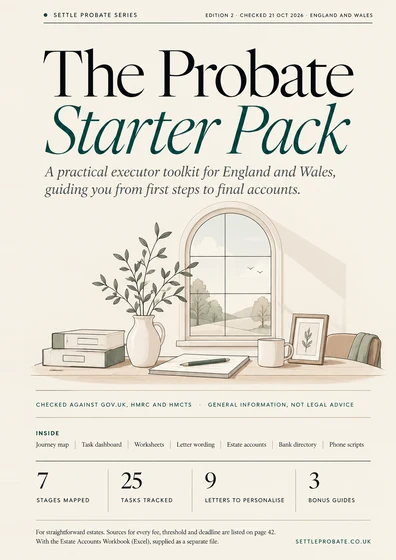
The Probate Starter Pack's property checklist covers this stage: protecting the empty home and its insurance, building the property file, and, if you sell, recording the proceeds and the 60-day deadline to report any Capital Gains Tax.
Transferring property to a beneficiary (Assent)
If the property is not being sold but is instead being transferred to a beneficiary under the will (for example, a child inheriting the family home), the process is different. Instead of a sale, the executor completes an "Assent" - a legal document transferring the property to the beneficiary. The Assent is registered at HM Land Registry using form AS1.
An Assent can only be completed after the grant is issued. A solicitor will typically handle this, though it is a simpler transaction than a sale.
Capital gains tax
CGT on estate property works differently from CGT on a personal sale. The base cost is the value at the date of death - not what the deceased originally paid for the property.
If the property sells for more than its probate value, the estate may owe CGT on the gain. The CGT annual exempt amount for estates is currently £1,500, and any gain above that is taxed at 24% for residential property.
CGT on estate property is most likely to arise where:
- The property market has risen significantly between the date of death and the date of sale
- There has been a long administration period
The main residence relief (private residence relief) does not apply to estate property - it applies to the owner's own home and ceases at death. However, there is an 18-month exemption period immediately after death during which sales of the deceased's main residence may qualify for relief. The rules are complex - take advice if this is relevant.
Note: CGT on estates is a complex area that can be affected by how long administration takes, the estate's specific circumstances, and current tax rules. If you are selling a property and believe CGT may be an issue, consult an accountant or tax adviser before completing the sale.
The 60-day trap. Where the estate sells UK residential property at a gain, the disposal has to be reported and the tax paid within 60 days of completion, through HMRC's UK Property Account. It is a separate deadline from the estate's Self Assessment return, the penalty for filing late starts at £100 regardless of the size of the gain, and it is the single most commonly missed step for executors selling a house.
In outline: the gain is worked out from the probate value, the disposal is reported and paid within 60 days of completion, and reliefs such as the annual exempt amount may reduce the bill. Because the property was valued for probate, that figure is the base cost for the calculation.
Not sure whether this applies to your estate? Take the free Settle assessment - it takes two minutes and gives you a personalised checklist of next steps.
Practical tips for a smoother sale
- Clear the property early. Buyers expect vacant possession. Start the process of clearing the property - keeping any items specifically bequeathed and making reasonable decisions on the rest - as soon as you have authority to do so.
- Ensure the property is insured. Buildings insurance is the executor's responsibility. Notify the insurer of the change in occupancy status immediately - many policies require notification when a property becomes unoccupied.
- Keep the property maintained. Utilities should stay connected (or be managed carefully) and the property should be kept secure and habitable to maintain its value.
- Manage buyer expectations. Be transparent with buyers about the probate timeline. An experienced buyer will understand - a buyer who has not dealt with a probate sale before may need clear communication about why completion dates are uncertain.
When to get professional advice
Property transactions during probate touch both conveyancing law and estate administration - they interact in ways that can catch executors out. Get professional advice if:
- The property has an unusual title, restrictive covenants, or leasehold complications
- CGT may be payable and you are unsure how to calculate it or report it
- There is a mortgage on the property and you need to deal with the lender
- A beneficiary is objecting to the sale or to the price you are accepting
- You are transferring the property to a beneficiary rather than selling it, and the title or circumstances are complex
A probate solicitor who also handles conveyancing can deal with both aspects of the transaction, which is often more efficient than instructing two separate firms.
Common mistakes to avoid
- Under-valuing at the date of death. A low probate value can inflate the later capital gain and the tax on it.4
- Ignoring Capital Gains Tax. If the property sells for more than its date-of-death value, the estate may owe CGT.3
- Promising buyers a completion date. You cannot complete before the grant, so keep timings honest.2
Frequently asked questions
Can I sell a house before probate is granted?
You can market and agree a sale, but completion has to wait for the grant so the title can be transferred.2
Will the estate pay Capital Gains Tax on a sale?
If the property sells for more than its date-of-death value, the gain may be taxable, after the estate's annual exempt amount. Selling at the probate value usually means no gain.3
What value do I use for probate?
The open-market value at the date of death, ideally from a RICS valuation for anything near the Inheritance Tax threshold.4
Who signs the sale contract?
The executors or administrators, using the authority the grant gives them. Before the grant they can prepare but not complete.1
What if the property is losing value?
If it sells for less than the probate value, the estate may be able to reclaim some Inheritance Tax; take advice where the figures are significant.3
Sources & references
The figures and rules in this guide are drawn from the official UK government pages below. Each link opens the relevant GOV.UK page. Always confirm current figures on GOV.UK before you act, as fees and thresholds can change.
- Update property records when someone dies — GOV.UK
- Applying for probate — GOV.UK
- Capital Gains Tax — GOV.UK
- How to value an estate for Inheritance Tax and report its value — GOV.UK
Starter Pack · £4.99 — a 44-page printable executor toolkit with a 25-step checklist, nine letters to personalise and an Excel estate accounts workbook.
See what’s inside →Free
Check what applies to this estate
Answer 7 questions and get a free probate assessment. No account needed.
Start free assessment →Secure Workspace · £9.99
Keep every value in one place
Record each balance at the date of death, the property estimate and known debts. The Workspace adds them up into an estate value, an Inheritance Tax allowance estimate and the probate fee.
See how the Workspace works →