How Long Does Probate Take?
Checked against current GOV.UK probate and Inheritance Tax guidance for England & Wales (2026/27).
- The grant is usually issued within 12 weeks of a complete application.1
- Full administration — death to final distribution — typically runs 6–18 months.2
- Where Inheritance Tax forms are needed, send the IHT400 first; HMRC's code for the probate application usually follows within 20 working days.3
- Move banks in parallel, check for excepted-estate status early, and apply online to keep things moving.
Quick answer
The Probate Registry usually issues a grant within 12 weeks of receiving a complete application. But the full process — from death to final distribution — typically takes 6 to 18 months. For larger estates, the IHT400 has to go to HMRC first, and HMRC's code for the probate application usually takes up to 20 working days after that.
"How long will this take?" is the question every executor asks, and the honest answer is: it depends which clock you mean. The grant itself is usually weeks. Winding up the whole estate is usually months. Muddling the two is what leaves people anxious, so here is each timeline laid out plainly.
There are two distinct timelines. First, the probate application itself: GOV.UK says the Probate Registry usually issues a grant within 12 weeks of receiving a complete application.1 Second, the full estate administration — collecting assets, paying debts, distributing the estate — typically takes 6–18 months from the date of death.2 These are different things, and conflating them is one of the most common sources of confusion. Below is what drives each timeline and what causes delays.
| Stage | Typical time or deadline |
|---|---|
| Register the death | Within 5 days7 |
| Collect balances and values (excepted estate) | Often 4–8 weeks |
| IHT400, if needed, then HMRC's code | Code usually within 20 working days of the IHT400 or payment3 |
| Inheritance Tax, if due | By the end of the 6th month after the death, or interest is charged |
| Probate application to grant | Usually within 12 weeks1 |
| Creditor notice in The Gazette | At least 2 months before you distribute4 |
| Family provision claims | Normally within 6 months of the grant5 |
| The "executor's year" | No duty to distribute before 1 year from the death6 |
| Death to final distribution | Typically 6–18 months |
The probate application: usually within 12 weeks
Once you submit a complete application, GOV.UK says a grant is usually issued within 12 weeks. This figure can change as HMCTS adjusts staffing - check gov.uk for the current estimate when you apply.
Online applications through the GOV.UK online probate service tend to be processed slightly faster than paper ones. Simple estates with a clear will, no inheritance tax requirement, and complete documents come in at the shorter end. Missing information, discrepancies in the will, or paper submissions can push it considerably longer.
Before you can apply: weeks to months
The probate application cannot be submitted until the estate has been valued and inheritance tax has been dealt with. Depending on the estate, getting to the point of application can itself take several weeks or months:
- Gathering date-of-death balances from banks typically takes 1–4 weeks (write to each institution with a death certificate)
- Property valuation can be arranged within a week or two, but RICS surveyors can be busy
- IHT400 and HMRC's code: if the estate is not excepted, send the IHT400 first; HMRC sends the code for your probate application usually within 20 working days of receiving the form or any tax payment, whichever is later3
For most straightforward estates that qualify as excepted estates (no separate inheritance tax form needed), you can typically submit the probate application within 4–8 weeks of the death, provided you move promptly.
Is there a deadline to apply? No, but Inheritance Tax and family claims run on their own clocks. See is there a time limit to apply for probate?
Full estate administration: 6–18 months
The Grant of Probate is not the end of the process - it is the point at which you can start dealing with assets. After the grant is issued, you still need to:
- Collect and transfer all assets (banks, investments, property)
- Pay any outstanding debts and bills
- Complete and file any outstanding tax returns
- Sell or transfer property if required
- Distribute the estate to beneficiaries
For a simple estate with no property, no complications, and co-operative institutions, the full process from death to distribution might take 6–9 months. For estates involving property sales, significant investments, or anything complex, 12–18 months is more typical. Disputed estates can take years. Our guide to what happens after probate is granted covers these post-grant steps in full.
What causes the biggest delays?
Inheritance tax forms (IHT400)
If the estate is not an excepted estate - typically because its value exceeds the nil-rate band or it has complex features - you must submit form IHT400 to HMRC before applying for probate, within 12 months of the death.3 HMRC then sends the code you need for the probate application, usually within 20 working days of receiving the IHT400 or any tax payment, whichever is later. You usually need to pay some of any tax due before you can get the grant, so arranging the money (for example, asking the bank to pay HMRC from the frozen account) is often what takes the time. See paying Inheritance Tax before probate.
Property sales
Selling a property during probate has its own timeline. While you can instruct an estate agent and accept an offer before the grant is issued, you cannot complete the sale until you have the grant in hand. In a slow market, a property can sit on the market for months. Even once you have a buyer and the grant, the conveyancing process typically takes 8–12 weeks to complete.
Uncooperative or slow institutions
Some banks and financial institutions are significantly faster than others at responding to executor enquiries. Chasing institutions for date-of-death balances, and then again to close accounts after the grant is issued, can add weeks to the process.
Missing assets or unclear paperwork
Old insurance policies, forgotten savings accounts, and pension schemes the deceased had not mentioned can take time to track down. The Unclaimed Assets Register and pension tracing services can help, but add time.
Disputes
If family members dispute the will or the administration of the estate, the entire process can be paused while the dispute is resolved. Contested probate cases can take years and are extremely expensive in legal fees.
Does probate take longer without a will?
The application is processed in the same way: you apply for Letters of Administration instead of a Grant of Probate. What often takes longer is getting to the point of applying, because the intestacy rules decide who may apply, everyone entitled must agree who will, and there is no will to say who inherits. See probate without a will.
How long after probate can money be paid out?
There is no fixed date, but three time limits shape it. If you place a creditor notice in The Gazette, you wait at least 2 months before distributing.4 Claims under the Inheritance (Provision for Family and Dependants) Act 1975 normally have to be made within 6 months of the grant, so many executors keep back enough to cover any risk until then.5 And an executor is not bound to distribute before one year from the death, often called the executor's year.6 Bank balances usually reach the estate account within a few weeks of each bank seeing the grant. See what happens after probate is granted and how long after probate you receive an inheritance.
Tips to reduce delays
- Apply for multiple death certificates immediately - you will need to send originals to many institutions simultaneously
- Write to all banks in parallel rather than sequentially - getting date-of-death balances is the first bottleneck
- Check if the estate qualifies as an excepted estate early - avoiding the IHT400 process saves months
- Apply for probate online through the GOV.UK online probate service rather than by post - applications tend to be processed faster
- Get everything ready before you start the form - the Probate Starter Pack's application preparation sheet lists the values, tax route, executor details and number of copies to settle first, so you don't stop halfway through
- Order additional sealed copies of the grant when you apply - you can use different copies simultaneously rather than waiting for each institution to return one before sending to the next
- Instruct a solicitor for property work early if a property is to be sold - they can start work on the title before the grant arrives
Note on beneficiaries: Beneficiaries are not entitled to receive their inheritance until the estate is fully administered. However, an executor can make interim distributions from funds already collected if it is clear there are sufficient assets to cover all debts. This can help beneficiaries who are waiting for funds without waiting for the entire estate to be finalised.
Not sure whether this applies to your estate? Take the free Settle assessment - it takes two minutes and gives you a personalised checklist of next steps.
Frequently asked questions
How long does probate take once the application is submitted?
GOV.UK says you will usually get probate within 12 weeks of submitting your application. It can take longer if the probate service needs more information from you.1
How long does probate take in the UK?
The Probate Registry usually issues a grant within 12 weeks of receiving a complete application. However, the full estate administration — collecting assets, paying debts, and distributing to beneficiaries — typically takes 6 to 18 months from the date of death, depending on complexity.
What causes delays in probate?
The biggest cause of delay is Inheritance Tax. If the estate is not an excepted estate, form IHT400 must go to HMRC before you apply, and HMRC sends the code you need for the probate application usually within 20 working days of receiving the IHT400 or any tax payment, whichever is later. Property sales, slow institutions, missing documents, and disputes can also add months to the timeline.
Does probate take longer without a will?
The application itself is processed in the same way: you apply for Letters of Administration instead of a Grant of Probate. It can take longer to get to the point of applying, because the intestacy rules decide who may apply and everyone must agree who will.
How long after probate can money be paid to beneficiaries?
There is no fixed date. Executors usually wait for the 2-month creditor notice period to end, and many keep back enough money until 6 months after the grant, when the usual deadline for family provision claims passes. The law does not require an executor to distribute before one year from the death.
When to get professional advice
Delays are often caused by avoidable errors or gaps in the application. Get professional advice if:
- HMRC has raised queries about the estate valuation or IHT400 form
- The Probate Registry has come back with queries about the application
- The estate involves an overseas property or assets in a foreign jurisdiction
- The administration is taking much longer than expected and you are unsure why
A probate solicitor can often pinpoint and clear blockers quickly. Their involvement may end up shortening the process, not lengthening it.
Sources & references
The figures and rules in this guide are drawn from the official UK government pages below. Each link opens the relevant GOV.UK page. Always confirm current figures on GOV.UK before you act, as fees and thresholds can change.
- Applying for probate — GOV.UK
- Dealing with the estate of someone who's died — GOV.UK
- How to value an estate for Inheritance Tax and report its value — GOV.UK
- Dealing with the estate: Settling debts and taxes — GOV.UK
- Inheritance (Provision for Family and Dependants) Act 1975, section 4 — legislation.gov.uk
- Administration of Estates Act 1925, section 44 (power to postpone distribution) — legislation.gov.uk
- Register a death — GOV.UK
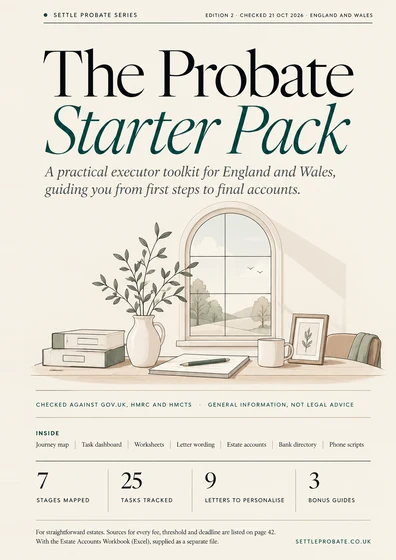
Starter Pack · £4.99 — a 44-page printable executor toolkit with a 25-step checklist, nine letters to personalise and an Excel estate accounts workbook.
See what’s inside →Free
Check what applies to this estate
Answer 7 questions and get a free probate assessment. No account needed.
Start free assessment →Secure Workspace · £9.99
Know you are ready before you apply
The Workspace's readiness check shows what is in place and what is still missing before you apply on GOV.UK, and your task list keeps everything else in order.
See how the Workspace works →