How to Apply for Probate
Checked against current GOV.UK probate and Inheritance Tax guidance for England & Wales (2026/27).
- Apply online through the GOV.UK probate service, or by post on PA1P (with a will) or PA1A (no will).1
- Value the estate and settle Inheritance Tax before you apply — the grant will not be issued until any tax due is paid or arranged.4
- The court fee is £526 for estates over £5,000; order grant copies with the application at £2 each.2
- A complete application is usually granted within 12 weeks.1
Quick answer
Apply for probate online through the GOV.UK online probate service or by post using form PA1P (with a will) or PA1A (without a will). You send the original will, a death certificate, and pay a £526 court fee. The Probate Registry usually issues the grant within 12 weeks of receiving a complete application.
The order matters more than anything else here. Value the estate first, deal with Inheritance Tax second, and only then apply — do it the other way round and your application stalls. Get those steps in sequence and probate is largely a form-filling exercise you can do yourself in an afternoon.
To apply, you submit an application to the Probate Registry with the original will (if there is one), a statement confirming the estate's Inheritance Tax position, and the £526 court fee.12 You can apply online through GOV.UK or by post on PA1P (with a will) or PA1A (without a will). GOV.UK says the Probate Registry usually issues a grant within 12 weeks of receiving a complete application.1 Here is what each step involves.
Before you apply: value the estate
You cannot complete the probate application until you know what the estate is worth. You need the date-of-death value of every asset the deceased owned.3 That means:
- Requesting date-of-death balances from banks and building societies in writing (a letter with a death certificate)
- Getting a professional valuation of any property - a formal RICS valuation is suitable for HMRC purposes; some estate agents also offer formal probate valuations
- Obtaining a date-of-death valuation of any shares or investment portfolios from the relevant platform or registrar
- Making a reasonable estimate of the value of personal possessions (contents of the home, jewellery, vehicles)
You also need to identify all debts: mortgage balance, credit cards, loans, outstanding bills, funeral expenses. These are deducted from the gross estate to give the net estate value. Our guide to documents needed for probate sets out a full checklist of what to gather.
Step 1: Check whether inheritance tax is due
Before applying for probate, you need to deal with Inheritance Tax. The key threshold is the nil-rate band, currently £325,000.4 There is an additional residence nil-rate band of up to £175,000 when a main residence is left to direct descendants, giving a potential combined threshold of £500,000 for a single person.4 Married couples and civil partners can transfer any unused nil-rate band, potentially doubling these thresholds to as much as £1 million.
If the estate is below these thresholds, and qualifies as an "excepted estate" under the rules introduced in January 2022, no separate inheritance tax form needs to be completed. You simply confirm on the probate application that the estate meets the excepted estate criteria. Note that the IHT205 form was abolished for deaths on or after 1 January 2022 - you no longer need to complete it.
If the estate does not qualify as an excepted estate - because it is above the threshold, or includes complex assets - you must complete form IHT400 and submit it to HMRC before applying for probate. Any inheritance tax due must be paid (or arrangements made to pay it) before the grant is issued. HMRC then sends a code you need for the probate application, usually within 20 working days of receiving the IHT400 or the Inheritance Tax payment, whichever is later. See our guide to inheritance tax forms for more detail.
Is there a deadline to apply? No, but Inheritance Tax and family claims run on their own clocks. See is there a time limit to apply for probate?
Step 2: Apply online or by post
There are two ways to apply for probate in England and Wales:
Online application (GOV.UK probate service)
Most executors and administrators can apply online through the government's online probate service. The online service guides you through the application step by step and allows you to track your application's progress. You will still need to send the original will and other documents by post after completing the online application.
To use the online service you will need to create an account for it with your email address. The application takes around 30–60 minutes to complete, depending on the complexity of the estate. Online applications tend to be processed slightly faster than paper applications.
Paper application
Not sure which paper form applies, or whether you need one of the less common forms (a lost will, an executor stepping down)? See probate forms PA1P, PA1A and the others explained.
If you prefer to apply on paper, or if the online service does not work for your situation, use:
- Form PA1P - for applying for a Grant of Probate when there is a will
- Form PA1A - for applying for Letters of Administration when there is no will
Both forms are available from gov.uk and from the Probate Registry directly. Completed forms are posted to the Probate Registry in Birmingham (HMCTS Probate) along with the supporting documents.
Step 3: Documents to send
Whether you apply online or by post, you will need to send the following by post to the Probate Registry:
- The original will (PA1P applications only - and any codicils, which are amendments to the will)
- The original death certificate (not a photocopy - the Probate Registry will return it)
- The court fee payment (see below)
- An IHT421 form from HMRC confirming inheritance tax has been paid or that the estate is an excepted estate (not needed for all excepted estate applications)
Do not send photocopies of the will or death certificate - the Probate Registry requires originals.
Step 4: The statement of truth
As part of the application, you must sign a statement of truth confirming that the information you have provided is accurate and that you will administer the estate correctly. This replaced the old "executor's oath" in 2020 - no solicitor visit needed - but it is still a solemn legal declaration. A false statement is a serious matter.
Step 5: Pay the court fee
The current Probate Registry court fee is:2
- £0 for estates valued at £5,000 or less
- £526 for all other estates
Order sealed copies of the grant at the same time. Copies cost £2 each when ordered with the application, but £16 each if you ask for them afterwards.2 Order at least five to seven — banks, investment platforms, HM Land Registry and other institutions each typically need one, and they want an original sealed copy rather than a photocopy. Ordering upfront is both cheaper and faster than requesting more later.
Step 6: What happens next
Once the Probate Registry receives your complete application, they will process it and issue the grant. GOV.UK says the Probate Registry usually issues a grant within 12 weeks of receiving your application. You can track your application online if you applied through the GOV.UK online service.
The Probate Registry may come back to you with queries. The most common issues are missing pages of the will, discrepancies in names or dates, and questions about the estate valuation.
After the grant is issued
Once you have the grant, you can use it to:
- Ask banks and building societies to release account balances
- Transfer or sell property (via a solicitor and HM Land Registry)
- Transfer or sell shares and investments
- Collect any other assets belonging to the estate
Send a sealed copy of the grant to each institution rather than the original. Keep the original safe. After collecting all assets, pay debts, complete any outstanding tax returns, and then distribute the estate to beneficiaries according to the will or rules of intestacy. Our guide to what happens after probate is granted covers the next steps in detail.
Practical tip: When writing to banks and institutions, always include a sealed copy of the grant, a copy of the death certificate, your ID, and a clear letter explaining what you need them to do. Dealing with the executor services team directly (rather than a local branch) will usually be faster.
Not sure whether this applies to your estate? Take the free Settle assessment - it takes two minutes and gives you a personalised checklist of next steps.
When to get professional advice
Many executors apply for probate without a solicitor. Get professional help if:
- You need to complete an IHT400 - the supplementary schedules are complex and errors can delay the application significantly
- The will is being challenged or its validity is in doubt
- The estate includes overseas assets, trusts, or business interests
- You are not confident completing the statement of truth or estate valuation accurately
Solicitors can be instructed just for the probate application itself, rather than the full estate administration, which keeps costs manageable. Our guide to doing probate without a solicitor will help you decide what suits your situation.
Common mistakes to avoid
- Applying before the tax is settled. The grant will not be issued until any Inheritance Tax is paid or an instalment arrangement is in place. Where IHT is due, HMRC needs its forms roughly 20 working days before you submit the probate application.4
- Sending photocopies. The registry needs the original will and an original death certificate — copies are rejected and the application is returned.
- Marking, stapling or pinning the will. Do not remove staples, attach anything, or write on it. Any mark can prompt questions about tampering and hold up the grant.
- Under-ordering copies of the grant. Running out and re-ordering later costs £16 a copy instead of £2.2
Frequently asked questions
Can I apply for probate myself, without a solicitor?
Yes. There is no legal requirement to use a solicitor, and the online service is designed for executors to use directly. Most straightforward estates are handled this way.
Do I apply online or on paper?
Either works. Online through GOV.UK is usually a little faster and lets you track progress; paper (PA1P or PA1A) is there if the online route does not fit your situation.1 Whichever you choose, you still post the original will and death certificate.
How long does probate take after I apply?
GOV.UK says a complete application is usually granted within 12 weeks.1 Missing documents, name discrepancies or an IHT400 in the background can push it out further. See how long probate takes.
What if there is no will?
You apply for Letters of Administration on form PA1A instead of a Grant of Probate. Who can apply is set by the rules of intestacy, starting with the spouse or civil partner. See Letters of Administration.
How much does it cost?
£526 for estates over £5,000, plus £2 per grant copy ordered with the application.2 A full breakdown is in our probate costs guide.
Do I need to send the IHT forms to the Probate Registry?
For most estates below the threshold you simply declare the excepted-estate figures on the probate application itself. Where an IHT400 is required, you send it to HMRC first; HMRC then issues the code the registry needs before it will grant probate.4
Sources & references
The figures and rules in this guide are drawn from the official UK government pages below. Each link opens the relevant GOV.UK page. Always confirm current figures on GOV.UK before you act, as fees and thresholds can change.
- Applying for probate — GOV.UK
- Applying for probate: Fees — GOV.UK
- How to value an estate for Inheritance Tax and report its value — GOV.UK
- How Inheritance Tax works: thresholds, rules and allowances — GOV.UK
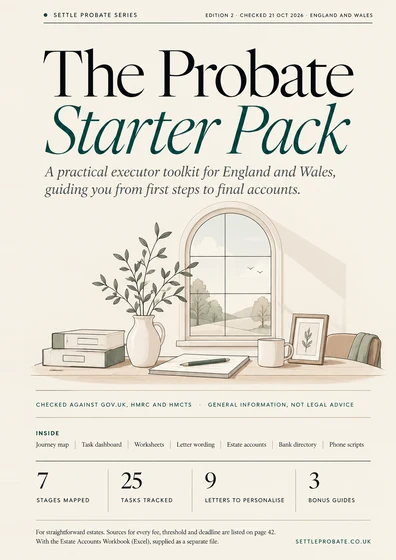
Starter Pack · £4.99 — a 44-page printable executor toolkit with a 25-step checklist, nine letters to personalise and an Excel estate accounts workbook.
See what’s inside →Free
Check what applies to this estate
Answer 7 questions and get a free probate assessment. No account needed.
Start free assessment →Secure Workspace · £9.99
Know you are ready before you apply
The Workspace's readiness check shows what is in place and what is still missing before you apply on GOV.UK, and your task list keeps everything else in order.
See how the Workspace works →