Documents Needed for Probate
Checked against current GOV.UK probate and Inheritance Tax guidance for England & Wales (2026/27).
- You need the original will and an original death certificate — photocopies are rejected.1
- Have the deceased's National Insurance number and date-of-death balances from every bank to hand.2
- Property needs a formal date-of-death valuation; near the threshold, use a RICS surveyor.2
- Where IHT is due, get the HMRC reference before you can submit the probate application.1
Quick answer
The core documents for probate are the original will, an original death certificate, date-of-death balances from each bank, a property valuation if applicable, and the deceased's National Insurance number. If inheritance tax is payable, you also need a reference from HMRC before the Probate Registry will issue the grant.
Nine times out of ten, what holds a probate application up is a missing piece of paper. Gather everything first and the application itself is quick. This is your checklist — the mandatory documents, the asset evidence, and the tax paperwork — so nothing comes back to bite you halfway through.
The Probate Registry cannot process an incomplete application, and missing paperwork is one of the most common reasons applications are held up.1 Here is exactly what you need, split into mandatory application documents, asset evidence, and Inheritance Tax paperwork.
Not sure which documents apply to your estate? Take the free Settle assessment - it asks about your situation and produces a personalised document checklist.
Mandatory Documents for the Application
These documents are required for every probate application where a will exists.
The original will
You must submit the original will - not a photocopy, not a scanned version. If there are any codicils (formal amendments to the will), the originals of those must be included too. If the original will cannot be found, it is possible to apply for probate on the basis of a copy, but this is significantly more complicated and usually requires a solicitor's help.
The will is sent to the Probate Registry as part of the application process. If you are applying online through GOV.UK, you submit the form online first and then send the original will by post. The Registry will retain the original and return a certified copy if you request one.
Death certificate
You need a certified copy of the death certificate — one of the copies issued by the register office when the death was registered, not a photocopy of the certificate.3 For the application itself, one copy is submitted. However, you will need many more copies to notify banks, HMRC, the Land Registry, and other institutions - see our section on planning ahead below.
Deceased's personal details
The application form asks for:
- Full legal name (and any aliases or former names)
- Last known address
- Date of birth
- Date of death
- National Insurance number
The National Insurance number is important for HMRC purposes and is required on the application form. It is usually found on payslips, letters from HMRC or DWP, or the deceased's tax documents.
Asset and Liability Documents
To complete the probate application, you need to state the total gross value of the estate and the total net value (after debts). This requires evidence of every asset and liability.
Bank and savings accounts
Write to each bank and building society to notify them of the death. They will provide a letter or statement showing the date-of-death balance. Keep the originals - some institutions will ask to see them, and you will need the figures for the application.
Property
If the estate includes any property owned solely (or in part) by the deceased, you need a formal probate valuation. This should be carried out by a RICS-qualified surveyor or estate agent with professional indemnity. The valuation should be the open market value as at the date of death. HMRC can challenge undervaluations, particularly on residential property, so use a reputable local agent and keep a written copy of the valuation report.
If the property was held as joint tenants, it passes automatically by survivorship and does not form part of the probate estate - though it may still be relevant for IHT purposes.
Shares and investments
For listed shares, the value is calculated using the lower of the two prices quoted in the Stock Exchange Daily Official List on the date of death (or the nearest preceding business day), plus one-quarter of the difference between the two prices. In practice, most executors ask the stockbroker or investment platform to provide a date-of-death valuation in writing.
For ISAs, unit trusts, and other investment accounts, contact the provider directly. They will usually provide a formal valuation letter.
Life insurance
If there are life insurance policies, contact each insurer. Policies written in trust do not form part of the estate - they pass directly to the named trustees or beneficiaries. Policies not written in trust do form part of the estate and need to be valued and included.
Pension death benefits
Most pension death benefits are paid at the discretion of the trustees and do not form part of the probate estate. However, any lump sum that the pension trustees decide to pay into the estate would be included. Contact the pension provider to confirm the position.
Outstanding debts owed to the estate
If anyone owed money to the deceased - for example an informal loan - this is an asset of the estate and should be included, along with any evidence of the debt.
Liabilities and debts
Collect evidence of all debts and liabilities, including:
- Outstanding mortgage balance (from the lender)
- Credit card statements
- Utility bills outstanding at the date of death
- Any personal loans
- Funeral invoice (funeral costs are a priority liability of the estate)
| Document | Where to get it | Notes |
|---|---|---|
| Original will | Solicitor, bank, or deceased's home | Must be the original - copies not accepted |
| Death certificate (certified copy) | Register office | Order at least 10 copies at registration |
| National Insurance number | HMRC letters, payslips, DWP correspondence | Required on the application form |
| Bank date-of-death balances | Each bank or building society | Write to each institution with a death certificate |
| Property valuation | RICS surveyor or estate agent | Open market value at date of death |
| Share / investment valuations | Stockbroker, investment platform | Date-of-death valuation in writing |
| Pension death benefit letter | Pension provider | Confirms whether proceeds form part of estate |
| IHT421 reference (if IHT payable) | HMRC (after submitting IHT accounts) | Must be obtained before submitting probate application |
Inheritance Tax Documents
The IHT documents you need depend on the size and nature of the estate.
Excepted estates (no IHT to pay)
Since January 2022, most straightforward estates that fall below the IHT threshold do not require a separate IHT form. Instead, you confirm the estate's value and IHT position directly on the probate application. No form IHT205 or IHT207 is needed for excepted estates - the rules changed significantly at that point.
An estate is typically excepted if its gross value is below the nil-rate band (currently £325,000), or below £650,000 if the deceased was a surviving spouse or civil partner who inherited the unused nil-rate band. There are also rules covering the residence nil-rate band. If you are unsure whether the estate qualifies as excepted, take advice before proceeding.
Estates where IHT is payable
If the estate is above the threshold and IHT is due, you must:
- Complete the full IHT account (form IHT400 and relevant schedules)
- Submit it to HMRC
- Pay at least some of the IHT due (or arrange to pay in instalments for property)
- Receive the IHT421 reference number from HMRC confirming the tax position
You cannot submit the probate application until you have the IHT421 reference. HMRC typically takes several weeks to process the IHT400, so submit it as early as possible. Keep copies of all IHT paperwork.
Not sure whether this applies to your estate? Take the free Settle assessment - it asks about your specific situation and gives a personalised checklist of next steps.
What About ID for Executors?
The Probate Registry does not require executors to submit personal identity documents as part of an online application. However, individual banks and institutions may ask you to verify your identity when you present the grant to them later - particularly for high-value accounts or when closing accounts and releasing funds. Keep your own ID documents to hand for that stage.
Practical Tip: Create a Master Folder
Before you begin contacting institutions, set up a dedicated folder - physical or digital - for every document related to the estate. Label each document clearly and keep a running log of what you have sent to whom and when. This makes the application process smoother and is essential for preparing estate accounts later.
Our probate checklist gives you a complete phase-by-phase view of the process from start to finish. Once you have the grant, see our guide to closing bank accounts after death for the next steps.
Ready to get organised? Take the free Settle assessment - free, 2 minutes, no account needed. You'll get a personalised document list and next-step checklist based on your estate.
Sources & references
The figures and rules in this guide are drawn from the official UK government pages below. Each link opens the relevant GOV.UK page. Always confirm current figures on GOV.UK before you act, as fees and thresholds can change.
- Applying for probate — GOV.UK
- How to value an estate for Inheritance Tax and report its value — GOV.UK
- Register a death — GOV.UK
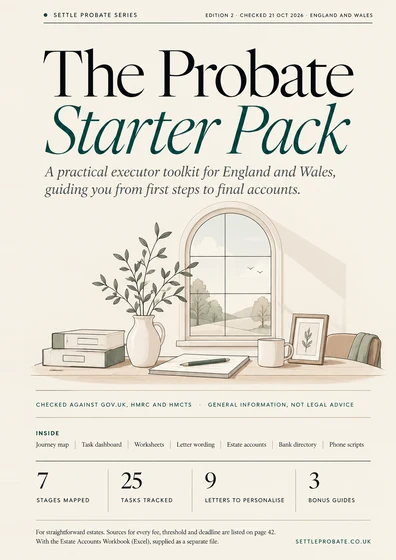
Starter Pack · £4.99 — a 44-page printable executor toolkit with a 25-step checklist, nine letters to personalise and an Excel estate accounts workbook.
See what’s inside →Free
Check what applies to this estate
Answer 7 questions and get a free probate assessment. No account needed.
Start free assessment →Secure Workspace · £9.99
Know you are ready before you apply
The Workspace's readiness check shows what is in place and what is still missing before you apply on GOV.UK, and your task list keeps everything else in order.
See how the Workspace works →