Probate Checklist for Executors
Checked against current GOV.UK probate and Inheritance Tax guidance for England & Wales (2026/27).
- Register the death and get several certified certificates before anything else.1
- Value the whole estate at the date of death before you apply for the grant.4
- Deal with any Inheritance Tax — it must be paid or arranged before the grant is issued.4
- Apply for probate (online or on PA1P/PA1A), then collect, pay debts, and distribute in that order.2
Probate goes far more smoothly when you take the steps in order: register the death, value the estate, deal with any Inheritance Tax, apply for the grant, then collect, pay and distribute. This checklist keeps them in the right sequence.1
Being named as an executor comes with a lot of responsibility - and a lot of tasks. This checklist breaks the probate process in England and Wales into five clear phases, so you can see at a glance what needs to happen and roughly when. Every estate is different, and not every step will apply to you, but this gives you a solid framework to work from.
This is a general checklist. The specific steps for your estate will depend on its size, assets, and whether inheritance tax applies. Take the free Settle assessment - it asks about your situation and produces a personalised list of next steps.
Phase 1: Immediately After Death
The first few days are often the hardest. There is no strict legal deadline to begin probate proceedings, but some practical steps need to happen quickly.
- Register the death. You must register the death within 5 days in England and Wales (8 days in Scotland). Take the medical certificate of cause of death to the register office for the area where the person died. You will receive the death certificate at this stage.
- Obtain enough death certificates. Order at least 10 certified copies at the time of registration - each institution you notify will typically need its own original copy, and ordering them later costs more and causes delays. See our guide to documents needed for probate for more detail.
- Find and secure the will. Locate the original will. It may be held by the person's solicitor, at their bank, or among their papers at home. The original must be submitted to the Probate Registry - copies are not accepted.
- Confirm who the executors are. Check the will carefully. If there are multiple executors named, contact them. You can apply together or one can take the lead with others renouncing or reserving power.
- Notify immediate next of kin. Ensure family members have been informed, particularly if they are named as beneficiaries.
- Secure the property. If the deceased owned or rented a property, make sure it is secure - locks changed if needed, insurance informed, mail redirected if possible. Read your guide to executor duties for your obligations here.
- Make a note of any funeral wishes. The will may contain funeral wishes. Executors are responsible for arranging the funeral; costs are paid from the estate.
Phase 2: Before Applying for Probate
Before you can submit a probate application, you need a clear picture of everything the deceased owned and owed. This phase often takes several weeks.
- Notify banks and financial institutions. Write to each bank, building society, pension provider, and investment platform to inform them of the death. They will freeze accounts (not close them) and tell you the date-of-death balances. Keep records of every balance - you will need these for the probate application.
- Notify DWP and HMRC. Inform the Department for Work and Pensions to stop any state pension or benefits. Notify HMRC so that the deceased's tax affairs can be settled. Use the government's Tell Us Once service where possible.
- Notify the employer or private pension provider. If the person was still working or receiving a private pension, contact the provider. Death-in-service benefits and pension drawdown may form part of the estate (or may pass outside it - check the rules).
- Value all assets. Obtain formal valuations for:
- Any property (a RICS-qualified surveyor can provide a probate valuation)
- Shares and investments (date-of-death price)
- Bank and savings account balances
- Contents of the home (for IHT purposes, a reasonable estimate is usually acceptable)
- Any business interests or unusual assets
- List all debts and liabilities. Outstanding mortgages, credit cards, utility bills, and any loans must be identified. These are deducted from the estate's value.
- Check the inheritance tax position. If the gross estate exceeds the nil-rate band (£325,000, or more with the residence nil-rate band and/or a transferred allowance from a deceased spouse), IHT may be payable. If IHT is due, you must obtain an IHT421 reference from HMRC before you can submit the probate application. For excepted estates - those below the IHT threshold - no separate IHT form is required since January 2022.
- Gather all documents. Assemble the original will, death certificate copies, and all asset and liability paperwork. See our full documents needed for probate guide.
Not sure whether this applies to your estate? Take the free Settle assessment - it asks about your specific situation and gives a personalised checklist of next steps.
Phase 3: Applying for Probate
Once you have valued the estate and gathered the documents, you can apply for the Grant of Probate (if there is a will) or the Grant of Letters of Administration (if there is no will). You are applying for probate using form PA1P (with a will) or PA1A (without).
- Complete the probate application online or by post. The online route through the GOV.UK online service is generally faster. You will need the deceased's full name, address, date of birth, date of death, and National Insurance number, along with the total estate values.
- Pay the court fee. The current Probate Registry fee is £526 for estates over £5,000. There is no fee for estates valued at £5,000 or below. Payment is made online at the point of application.
- Send the original will. If applying online, you will be prompted to send the original will (and any codicils) to the Probate Registry by post after submitting the online form.
- Order sealed copies. When applying, specify how many official sealed copies of the grant you need. Sealed copies cost £2 each when ordered with the application, but £16 each if you order them later. Order at least one per major institution (bank, investment platform, Land Registry, share registrar) — ordering them all upfront is far cheaper than requesting more later.
- Wait for the grant to issue. GOV.UK guidance indicates that most grants are issued within 12 weeks of the application being submitted and accepted, though this can vary with caseload. You cannot take any action to collect or distribute assets until you hold the grant.
Phase 4: After the Grant Is Issued
Receiving the grant is a significant milestone, but it is not the end. The administration of the estate continues. See our dedicated guide to what happens after probate is granted.
- Send sealed copies to institutions. Distribute the sealed copies of the grant to banks, investment platforms, pension providers, the Land Registry (if property is involved), and share registrars. Each institution needs its own original sealed copy.
- Collect assets. Banks and institutions will now release funds or transfer assets to the estate. Closing bank accounts after death is usually a straightforward process once the grant is presented.
- Open an executor bank account. It is good practice to open a dedicated executor account to receive all estate funds. This keeps estate money separate from your own and makes the accounts cleaner.
- Pay all debts and liabilities. Settle funeral costs, outstanding bills, credit cards, loans, and any income tax owed by the deceased. Creditors take priority over beneficiaries.
- Advertise for creditors if needed. Consider placing a deceased estate notice in The Gazette. This gives creditors 2 months to come forward and provides you with protection against unknown creditors making claims after distribution.
- Deal with property. If the estate includes property, this may need to be sold or transferred to a beneficiary. Property can only be sold or formally transferred once probate is granted. See our guide to selling property during probate.
- Submit the deceased's final tax return. HMRC will need a final self-assessment return (if the person completed one) covering the period up to the date of death. Any repayment belongs to the estate; any liability must be paid from it.
Phase 5: Finalising the Estate
The final phase brings the administration to a close. This typically happens several months after the grant is issued - sometimes longer if property is involved.
- Prepare estate accounts. Draw up a clear record of all assets collected, all debts and liabilities paid, and all costs incurred. Beneficiaries are entitled to see these accounts before distribution.
- Calculate the residue. The residue is what remains after all debts, taxes, and costs have been paid. This is what the residuary beneficiaries receive.
- Distribute to beneficiaries. Make payments or asset transfers to each beneficiary in accordance with the will. Specific legacies (cash gifts, particular items) should be distributed before the residue is divided.
- Obtain signed receipts. Ask each beneficiary to confirm in writing that they have received their entitlement. This protects you as executor if any dispute arises later.
- Close the executor bank account. Once all distributions are made and all receipts received, close the executor account.
- Keep records. Retain all estate paperwork for at least 12 years. If anyone challenges the administration in future, your records are your protection.
Do not distribute early. Distributing assets before all debts are paid, all taxes are settled, and probate has been granted (where required) can make you personally liable as executor. If in doubt, take professional advice before proceeding.
How Long Does the Whole Process Take?
For a straightforward estate, the full process from death to final distribution typically takes between 9 and 18 months. The probate application itself usually takes up to 12 weeks once submitted. More complex estates - particularly those involving property sales, disputes, or overseas assets - take longer.
The best way to keep things moving is to stay organised from the start. Settle gives you a structured workspace and task tracker to manage every phase without missing anything.
Ready to get started? Take the free Settle assessment - it's free, takes about 2 minutes, and needs no account. You'll get a personalised checklist based on your specific estate.
Common mistakes to avoid
- Applying before valuing the estate. You need the full date-of-death figures first, and any tax settled.4
- Distributing before debts and tax. Pay everything the estate owes before paying beneficiaries.3
- Not keeping records. Log every asset, debt and payment for the estate accounts.3
Frequently asked questions
What are the main steps of probate?
Register the death, value the estate, deal with Inheritance Tax, apply for the grant, collect the assets, pay debts and tax, then distribute.1
What comes first, valuing or applying?
Valuing. You cannot complete the probate application or settle Inheritance Tax without the date-of-death values.4
When is Inheritance Tax paid?
Before the grant is issued. HMRC generally needs its forms and payment (or an instalment arrangement) in place first.4
Do I need probate at all?
Not always. Small estates and jointly-owned assets can sometimes be dealt with without a grant, depending on the institutions involved.2
How long does the whole process take?
A grant usually issues within 12 weeks of a complete application; a full administration often takes 6–18 months.2
Sources & references
The figures and rules in this guide are drawn from the official UK government pages below. Each link opens the relevant GOV.UK page. Always confirm current figures on GOV.UK before you act, as fees and thresholds can change.
- What to do when someone dies: step by step — GOV.UK
- Applying for probate — GOV.UK
- Dealing with the estate of someone who's died — GOV.UK
- How to value an estate for Inheritance Tax and report its value — GOV.UK
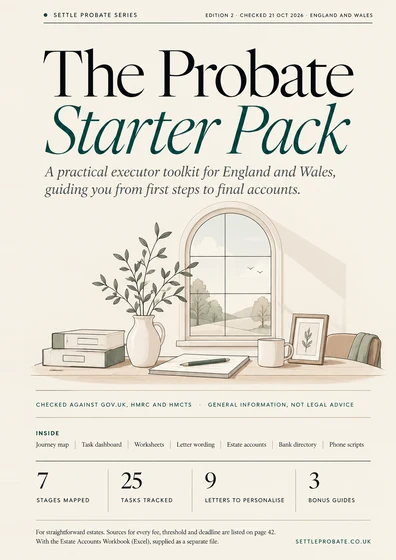
Starter Pack · £4.99 — a 44-page printable executor toolkit with a 25-step checklist, nine letters to personalise and an Excel estate accounts workbook.
See what’s inside →Free
Check what applies to this estate
Answer 7 questions and get a free probate assessment. No account needed.
Start free assessment →Secure Workspace · £9.99
Know you are ready before you apply
The Workspace's readiness check shows what is in place and what is still missing before you apply on GOV.UK, and your task list keeps everything else in order.
See how the Workspace works →