What to Do When Someone Dies and Leaves a Will
Checked against current GOV.UK probate and Inheritance Tax guidance for England & Wales (2026/27).
When there is a will, the person it names as executor takes charge. The first jobs are the same for everyone: get a medical certificate, register the death, and find the will — then work out whether probate is needed.1
Losing someone is hard enough without the added pressure of knowing there are practical and legal steps you need to take. If you have been named as an executor - or you think you might be - this guide walks you through what to do in the first days and weeks after the death. You do not have to do everything at once, and you do not need to be a legal expert.
This guide covers deaths in England and Wales where the person left a valid will. If there is no will, different rules apply around who administers the estate.
The First Hours and Days
There is no legal clock ticking in the immediate aftermath of a death, but a few things need to happen promptly.
Register the death
You must register the death within 5 days of it occurring (in England and Wales). Take the medical certificate of cause of death - issued by the doctor or hospital - to the register office for the area where the person died. You do not have to be the executor to register a death; any relative or person present at the death can do this.
At the register office, you will receive the death certificate. This is an important legal document that you will need multiple copies of.
Obtain enough death certificates
Order at least 10 certified copies at the time of registration. Each bank, investment platform, and government department you contact will typically ask for its own original copy, and ordering additional copies later is more expensive and slower. It is almost always worth getting more than you think you need. Our documents needed for probate guide has more detail on exactly what you will need.
Tell immediate family
Ensure that the people closest to the deceased know what has happened. You are not legally required to do this, but it is the right thing to do - and beneficiaries named in the will have an interest in knowing, as they will eventually need to be contacted.
Finding and Reading the Will
The will is the foundation of everything you will do as executor. You need to locate the original as soon as possible.
Where the will might be held
- At the person's home - often in a filing cabinet, safe, or important documents folder
- With their solicitor - many solicitors store wills for clients; a letter or file among their papers may give a clue
- At their bank - some banks offer will storage services
- With the National Will Register - you can search Certainty (the National Will Register) for a small fee
- At HM Courts and Tribunals Service - older wills may have been deposited with the Probate Registry
If a solicitor holds the will, contact them promptly. They will usually release it to the executors named in it.
Reading the will
Read the will carefully. Note who is named as executor (there may be more than one), who the beneficiaries are, and what specific gifts or legacies are included. If there is anything you do not understand, a solicitor can advise - though this does not need to happen immediately.
If there are multiple executors, get in touch with each other. You will all need to agree on how to proceed - though you can also formally renounce or reserve your power if needed.
Not sure whether this applies to your estate? Take the free Settle assessment - it asks about your specific situation and gives a personalised checklist of next steps.
Checking Whether Probate Is Needed
Not every estate requires a Grant of Probate. Some assets pass automatically - for example, joint assets that pass by survivorship, or assets held in trust. If the estate is small and consists mainly of cash and personal possessions, some institutions may release funds without a grant.
However, for most estates that include a property in the deceased's sole name, or significant bank accounts or investments, you will need probate before institutions will release anything. Our guide to do I need probate explains the rules in detail. If the home is mortgaged, see what happens to a mortgage when someone dies for how the debt and the property are dealt with.
Securing the Estate
As executor, you have a duty to preserve the estate until you can properly administer it. This means taking practical steps to protect assets from loss or deterioration.
Property
- Ensure the property is secure - change locks if keys have been given out widely
- Notify the buildings insurer; some policies have conditions about unoccupied properties that may require action
- Redirect mail to your address or arrange for someone to collect it regularly
- Cancel or pause direct debits for services no longer needed, but keep utilities running if the property needs to remain habitable
Pets and dependants
Make arrangements for any pets immediately. If the deceased had dependants - including children or a vulnerable adult who relied on them - urgent safeguarding steps may be needed. This falls outside the scope of probate administration but should not be overlooked.
Notifying Key Parties
In the weeks following the death, you will need to notify a range of organisations. Work through these systematically, using a death certificate copy for each notification.
Banks and financial institutions
Notify each bank, building society, and investment platform in writing. They will freeze the accounts (not close them) and provide you with a date-of-death balance statement. You will need these valuations for the probate application. Do not request account closures at this stage - that comes after probate is granted. See our guide to closing bank accounts after death for what happens once you have the grant.
Sole accounts are frozen the moment you notify the bank — no outgoing payments, direct debits or card transactions will be processed from that point. If you are not sure what "frozen" means in practice, or how long the freeze typically lasts, see are bank accounts frozen when someone dies and how long bank accounts stay frozen after death. For a document-by-document checklist of what each bank will ask for, see documents required to close a bank account after death.
If the deceased held a joint account, the process is different. Joint accounts normally pass to the surviving holder by right of survivorship, without probate. The account is not frozen in the same way — the bank simply removes the deceased's name. See our guide to joint bank accounts after death for the full picture, including inheritance tax implications.
DWP (Department for Work and Pensions)
Contact the DWP to stop the state pension and any other benefits the person was receiving. Overpayments after the date of death will need to be repaid from the estate. The government's Tell Us Once service lets you notify multiple government departments in a single step - ask the registrar about it when you register the death.
Employer or private pension provider
If the deceased was still employed, contact their employer. If they were receiving a private pension, contact the pension provider. Death-in-service benefits and pension funds may or may not form part of the estate, depending on how the policy is set up - the provider will advise you.
HMRC
Notify HMRC of the death. You will need to ensure any outstanding income tax is settled and submit a final tax return if the person was registered for self-assessment. Any tax refund owed belongs to the estate; any tax owed must be paid from it before distribution to beneficiaries.
Other organisations
- TV Licensing, council tax, utilities (to update account holder details or close accounts)
- Insurance providers (home, car, life)
- The DVLA (to return the driving licence and, if applicable, notify of a vehicle)
- Any subscription services, clubs, or professional memberships
Gathering Assets and Getting Valuations
Once you have notified institutions and received their responses, you will start building a full picture of the estate. The total value of all assets - minus all debts and liabilities - determines whether inheritance tax applies and forms the basis of the probate application.
For property, you will need a formal probate valuation from a RICS-qualified surveyor. For investments and shares, the date-of-death price is used. For bank accounts, institutions will provide the balance as at the date of death.
Our probate checklist covers this phase in detail, alongside all the other steps involved in the full administration process.
What Not to Do
Do not distribute any assets before probate is obtained (where probate is required). If you give money or property to a beneficiary before all debts are paid and before the grant is issued, you can be held personally liable as executor. Even if a beneficiary is pressing you, the legal process must be followed.
Similarly, do not:
- Close bank accounts before the grant is issued - freeze them only
- Sell property before probate is granted (except in some circumstances; take advice if this is urgent)
- Destroy any documents, no matter how unimportant they seem - financial records, letters, and agreements may all be relevant
- Pay beneficiaries from your own money with the intention of reimbursing yourself later - keep estate and personal funds separate
Getting Support
Administering an estate is a significant responsibility, but it is something many people do themselves for straightforward cases. You do not need to be a solicitor. What helps most is being organised and methodical, and not trying to do everything at once.
Settle is designed to support executors through exactly this kind of process - giving you a structured workspace, task tracker, and document checklist so nothing gets missed. It does not replace legal advice, but for a straightforward estate it can make the whole process far more manageable.
Find out what your estate involves. Take the free Settle assessment - it's free, takes 2 minutes, and requires no account. You'll get a personalised checklist based on your specific situation.
If the estate is complex - overseas assets, disputes between beneficiaries, trusts, or a significant IHT position - consider taking legal advice at an early stage. See our guide to executor duties for a fuller picture of what you are responsible for.
Common mistakes to avoid
- Acting before finding the will. The will names who is entitled to act and how the estate is shared.1
- Delaying registration. You generally must register the death within five days in England and Wales.2
- Distributing before probate. Where a grant is needed, wait for it before dealing with major assets.3
Frequently asked questions
Who is in charge when there is a will?
The executor named in the will. They have authority to deal with the estate, confirmed by the Grant of Probate where one is needed.1
What are the first steps?
Get the medical certificate, register the death, arrange the funeral, and find the original will.2
Do we always need probate if there is a will?
No. Whether probate is needed depends on the assets and the institutions holding them, not just on whether there is a will.3
Where do we look for the will?
At home, with the person's solicitor or bank, or on the National Will Register. The original is needed for probate.1
How soon must we register the death?
Within five days in England and Wales, unless the death has been referred to a coroner.2
Is the surviving parent protected? See our free LPA guide →
Sources & references
The figures and rules in this guide are drawn from the official UK government pages below. Each link opens the relevant GOV.UK page. Always confirm current figures on GOV.UK before you act, as fees and thresholds can change.
- What to do when someone dies: step by step — GOV.UK
- Register a death — GOV.UK
- Applying for probate — GOV.UK
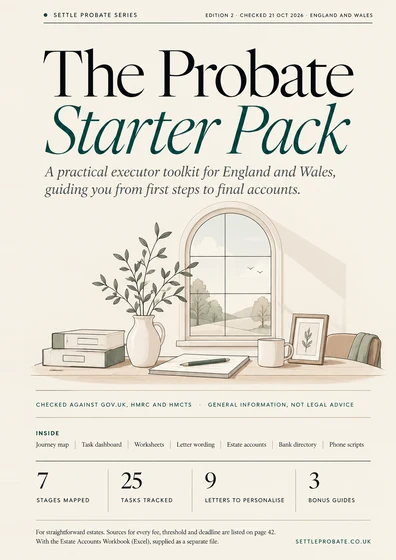
Starter Pack · £4.99 — a 44-page printable executor toolkit with a 25-step checklist, nine letters to personalise and an Excel estate accounts workbook.
See what’s inside →Free
Find out exactly what you need to do
Answer 7 questions and get a free probate assessment. No account needed.
Start free assessment →Secure Workspace · £9.99
Know what comes next, from the first phone call to the final estate accounts
Your own private account with a task list built from your answers, a bank and institution tracker, and estate accounts. Includes the Starter Pack.
See how the Workspace works →