Do I Need Probate?
Checked against current GOV.UK probate and Inheritance Tax guidance for England & Wales (2026/27).
- It depends on the assets, not the size of the estate — sole-name property means probate is always required.1
- Each bank sets its own release threshold, usually £25,000–£50,000; above it, they want the grant.
- Assets held as joint tenants, or written in trust, pass outside the estate and normally need no probate.3
- Distributing an estate without a needed grant can leave you personally liable — check first.
Quick answer
Whether you need probate depends on what assets the person owned, not just the size of the estate. If they owned property in their sole name, probate is always required. For bank accounts, each bank sets its own threshold — typically £25,000 to £50,000 — above which they will not release funds without a Grant of Probate.
The question everyone asks first, and the answer surprises people: it is not about how much money there is. A £4,000 estate with a house needs probate; a £40,000 estate held entirely jointly with a spouse often does not. What matters is what the person owned and whose name it was in.
Whether you need probate depends on what assets the person owned and how they were held — not on the size of the estate alone.1 If the deceased owned property solely in their own name, probate is required. If the estate is mainly joint assets and small bank balances, it may not be. Work through each asset type below to figure out your situation. If you want a quick answer, take the free Settle assessment — it takes two minutes.
Start with property
If the person who died owned a house, flat, or any other property solely in their own name, you will need probate. There is no exception. HM Land Registry will not allow a transfer or sale of solely-owned property without a Grant of Probate (or Letters of Administration if there is no will). This is the single biggest factor that determines whether probate is required.
Jointly owned property works differently. If the property was held as joint tenants - the most common arrangement for married couples - the property passes automatically to the surviving owner when the other person dies. The survivor simply needs to notify HM Land Registry using form DJP, along with a death certificate. No probate is needed for this transfer.
If the property was held as tenants in common, where each person owns a defined share, the deceased's share forms part of their estate and probate will be required to transfer it to a beneficiary or enable a sale. See our dedicated guide: do I need probate for a house.
Bank accounts and savings
Banks and building societies set their own thresholds for how much they will release without seeing a Grant of Probate. Below this threshold, they will typically release funds on production of a death certificate and some form of identification. Above the threshold, they require the official grant.
These thresholds vary significantly by institution and can change. As a rough guide, most major high-street banks currently set their limit at around £25,000–£50,000, but this is not universal. Always contact the bank directly to confirm their current policy - do not rely on published figures, which can be out of date. Here are approximate thresholds at the time of writing:
- Barclays: up to £50,000 in sole accounts without a grant
- HSBC: no published figure; ask the bereavement team
- Lloyds / Halifax: no published figure for personal accounts; ask the bereavement team
- NatWest / RBS: no published figure; the bereavement team tells you whether a grant is needed
- Santander: up to £50,000 in sole accounts without a grant
- Nationwide: up to £50,000 in sole accounts without a grant
- NS&I (Premium Bonds, savings): a grant may be asked for at £5,000 or over
For a more detailed breakdown, see our guide to bank probate thresholds.
Note: Thresholds apply per institution, not per account. If the deceased held multiple accounts at the same bank, the bank looks at the combined total when deciding whether to require a grant.
Investments and shares
Listed shares and investment funds held in a sole name nearly always require probate before they can be transferred or sold. The registrar (for shares) or investment platform will typically ask for a sealed copy of the grant before releasing or transferring anything. Small amounts in some share savings schemes may be released informally, but this is at the discretion of each institution.
Shares held in an ISA have a special treatment: on death, the ISA wrapper continues but becomes an "APS" (Additional Permitted Subscription) - the surviving spouse can effectively inherit the ISA allowance. The ISA itself still needs to go through the estate, but the tax benefits can be passed on.
Assets that pass outside the estate (no probate needed)
Several types of asset pass directly to a named individual and do not form part of the estate for probate purposes:
- Life insurance written in trust: If the policy was set up in trust for named beneficiaries, the payout goes directly to those beneficiaries and is not part of the estate.
- Pension death benefits: Pensions do not pass under a will. They are controlled by the pension scheme's trustees, who consider a "nomination of beneficiaries" form completed by the deceased. The trustees have discretion but usually follow the nomination.
- Jointly held assets (joint tenancy): As described above, property and accounts held as joint tenants pass automatically by survivorship.
- Assets held in trust: If assets were held in a trust set up during the person's lifetime, they do not form part of the estate and are not subject to probate.
Vehicles
A car or other vehicle registered solely in the deceased's name technically forms part of the estate. However, in practice, if the estate is otherwise straightforward and below bank thresholds, beneficiaries often find they can transfer ownership by dealing directly with the DVLA and insurance company using a death certificate. If probate is required for other reasons, you would use the grant to transfer the vehicle formally as part of estate administration.
What if there is a will - does that change anything?
Whether there is a will does not, by itself, determine whether probate is needed. What matters is what assets the estate contains and how they are held. A will simply names who should receive things - but you still need the grant to unlock those assets. See our guide: do I need probate if there is a will.
Inheriting everything yourself does not change this. See do I need probate if I am the sole beneficiary?
What if the estate is very small?
For very small estates - typically under £5,000 in total value, with no property, no significant investments, and no individual bank account above the relevant threshold - probate is usually not required. Banks will typically release small balances on sight of a death certificate, a proof of identity, and sometimes a simple indemnity letter. The Probate Registry charges no court fee for estates under £5,000, reflecting the fact that formal probate may not be needed. See also: probate for small estates.
Tip: Even if probate is not legally required, you may still find it helpful to obtain a grant. Some institutions are reluctant to release funds without one, and having the grant makes your authority to act unambiguous. Weigh the cost (£526 plus time) against the potential friction of dealing with each institution individually.
A practical checklist
Run through these questions:
- Did the person own property solely in their name? If yes - probate is required.
- Did the person have bank accounts above the individual bank's threshold? If yes - probate is likely required.
- Did the person hold shares or investments in their sole name? If yes - probate is almost certainly required.
- Were any significant assets held jointly or in trust? If yes - these may pass automatically.
- Is the total estate value under £5,000? If yes - probate may not be needed.
Not sure whether this applies to your estate? Take the free Settle assessment - it takes two minutes and gives you a personalised checklist of next steps.
What happens if you administer the estate without probate when you should have obtained one?
If you distribute an estate without getting probate when a grant was needed, you can be personally liable to creditors and beneficiaries who were not paid correctly. Executors who distribute assets improperly may have to make up the shortfall from their own funds. That is reason enough to sort out whether probate is required before you move any money or assets.
When to get professional advice
Most executors can work this out themselves using the checklist above. Get professional advice if:
- The estate includes overseas assets or foreign property
- The deceased had business interests or held assets in trust
- You are uncertain about how assets were held (joint tenancy vs tenants in common)
- There is a dispute between family members about the estate
A probate solicitor or estate administration service can give you a clear answer and help you take the right next steps. Many offer a free initial consultation.
Sources & references
The figures and rules in this guide are drawn from the official UK government pages below. Each link opens the relevant GOV.UK page. Always confirm current figures on GOV.UK before you act, as fees and thresholds can change.
- Applying for probate — GOV.UK
- Wills, probate and inheritance — GOV.UK
- Dealing with the estate of someone who's died — GOV.UK
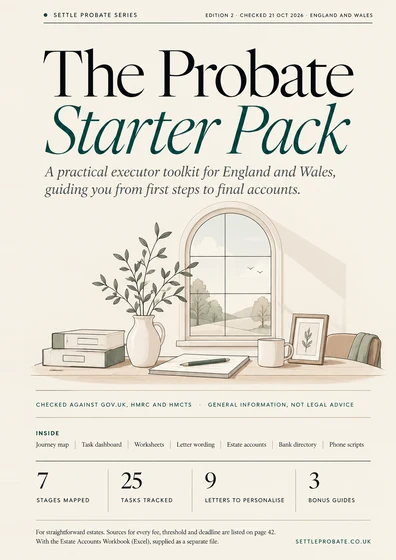
Starter Pack · £4.99 — a 44-page printable executor toolkit with a 25-step checklist, nine letters to personalise and an Excel estate accounts workbook.
See what’s inside →Free
Find out if you need probate
Answer 7 questions about the estate and get a free assessment in about 2 minutes. No account needed.
Start free assessment →Secure Workspace · £9.99
If you do need it, know what comes next
Your own private account that builds your task list from your answers, with target dates and key deadlines set out for you, through to the final estate accounts.
See how the Workspace works →