Probate for Small Estates: When Is It Needed?
Checked against current GOV.UK probate and Inheritance Tax guidance for England & Wales (2026/27).
- There is no fixed value that makes an estate "small" — it is the assets that decide whether probate is needed.1
- Sole-name property always triggers probate, however little the rest of the estate is worth.1
- Banks release up to their own threshold (often £25,000–£50,000) without a grant; NS&I's is around £5,000.
- The £5,000 court-fee waiver is not a probate threshold — it only means no fee is charged if you apply on a tiny estate.1
Quick answer
A "small estate" is not a legal category, and being small does not automatically avoid probate. What matters is the assets: sole-name property always needs a grant, and any account above the bank's own threshold does too. Work through each asset one by one — an estate worth £30,000 can need probate while one worth £200,000 held jointly does not.
People hope there is a magic number — below it, no probate. There is not. A modest estate with a house still needs a grant; a larger one held jointly with a spouse often does not. The honest way to find out is to look at each asset in turn, which is exactly what this guide walks you through.
There is no single legal definition of a "small estate" in England and Wales, and no threshold below which probate is automatically unnecessary.1 Whether a grant is required depends not on the total value of the estate but on what specific assets it contains and how they are held. An estate worth £30,000 might need probate; an estate worth £200,000 might not. Working through each asset type is the only reliable way to find out.
When a small estate generally does not need probate
If all of the following apply, it is likely that the estate can be administered without a formal Grant of Probate:
- No property in the deceased's sole name - no house, flat, or land registered solely in their name at HM Land Registry
- All bank and savings accounts below the relevant institution's threshold - most major high-street banks will release up to £25,000–£50,000 without a grant (see bank probate thresholds for figures by institution)
- No significant shares or investments held solely - most investment platforms and share registrars require a grant; small amounts may be released at the institution's discretion
- No outstanding inheritance tax liability requiring formal clearance
In these circumstances, each institution typically releases funds on sight of a death certificate, proof of identity, and sometimes a signed indemnity letter. You work through each institution individually and do not need to involve the Probate Registry at all.
When even a small estate still needs probate
Probate may be required even when the estate appears modest in value if any of the following apply:
- The deceased owned property in their sole name - even a small or low-value property triggers the need for a grant. HM Land Registry will not record a transfer of title from a deceased sole owner without one. There is no minimum property value that exempts you from this requirement.
- Any single bank account or combined holding at one institution exceeds that institution's threshold - a £40,000 savings account at a bank with a £25,000 threshold requires the grant, even if the rest of the estate is minimal.
- Shares or investment funds are held in the deceased's sole name - even a relatively small portfolio will typically require a grant before the registrar will act.
Property always triggers probate - regardless of estate size. If the deceased owned a property solely in their own name, a grant is required even if the rest of the estate is otherwise straightforward and small.
The £5,000 court fee waiver - what it does and does not mean
The Probate Registry charges a court fee of £526 to issue a Grant of Probate. However, estates where the gross value is under £5,000 pay no court fee at all. This waiver exists because very small estates are unlikely to need a formal grant, so the fee is waived if one is applied for.
This is sometimes misunderstood as a threshold - as if estates under £5,000 do not need probate. That is not what the rule says. It simply means that if you do apply for probate on a very small estate, no fee is charged. Whether probate is required is still determined by the assets in the estate, not by whether the £5,000 fee waiver applies.
NS&I and the low threshold
One institution worth highlighting for small estates is NS&I (National Savings and Investments), which includes Premium Bonds, savings accounts, and investment accounts. NS&I has a notably low threshold of around £5,000 for releasing funds without a grant. If the deceased held Premium Bonds or other NS&I products totalling more than approximately £5,000, a grant will be required even if every other institution is below its threshold.
This catches many families off guard, particularly where the deceased had been accumulating Premium Bonds over many years. Always confirm the current NS&I threshold by contacting them directly.
Indemnity letters for very small amounts
For very small balances - often under £1,000–£5,000 depending on the institution - some banks and other organisations will release funds on the basis of a simple signed letter from the next of kin or executor. This letter, sometimes called an indemnity letter or statutory declaration, confirms that you are entitled to the funds and that you will repay them if a creditor or other beneficiary later makes a valid claim.
Whether an institution will accept an indemnity letter is entirely at their discretion. There is no legal obligation for them to do so, and policies vary. Some institutions have moved away from accepting them; others still use them routinely for very small amounts. Always ask the institution what their current policy is before assuming this option is available.
Not sure whether this applies to your estate? Take the free Settle assessment - it asks about your specific situation and gives a personalised checklist of next steps.
A practical approach to small estates
Rather than trying to categorise the estate as "small" and assuming probate is unnecessary, work through each asset individually:
- Property: Did the deceased own any property solely in their name? If yes, probate is required.
- Bank accounts: What is the total balance at each institution? Does any institution's combined holding exceed their threshold? If yes, probate is required for that institution.
- Shares and investments: Did the deceased hold shares or investment funds in their sole name? If yes, probate is almost certainly required.
- NS&I: Did the deceased hold Premium Bonds or NS&I savings? What is the total? If above ~£5,000, probate is required.
- Other assets: Pensions pass outside the estate; life insurance written in trust passes outside the estate; joint assets pass by survivorship. None of these trigger probate requirements on their own.
If you reach the end of this list and the answer to every question is no, there is a reasonable prospect you can administer the estate without a formal grant. In that case, you would contact each institution individually, explain the situation, and follow their individual bereavement process.
Choosing to obtain probate anyway
Even if probate is not strictly required, some executors choose to obtain a grant voluntarily. This can be worthwhile if:
- One or more institutions are being difficult about releasing funds without a grant
- The estate's affairs are complex enough that having unambiguous authority is helpful
- There is a risk of future disputes among beneficiaries and you want formal protection as executor
The cost - £526 in court fees plus time - is modest compared with the difficulty of dealing with an awkward institution without it. But for truly simple, small estates with co-operative institutions, it is often an unnecessary step.
For the full breakdown of what triggers probate across all asset types, see do I need probate? and for guidance on bank-by-bank thresholds, see bank probate thresholds explained. If you are unsure where to start, what is probate? explains the process from the beginning.
Sources & references
The figures and rules in this guide are drawn from the official UK government pages below. Each link opens the relevant GOV.UK page. Always confirm current figures on GOV.UK before you act, as fees and thresholds can change.
- Applying for probate — GOV.UK
- How to value an estate for Inheritance Tax and report its value — GOV.UK
- Wills, probate and inheritance — GOV.UK
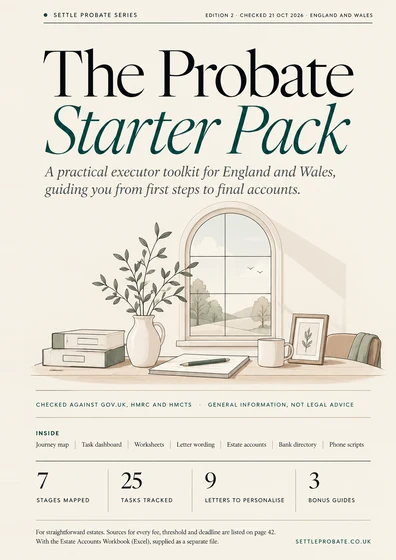
Starter Pack · £4.99 — a 44-page printable executor toolkit with a 25-step checklist, nine letters to personalise and an Excel estate accounts workbook.
See what’s inside →Free
Find out if you need probate
Answer 7 questions about the estate and get a free assessment in about 2 minutes. No account needed.
Start free assessment →Secure Workspace · £9.99
If you do need it, know what comes next
Your own private account that builds your task list from your answers, with target dates and key deadlines set out for you, through to the final estate accounts.
See how the Workspace works →