What is Probate?
Checked against current GOV.UK probate and Inheritance Tax guidance for England & Wales (2026/27).
- Probate is the legal authority to deal with someone's estate — a Grant of Probate where there is a will, Letters of Administration where there is not.1
- It is usually needed when the person owned property in their sole name or held significant savings or investments.2
- Assets held as joint tenants pass to the survivor automatically and normally need no probate.3
- The Registry usually issues the grant within 12 weeks; full administration typically takes 6–18 months.1
Quick answer
Probate is the legal process for winding up a deceased person's estate — valuing assets, paying debts, and distributing what remains to beneficiaries. A Grant of Probate gives the executor legal authority to deal with banks, property, and other institutions. Most estates involving property or significant savings require it.
If you have just been named an executor, this is the word everyone keeps using and no one quite explains. Probate simply means getting the legal authority to sort out someone's money, property and belongings after they die — and then doing it in the right order. Not every estate needs it, but most that include a home or real savings do.
Probate is the legal process for winding up a person's estate after they die — valuing their assets, paying their debts, and distributing what remains to the people entitled to inherit.1 If you have been named as an executor, you will almost certainly need a Grant of Probate before banks, financial institutions and HM Land Registry will release assets or allow property to be transferred. Not every estate requires it — smaller estates and jointly held assets sometimes pass automatically — but for most estates involving property or significant savings, it is a necessary step.2
The basic definition
Probate is overseen by the Probate Registry, which is part of HM Courts & Tribunals Service. The word is often used informally to mean the entire process of winding up someone's estate after death. Technically, probate refers specifically to the court's confirmation that a will is valid and that the executor has authority to act. But in everyday usage, and throughout these guides, "probate" covers the whole administration process from death to final distribution.
What is a Grant of Probate?
A Grant of Probate is the official legal document issued by the Probate Registry that confirms a will is valid and grants the named executor(s) the legal authority to deal with the estate. Without this document, most banks, financial institutions, and HM Land Registry will refuse to release assets or allow property to be transferred.
The grant is a single document bearing the court's seal. You will typically need to order between five and ten certified copies when you apply — each institution you deal with will usually require an original sealed copy, not a photocopy. Copies cost £2 each when ordered with the application, and £16 each if you order them afterwards, so it pays to order enough upfront.1
What are Letters of Administration?
When someone dies without a valid will - known as dying "intestate" - there is no named executor to manage the estate. In this case, an eligible family member applies to the Probate Registry for Letters of Administration. This document performs the same function as a Grant of Probate: it gives the applicant (called an "administrator" rather than an executor) legal authority to deal with the estate.
The rules of intestacy determine both who inherits and who can apply for Letters of Administration. A surviving spouse or civil partner has first priority, followed by children, and so on down the family tree. If you find yourself in this situation, our guide to probate without a will covers the process in detail.
When is probate required?
Not every death requires a grant. Whether probate is necessary depends mainly on what assets the person owned and how they were held.
Probate is almost always required when:
- The deceased owned property (a house or flat) solely in their own name
- The estate includes shares or investments held in a single name
- Bank or building society accounts exceed the institution's individual release threshold (usually between £15,000 and £50,000, though thresholds vary by bank)
Probate is usually not required when:
- The estate is very small - typically under £5,000 in total
- All significant assets were held jointly (these pass automatically to the surviving owner by a legal rule called "survivorship")
- Assets were held in trust, which pass outside the estate
- Life insurance or pension death benefits were written in trust or have a named beneficiary, meaning they pass directly without going through the estate
Joint assets and survivorship: When two people own a property or bank account as "joint tenants" (the most common form of joint ownership), the asset passes automatically to the surviving owner when the first person dies. No probate is needed for this transfer. However, if the property was held as "tenants in common" - where each person owns a defined share - the deceased's share is part of their estate and probate will be required to transfer it.
What happens if you don't get probate when you should?
If you distribute an estate without getting probate when a grant was needed, you can be personally liable to creditors and beneficiaries who were not paid correctly. Executors who transfer or distribute assets improperly may have to make up any shortfall from their own funds. Before you take any steps to transfer or distribute assets, establish whether probate is required. Our guide to whether you need probate will help you work this out.
Who applies for probate?
The executor named in the will applies for a Grant of Probate. If there are multiple executors named, all of them can apply jointly, or some may choose to "reserve power" and not join in the initial application while remaining able to act later. Up to four executors can be named on a grant.
An executor does not have to accept the role. If you are named as executor but do not wish to act, you can formally renounce the role by signing a form before the Probate Registry. Once you have intermeddled with the estate - meaning taken any steps to deal with the assets - you cannot renounce.
What does the probate process involve?
In broad terms, administering an estate involves these stages:
- Register the death and obtain death certificates (order at least ten copies - institutions may each ask for one)
- Locate the will and confirm who the executors are
- Value the estate - get professional valuations for property, obtain date-of-death balances from banks, value investments and possessions
- Deal with inheritance tax - report the estate to HMRC and pay any tax due (or confirm the estate is below the threshold)
- Apply for probate via the Probate Registry
- Collect assets using the grant - banks and other institutions will release funds once they have seen a sealed copy
- Pay debts - including any outstanding bills, loans, credit cards, and final utility bills
- File any outstanding tax returns for the deceased and for the estate itself
- Distribute the estate according to the will (or the rules of intestacy if there is no will)
The full process typically takes 6–18 months, depending on the complexity of the estate and how quickly institutions respond. For more detail, see our guide on how long probate takes.
Not sure whether this applies to your estate? Take the free Settle assessment - it takes two minutes and gives you a personalised checklist of next steps.
Does probate have to go through court?
Despite being processed by the court system, probate is not usually a court hearing or legal dispute. The application is administrative: you submit documents and fees, and the Probate Registry checks them and issues the grant. Unless there is a dispute - such as someone challenging the validity of the will - there is no need to appear before a judge.
Can you do probate yourself?
Yes. Many executors successfully handle probate without a solicitor, particularly for straightforward estates. The government encourages this and the online application process at gov.uk is designed to be accessible. Tools like Settle help you organise what you need to do at each stage. For a full overview of your responsibilities, see our guide to executor duties, and our probate checklist gives you a step-by-step task list to work through.
For complex estates - those involving overseas assets, trusts, business interests, large amounts of inheritance tax, or disputes - professional advice is often worth the cost. A probate solicitor can take on as much or as little of the work as you want, and many offer fixed-fee services for common tasks.
When to get professional advice
Most executors handle a straightforward estate without legal help. Get advice if:
- The estate is above the inheritance tax threshold and the position is complicated (trusts, gifts, foreign assets)
- There is a dispute about the will or about the administration
- The will is ambiguous or its validity is in doubt
- The deceased had business interests or overseas property
- You are unsure about your personal liability in a particular situation
Probate solicitors can be instructed for specific tasks - such as the property transfer or the IHT400 - rather than the whole estate. Many offer a free initial conversation.
Sources & references
The figures and rules in this guide are drawn from the official UK government pages below. Each link opens the relevant GOV.UK page. Always confirm current figures on GOV.UK before you act, as fees and thresholds can change.
- Applying for probate — GOV.UK
- Wills, probate and inheritance — GOV.UK
- Dealing with the estate of someone who's died — GOV.UK
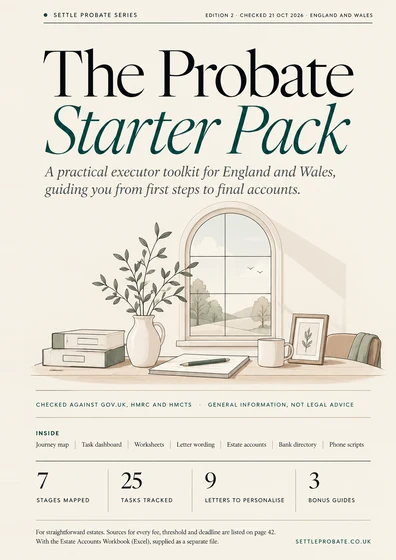
Starter Pack · £4.99 — a 44-page printable executor toolkit with a 25-step checklist, nine letters to personalise and an Excel estate accounts workbook.
See what’s inside →Free
Find out if you need probate
Answer 7 questions about the estate and get a free assessment in about 2 minutes. No account needed.
Start free assessment →Secure Workspace · £9.99
If you do need it, know what comes next
Your own private account that builds your task list from your answers, with target dates and key deadlines set out for you, through to the final estate accounts.
See how the Workspace works →