Do I Need Probate for a House?
Checked against current GOV.UK probate and Inheritance Tax guidance for England & Wales (2026/27).
- A property in the sole name of the deceased almost always needs probate before it can be sold or transferred.1
- Property held as joint tenants passes to the survivor automatically — no probate needed for that transfer.3
- Property held as tenants in common does not pass automatically; the deceased's share goes through the estate.1
- You apply for probate first, then update the register with HM Land Registry once the grant is issued.2
If the property was in the deceased's sole name, you will almost always need a Grant of Probate before it can be sold or transferred — HM Land Registry requires it. A home held as joint tenants is the main exception.1
If the deceased owned a house or flat solely in their own name, probate is almost always required before the property can be sold or transferred to a beneficiary. This applies regardless of the value of the property, regardless of whether there is a will, and regardless of the size of the rest of the estate. It is one of the clearest rules in probate law: HM Land Registry will not record a transfer of title from a deceased sole owner without a sealed Grant of Probate or Letters of Administration.
Why probate is required for sole-name property
When a property is registered at HM Land Registry in a single person's name, only that person has the legal authority to deal with it - to sell it, mortgage it, or transfer it. When they die, that authority disappears. The Grant of Probate (or Letters of Administration where there is no will) is the document that restores legal authority to the executor or administrator, allowing them to stand in the deceased's shoes and complete the transaction.
Without the sealed grant, the Land Registry will simply refuse to process the transfer. Conveyancers instructed on the sale will not be able to exchange contracts. The property is effectively locked until the grant is in hand.
Exception: jointly held as joint tenants
The main exception to this rule is where the property was held by two (or more) people as joint tenants. Joint tenancy is the most common ownership structure for married couples and civil partners. Under joint tenancy, when one owner dies, their share automatically passes to the surviving owner by right of survivorship - there is nothing to transfer under the will or intestacy rules, because the deceased's share ceases to exist and the survivor becomes the sole owner by operation of law.
In this situation, probate is not required purely for the property. The surviving owner simply needs to notify HM Land Registry of the death by submitting form DJP along with an official copy of the death certificate and the relevant fee. The register is updated to reflect the survivor as sole owner, usually within a few weeks.
This does not mean probate is unnecessary for the estate as a whole - it may still be required for other assets such as bank accounts or investments. But the property itself passes without it.
Tenants in common: probate is required
If the property was held as tenants in common - where each owner holds a defined share - the position is different. The deceased's share does not pass automatically. It forms part of their estate and passes either under the will or under the intestacy rules. To transfer or sell that share, the executor needs a Grant of Probate (or administrator needs Letters of Administration). Probate is required.
Tenants in common arrangements are common where owners want their respective shares to pass to different beneficiaries - for example, to children from a previous relationship rather than automatically to a surviving spouse. The ownership structure is recorded at the Land Registry; if you are unsure how the property was held, you can check the title register (see below).
Do not exchange contracts on a property sale until the Grant of Probate is in your hands. If you exchange without the grant, you create a legally binding obligation to complete the sale - but you may not be able to do so without the grant. Missing the completion date would put you in breach of contract and could expose the estate to significant financial penalties.
If there is still a mortgage on the house, see what happens to a mortgage when the owner dies, including whether whoever inherits the house takes on the loan.
Can you start the sale process before probate?
Yes - and in fact it is often sensible to do so. You can:
- Instruct an estate agent and market the property
- Accept offers subject to contract
- Instruct a conveyancing solicitor to begin the legal work
- Commission searches and enquiries
What you cannot do is exchange contracts - the point at which the sale becomes legally binding - until you have the sealed grant. In practice, solicitors will flag this to all parties and will hold off on exchange until the grant arrives. Most buyers are familiar with this delay in probate sales and will accept it provided they are kept informed.
Starting the marketing process early is therefore good practice: it means the sale can proceed to completion much more quickly once the grant is issued, rather than waiting for the grant before even starting.
Not sure whether this applies to your estate? Take the free Settle assessment - it asks about your specific situation and gives a personalised checklist of next steps.
What if you are not selling, but transferring to a beneficiary?
Even if there is no sale and the property is simply being transferred to a beneficiary named in the will (for example, a house passing to an adult child), you still need the grant. The same rule applies: HM Land Registry will not update the register without it. The executor uses the grant to effect the transfer, known as an assent. This is a formal legal process and typically involves a solicitor, though it is not inherently complicated.
How to check how the property was held
If you are not certain whether the property was held as joint tenants or tenants in common, you can check the title register at HM Land Registry. An official copy of the title register costs £7 and can be ordered online at gov.uk/search-property-information-land-registry (the free property summary does not name the owner). The register will show the names of the registered proprietors and will include a note in the proprietorship register if a restriction is in place - a restriction is the main indicator that the property was held as tenants in common.
You should check the title register early in the administration process, as it affects the entire approach to the property and to deciding whether to apply for probate.
Wondering how long a sale will have to wait? See how long probate takes in England and Wales.
Grant of Probate versus Letters of Administration
If the deceased left a valid will, the relevant document is a Grant of Probate, issued to the named executor. If there was no will, the document is Letters of Administration, issued to an administrator (usually the next of kin in a priority order set by the intestacy rules). Both documents have the same effect for land registry purposes - the Land Registry accepts either. For more on how to obtain a grant, see how to apply for probate. For guidance on handling the property once the grant is in hand, see selling property during probate.
Summary
- Selling at a gain: if the property sells for more than its probate value, capital gains tax may be due, reportable within 60 days of completion.
- Sole-name property: probate almost always required - no exceptions in practice
- Joint tenants: property passes by survivorship; notify HM Land Registry with form DJP; no probate needed for the property itself
- Tenants in common: deceased's share forms part of the estate; probate required
- Starting the sale: you can market and accept offers before probate, but cannot exchange contracts until the grant is in hand
- Transferring to a beneficiary: grant still required even if no sale is taking place
To check whether probate is needed for the estate as a whole - not just the property - see the do I need probate? guide.
Common mistakes to avoid
- Assuming a jointly-owned home never needs probate. That is only true for joint tenants; tenants in common is different.1
- Marketing before the grant. You can market a sole-name property, but you cannot complete the sale until probate is granted.2
- Forgetting to check the tenancy type. The Land Registry title tells you whether it was joint tenants or tenants in common.
Frequently asked questions
Do I always need probate to sell a house after death?
For a sole-name property, yes — HM Land Registry needs the grant before the title can be transferred or sold. Jointly-owned homes held as joint tenants are the exception.1
What if the house was jointly owned?
As joint tenants, it passes automatically to the survivor and you only send the death certificate to update the register. As tenants in common, the deceased's share passes through the estate and usually needs probate.3
Can I put the house on the market before probate?
You can market it and even agree a sale, but you cannot complete until probate is granted, so keep buyers informed about timing.2
How do I change the ownership after probate?
You update the register through HM Land Registry, either transferring to a beneficiary or recording the sale to a buyer.1
How long does it take?
Probate is usually granted within 12 weeks of a complete application; the Land Registry update after that typically takes a few weeks.2
Sources & references
The figures and rules in this guide are drawn from the official UK government pages below. Each link opens the relevant GOV.UK page. Always confirm current figures on GOV.UK before you act, as fees and thresholds can change.
- Update property records when someone dies — GOV.UK
- Applying for probate — GOV.UK
- Dealing with the estate of someone who's died — GOV.UK
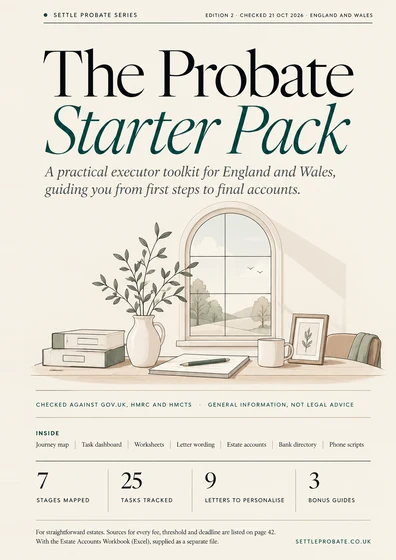
Starter Pack · £4.99 — a 44-page printable executor toolkit with a 25-step checklist, nine letters to personalise and an Excel estate accounts workbook.
See what’s inside →Free
Find out if you need probate
Answer 7 questions about the estate and get a free assessment in about 2 minutes. No account needed.
Start free assessment →Secure Workspace · £9.99
If you do need it, know what comes next
Your own private account that builds your task list from your answers, with target dates and key deadlines set out for you, through to the final estate accounts.
See how the Workspace works →