What Happens to a Mortgage When Someone Dies?
Checked against current GOV.UK probate and Inheritance Tax guidance for England & Wales (2026/27).
- A mortgage is a debt that must be dealt with — it is not written off on death unless there is insurance to clear it.2
- On a joint mortgage, the surviving borrower normally takes on the loan and keeps the home.1
- On a sole mortgage, the estate pays it from the sale or a beneficiary takes it on, usually needing probate first.3
- Mortgage life insurance, if held, can repay the balance in full — check the paperwork early.
A mortgage does not disappear when the borrower dies — it stays a debt of the estate or the surviving co-owner. What happens next depends on whether it was a joint or sole mortgage, and whether there is life cover to clear it.2
Quick answer
A mortgage is not cancelled when someone dies. The debt stays with the estate and keeps accruing interest until it is repaid. For a joint mortgage held as joint tenants, the usual arrangement between spouses, the surviving owner takes on the mortgage and the deceased's name is removed using the death certificate and Land Registry form DJP, with no probate needed. For a sole mortgage, or a joint mortgage held as tenants in common, probate is usually needed before the property can be sold or transferred. Payments must continue from the estate throughout.
A mortgage does not disappear when the borrower dies. The debt remains and continues to accrue interest. As executor, you need to understand what type of mortgage is involved, notify the lender promptly, and work out how the mortgage will be dealt with as part of administering the estate. The steps you need to take depend on whether the mortgage was held in a sole name or jointly, and on whether there is any insurance in place to pay off the debt. If you haven't yet established what the estate needs overall, the free probate assessment gives you a personalised next-steps checklist in around two minutes.
| Situation | Who deals with the mortgage | Probate for the property? |
|---|---|---|
| Joint mortgage, owned as joint tenants | The surviving borrower keeps paying and takes on the whole loan | No: death certificate and form DJP |
| Joint mortgage, owned as tenants in common | The survivor keeps paying; the deceased's share passes under the will or intestacy | Usually yes, for the deceased's share |
| Sole mortgage, house left to someone | The estate keeps paying; the person who inherits takes the house with the mortgage unless the will says otherwise | Yes |
| Sole mortgage, house to be sold | The estate keeps paying, then repays the loan from the sale | Yes, before completion |
| Life or mortgage protection cover | The insurer usually pays the lender directly and the loan is cleared | Depends on the rest of the estate |
| Equity release (lifetime mortgage) | No monthly payments; the loan and rolled-up interest are repaid from the estate, often within 12 months | Yes, to sell |
Sole mortgages
Where the deceased was the sole borrower, the mortgage passes into the estate. The lender has a charge over the property, and that charge does not end when the borrower dies. The outstanding mortgage debt is a liability of the estate and must be settled, either by selling the property, by a beneficiary taking on the mortgage, or by repaying the debt from other estate assets.
Importantly, the lender will not immediately repossess the property. Lenders are required by the Financial Conduct Authority to treat bereaved families fairly and to allow reasonable time for the estate to be administered. The estate has time to obtain probate, value the property, and make arrangements for the sale or transfer before any repossession action could be considered.
During the administration period, mortgage payments continue to fall due. These must be paid from estate funds. If payments stop without explanation, the lender will begin to accrue arrears and may apply charges. Keeping the mortgage payments up to date, even while waiting for probate, protects the estate from unnecessary costs.
If you inherit a house with a mortgage, do you inherit the mortgage?
Usually yes. Unless the will clearly says otherwise, a property carries its own mortgage: as between the people inheriting, the mortgaged property is "primarily liable" for the loan secured on it.4 So if a parent leaves you their home and it still has £80,000 owing, you inherit the home subject to that £80,000, not the home free and clear with the debt paid from the rest of the estate. A general instruction in the will to "pay my debts" is not enough to change this; the will has to refer to the mortgage itself.4
To keep the house you would normally repay the loan, or take out a mortgage in your own name, which the lender has to approve. Many people instead sell, repay the lender from the proceeds and keep the rest.
Are children responsible for a parent's mortgage?
Not personally, unless they signed the mortgage as a joint borrower or a guarantor. The loan is a debt of the estate. It is repaid from the house, from life cover if there is any, or from other estate money. If the house is worth less than the mortgage (negative equity), the lender takes what the sale raises and the shortfall becomes an unpaid estate debt: it does not pass to family members to pay from their own money. Equity release plans that meet the Equity Release Council's standards go further, with a no-negative-equity guarantee.
Joint mortgages: the key distinction
Where two or more people held the mortgage jointly, the outcome depends on how they owned the property. There are two forms of co-ownership in England and Wales, and they produce very different results.
| Ownership type | What happens on death | Probate needed for the property? |
|---|---|---|
| Joint tenants | Deceased's share passes automatically to the surviving owner. Mortgage continues in the survivor's name. | Not usually, for the property itself. The survivor notifies the lender and Land Registry. |
| Tenants in common | Deceased's share forms part of the estate and passes under the will or intestacy rules. Probate is usually needed before the share can be transferred. | Usually yes, unless the estate qualifies as small and the lender agrees to proceed without. |
Joint tenants
Where the property was owned as joint tenants, the right of survivorship applies. The deceased's share passes automatically to the surviving co-owner, regardless of what the will says. The mortgage continues in the survivor's name. The lender should be notified so their records are updated and any payment arrangements can be reviewed. The surviving owner may need to demonstrate they can continue to meet the mortgage payments. If the lender has concerns about affordability, they may propose a restructured mortgage term or refer the survivor for advice.
Tenants in common
Where the property was owned as tenants in common, each owner holds a defined share. The deceased's share forms part of the estate and passes under the will (or under intestacy rules if there is no will). A Grant of Probate is usually required before that share can be transferred to a beneficiary. The surviving co-owner's share is unaffected: they continue to hold their own share and remain jointly responsible for the mortgage debt in the meantime.
The practical difficulty for tenants in common situations is that the property cannot usually be sold or the estate's share transferred without probate. During this period, the mortgage continues to run and payments must be maintained from estate funds or by the surviving co-owner.
Death of a joint mortgage holder: removing a name from the mortgage
Full step-by-step guide: removing a name from a mortgage after death.
When a joint mortgage holder dies, the surviving borrower needs to remove the deceased's name from the mortgage and the property title. This is sometimes called "removing a name from a mortgage after death." The process is different depending on whether the property was owned as joint tenants or tenants in common.
Removing a name from a joint tenants mortgage
Where the property was owned as joint tenants, the process is relatively straightforward. The right of survivorship means the deceased's share passes automatically to the surviving owner, but the mortgage and Land Registry records still need to be updated to reflect this.
- Notify the mortgage lender. Contact the lender's bereavement team with the death certificate. They will update their records, remove the deceased from the mortgage, and confirm whether the mortgage continues in the survivor's sole name or whether a new affordability assessment is needed.
- Update the Land Registry title. The Land Registry must be told that one of the registered proprietors has died. You submit form DJP (Deceased Joint Proprietor) to the Land Registry, with the death certificate. There is no Land Registry fee for this. The Land Registry then updates the title register so the property is shown in the surviving owner's name alone. You do not need a Grant of Probate for joint tenants, the death certificate is sufficient.
- Confirm the mortgage is in the survivor's sole name. Once both the lender and Land Registry have updated their records, the mortgage continues in the surviving holder's name. The lender may review the affordability of the mortgage under the survivor's sole income at this point.
The Land Registry update typically takes four to six weeks. The mortgage change is quicker, most lenders process this within two to four weeks of receiving the death certificate.
Removing a name from a tenants in common mortgage
Where the property was owned as tenants in common, removing the deceased's name is more complex. The deceased's share does not pass automatically, it forms part of the estate and passes under the will or intestacy rules. A Grant of Probate is usually required before that share can be transferred or the title updated.
Until probate is granted, the surviving co-owner continues to hold their own share and remains jointly responsible for the full mortgage debt. Once probate is granted, the executor can transfer the deceased's share to the named beneficiary (or sell the property), and the Land Registry title can be updated accordingly. The mortgage lender will need to agree to any changes to the borrower names on the mortgage, this sometimes requires a formal mortgage transfer or a new mortgage application by the surviving owner.
If the surviving owner cannot afford the mortgage alone, they may need to refinance or agree a new arrangement with the lender before the estate can be fully resolved.
Mortgage after the death of a spouse
When a husband, wife or civil partner dies, the mortgaged home is very often held as joint tenants. In that case the deceased's share passes automatically to the surviving spouse by right of survivorship, the mortgage continues in the survivor's sole name, and there is no inheritance tax on the transfer between spouses or civil partners because of the spousal exemption. You still notify the lender and update the Land Registry with form DJP, but you do not need a Grant of Probate to deal with the property itself.
If the survivor cannot meet the payments on their income alone, the lender will usually discuss options rather than move straight to repossession. That might mean extending the term, moving to interest only for a period, or the survivor applying to remortgage. Where the home was instead held as tenants in common, the deceased spouse's share passes under their will or the intestacy rules and probate is usually needed before it can be transferred. If you are not sure how the property was owned, the title register from the Land Registry will tell you, and our free two-minute assessment can confirm whether probate is likely to be needed for the estate as a whole.
Mortgage payments after death: who keeps paying?
Mortgage payments do not stop when the borrower dies. They must keep being paid throughout the administration period, or the lender will record arrears and may add charges. Who pays depends on the type of mortgage:
- Sole mortgage. Payments are made from estate funds until the property is sold, transferred to a beneficiary, or cleared by a life or mortgage protection policy.
- Joint mortgage. The surviving borrower is responsible for the payments and remains liable for the full debt, whether the property was held as joint tenants or tenants in common.
If there is not enough ready cash in the estate to cover the payments while you wait for probate, contact the lender early. Many lenders will agree a short payment arrangement for a bereaved estate, though interest normally continues to build up in the meantime.
Notifying the lender
Notify the mortgage lender as soon as possible after the death. You do not need to wait for probate or to have resolved the wider estate before making this call. Early notification allows the lender to:
- Note the death on the account and flag it for their bereavement team
- Discuss payment arrangements for the administration period
- Confirm the outstanding balance and the account reference you will need for estate records
- Advise on any payment holiday, reduced payments, or other options available while the estate is administered
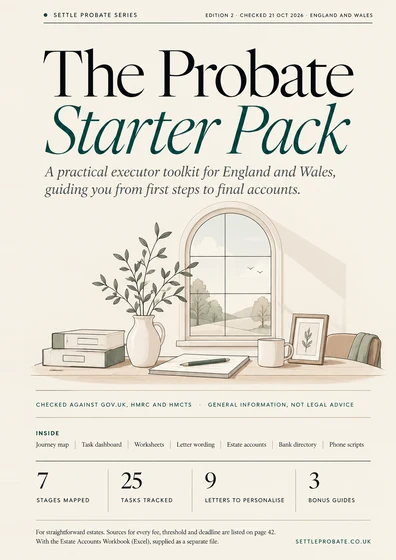
If you would rather write than call, template 4 in the Probate Starter Pack is a letter to the mortgage lender or home insurer: it records the death, asks for the current balance and what authority the lender needs, and asks the insurer what applies while the home is empty. The pack's property checklist covers the rest: insurance, the title, the valuation and whether to sell or transfer.
Contact the lender's bereavement team rather than the general customer service line. Most major mortgage lenders have a dedicated team. You will need to provide the death certificate, the account number or mortgage reference, and your own identification as executor.
Mortgage protection insurance
Many people take out a life insurance policy linked to their mortgage, sometimes called mortgage protection insurance or decreasing term insurance. This type of policy is designed to pay off the outstanding mortgage balance on the death of the policyholder. If such a policy exists, it can clear the mortgage entirely and remove it as a liability from the estate.
To check whether a policy exists:
- Search the deceased's correspondence and financial documents for policy schedules or annual statements
- Check the deceased's email inbox for insurance-related correspondence
- Ask the mortgage lender whether a payment protection or life policy was taken out at the time the mortgage was arranged (lenders sometimes arrange policies directly)
- Check bank statements for regular premium payments to an insurance provider
If a policy is found, contact the insurer promptly. The insurer will typically require a death certificate and the policy schedule. They will pay the claim directly to the lender in most cases, not to the estate. Once the mortgage is cleared, notify the lender and obtain written confirmation that the charge on the property has been released.
Payment holidays and lender flexibility
Most mortgage lenders recognise that estates take time to administer and will offer some degree of flexibility to executors dealing with a bereavement. Some lenders may offer a short payment holiday while the estate is being sorted. Arrangements vary between lenders, so always ask what support is available.
Even where a payment holiday is agreed, interest usually continues to accrue on the outstanding balance. A payment holiday is not a debt holiday. Keep a record of any arrangement agreed with the lender in writing.
Equity release mortgages
Equity release products, such as lifetime mortgages, operate under different rules from standard residential mortgages. With a lifetime mortgage, no monthly payments are typically made during the homeowner's lifetime. The loan, plus rolled-up interest, is repaid when the homeowner dies or moves permanently into care.
If the deceased held an equity release product:
- The lender must be notified promptly. Most equity release plans give the estate a set period (often twelve months) to repay the loan, either by selling the property or using other estate assets.
- The amount owed will be larger than the original loan because of rolled-up interest. Request a redemption statement from the lender to establish the current amount owed.
- Equity release products regulated by the Equity Release Council include a no-negative-equity guarantee, meaning the estate will never owe more than the property is worth when sold at market value.
Equity release mortgages require probate before the property can be sold or the loan formally discharged. Notify the lender as soon as possible and ask them to confirm their process and timescales in writing.
What probate is needed for the mortgage
Probate is not needed simply because a mortgage exists. Whether probate is required depends on the broader estate. However, probate is almost always needed before the property can be sold or transferred, because the Land Registry requires the Grant of Probate before it will register a change of ownership following a death. If the mortgage lender is owed money and the property must be sold to repay it, probate will be required before that sale can complete.
For joint tenants, the surviving owner can usually have the deceased's name removed from the title without a grant, by providing a death certificate to the Land Registry and the lender. For tenants in common, a grant is needed to deal with the deceased's share.
Practical steps for executors
- Locate all mortgage and property documents, including the original mortgage offer, any payment protection or life insurance schedules, and the most recent annual mortgage statement.
- Identify whether the property was held as joint tenants or tenants in common. This information is on the Land Registry title register, which can be obtained online from the Land Registry for a small fee.
- Notify the mortgage lender's bereavement team as soon as possible with the death certificate and your details as executor.
- Check for any linked life insurance or mortgage protection policy and make a claim if one exists.
- Ensure mortgage payments continue to be made from estate funds during the administration period, to avoid arrears.
- Obtain a written redemption statement from the lender showing the outstanding balance at the date of death and at the date you intend to repay.
- Apply for probate if the estate requires it (which it usually will if the property needs to be sold or transferred). See our guide to how to apply for probate for the full application process. Most straightforward estates can be administered without a solicitor. See probate without a solicitor for what that involves.
For more on whether probate is required in your estate, see our guide to do I need probate? For guidance on selling a property during the administration period, see selling property during probate. If you need step-by-step guidance specifically on joint mortgages, removing a name after a death, or using form DJP, see our dedicated guide to joint mortgages when someone dies.
Not sure what you need to do next?
The free assessment gives you a personalised checklist of every step, in the right order. Or explore the workspace to see how Settle helps you track every task and document in one place.
Start free assessmentCommon mistakes to avoid
- Missing payments while you sort things out. Tell the lender straight away; most pause action once they know, but arrears still matter.
- Overlooking life cover. Many mortgages have an associated policy that clears the debt — find out before assuming a sale is needed.
- Assuming a beneficiary can just keep paying. Taking on a mortgage usually needs the lender's approval and probate to transfer the property.1
Frequently asked questions
Does a mortgage get paid off when someone dies?
Only if there is life insurance or mortgage protection covering it. Otherwise it remains a debt of the estate or the surviving co-borrower.2
What happens to a mortgage when someone dies?
A mortgage does not disappear when the borrower dies. The debt continues to accrue interest and must be repaid from the estate. For sole mortgages, the estate is liable and the lender must be notified promptly. For joint mortgages, the outcome depends on whether the property was owned as joint tenants (where the surviving owner takes on the mortgage) or tenants in common (where probate is usually needed to deal with the deceased's share).
How do I remove a name from a mortgage after someone dies?
For joint tenants, you notify the mortgage lender with the death certificate and file form DJP with the Land Registry to remove the deceased's name from the title, no probate is needed. For tenants in common, a Grant of Probate is usually required before the deceased's share of the property can be transferred and their name removed from the mortgage.
Do you need probate to remove a name from a mortgage after death?
For joint tenants, no, you can remove the deceased's name from the mortgage and Land Registry title using the death certificate alone (form DJP). For tenants in common, probate is usually needed before the deceased's share can be formally transferred and the mortgage updated.
What happens to a mortgage after the death of a spouse?
Where a couple owned the home as joint tenants, which is the most common arrangement, the deceased spouse's share passes automatically to the surviving spouse and the mortgage continues in their sole name. The survivor notifies the lender and updates the Land Registry with form DJP, and no probate is needed for the property. There is no inheritance tax on the transfer because of the spousal exemption. If the home was owned as tenants in common, the deceased's share passes under their will or intestacy and probate is usually required before it can be transferred.
What happens to a joint mortgage when one person dies?
When a joint mortgage holder dies, the surviving borrower typically takes on full responsibility for the mortgage. If the property was owned as joint tenants, this happens automatically, the surviving owner notifies the lender and updates the Land Registry with form DJP. If owned as tenants in common, the situation is more complex and probate is usually needed to deal with the deceased's share.
What happens to a mortgage when the owner dies?
When the sole owner of a mortgaged property dies, the mortgage becomes a liability of the estate. The lender must be notified promptly. The estate has time to administer the property, lenders cannot immediately repossess. The mortgage is typically repaid when the property is sold, or a beneficiary may apply to take it on. Payments should continue from estate funds during administration to avoid arrears.
Who pays the mortgage after someone dies?
Mortgage payments continue after death and must be paid from the estate during administration to avoid arrears. For a sole mortgage the estate pays until the property is sold, transferred, or cleared by a life or mortgage protection policy. For a joint mortgage the surviving borrower is responsible for the payments and remains liable for the full debt. If the estate lacks ready cash, contact the lender early to agree a temporary arrangement.
If I inherit a house with a mortgage, do I inherit the mortgage too?
Usually yes. Unless the will clearly says the mortgage should be paid from the rest of the estate, the house carries its own mortgage, so the person who inherits it takes it subject to the loan (Administration of Estates Act 1925, section 35). To keep the house they normally need to repay the loan or take out a mortgage in their own name with the lender's approval.4
Are children responsible for a parent's mortgage after they die?
Not personally, unless they were a joint borrower or a guarantor. The mortgage is a debt of the estate and is repaid from the house or other estate money. If the house is worth less than the loan, the shortfall is an estate debt; family members do not have to pay it from their own money.
How do I find out if there is mortgage life cover?
Check the mortgage offer, bank statements for insurance premiums, and any policy documents at home. The lender or a broker can also confirm what was in place.
Sources & references
The figures and rules in this guide are drawn from the official UK government pages below. Each link opens the relevant GOV.UK page. Always confirm current figures on GOV.UK before you act, as fees and thresholds can change.
- Update property records when someone dies — GOV.UK
- Dealing with the estate of someone who's died — GOV.UK
- Applying for probate — GOV.UK
- Administration of Estates Act 1925, section 35 (charges on property of deceased) — legislation.gov.uk
Starter Pack · £4.99 — a 44-page printable executor toolkit with a 25-step checklist, nine letters to personalise and an Excel estate accounts workbook.
See what’s inside →Free
Find out exactly what you need to do
Answer 7 questions and get a free probate assessment. No account needed.
Start free assessment →Secure Workspace · £9.99
Know what comes next, from the first phone call to the final estate accounts
Your own private account with a task list built from your answers, a bank and institution tracker, and estate accounts. Includes the Starter Pack.
See how the Workspace works →