Can I Do Probate Without a Solicitor?
Checked against current GOV.UK probate and Inheritance Tax guidance for England & Wales (2026/27).
- The GOV.UK online probate service is designed for executors to apply without a solicitor.1
- You pay the £526 court fee (over £5,000) plus £2 per sealed copy — no legal fees.2
- Value the estate, deal with any tax, apply, then collect, pay and distribute.3
- Get help if the estate needs an IHT400, or involves disputes, trusts or businesses.1
You can absolutely do probate yourself, and most people with a straightforward estate do. The online service walks you through it; the work is careful admin, not legal expertise.1
Quick answer
Yes — there is no legal requirement to use a solicitor for probate. For straightforward estates with a clear will, no disputes, and assets below the inheritance tax threshold, many executors handle the whole process themselves. The government's online probate service is designed for exactly this, and the main challenge is organisation rather than legal complexity.
Yes - you can apply for probate without a solicitor, and many executors do exactly that. There is no legal requirement to use a solicitor to obtain a Grant of Probate in England and Wales. For a straightforward estate, many people find they can manage the process themselves with the right information and a methodical approach.
That said, it is important to go in with a clear understanding of what is involved and when professional help is worth the cost. This guide covers both.
When DIY Probate Is Likely to Be Suitable
Handling probate yourself is most appropriate when the estate is relatively straightforward. As a general guide, DIY probate tends to work well when:
- There is a clear, valid will that is not likely to be disputed
- All assets are in England and Wales - no overseas property or foreign bank accounts
- There are no trusts created by the will that need to be administered
- The estate is below the inheritance tax threshold, or the tax position is simple and straightforward
- The asset mix is manageable - typically a property, one or two bank accounts, and perhaps some investments
- There are no disputes between beneficiaries
- The executors are on good terms with each other (if there are multiple)
If several of these factors apply to your situation, DIY probate is a realistic option. Hundreds of thousands of estates are administered without professional legal help each year.
What the Process Involves
The probate application itself - the formal step of applying to the Probate Registry - is probably less complicated than you might expect. Most executors apply online through the GOV.UK online probate service.
The online application
The GOV.UK online probate service guides you through the application step by step. You will need:
- The original will (sent by post after you submit online)
- A certified copy of the death certificate
- The deceased's National Insurance number and personal details
- The total gross and net value of the estate
- Details of all executors applying (or renouncing)
You pay the £526 court fee online at the point of application. See our full guide to how to apply for probate and our documents needed for probate guide for more detail on what to prepare.
How long does it take?
GOV.UK guidance indicates that most grants are issued within 12 weeks of a complete application being received. The time before that - gathering valuations, notifying banks, and assembling documents - typically takes several weeks on top of that. See our probate checklist for the full picture of every phase.
What happens after probate is granted
Once you hold the grant, you use sealed copies (ordered at £2 each with the application, or £16 each later) to collect assets from banks and institutions, pay debts, and eventually distribute what remains to beneficiaries. This phase can take months. Being organised is more important than legal expertise.
Common Concerns About Doing It Yourself
"Is it really as complicated as it sounds?"
For most straightforward estates, the honest answer is no - it is less complicated than people expect. The legal forms are detailed but logical. Banks and institutions deal with executors directly every day. The main thing that makes probate feel daunting is unfamiliarity with the process, not genuine complexity.
The challenges are usually practical: staying organised across many different tasks, keeping track of correspondence with institutions, and making sure nothing is missed. A structured approach - even just a clear checklist and document folder - goes a long way.
"What if I make a mistake?"
Executor liability is real, and it is worth taking seriously. As an executor, you can be held personally liable if you distribute assets incorrectly, pay the wrong person, fail to pay a creditor, or make an error in the IHT return that results in a penalty. This is one reason it is important to understand your duties properly before you begin - our guide to executor duties is a good starting point.
For straightforward estates, the main risks are manageable with care: pay debts before beneficiaries, keep records of everything, get signed receipts from beneficiaries, and consider placing a deceased estate notice in The Gazette to protect yourself from unknown creditors. These are sensible steps that do not require a solicitor to action.
What Settle Does
Settle is designed for exactly this kind of situation - an executor who wants to do things properly without necessarily paying thousands of pounds in legal fees. Settle provides:
- A structured task tracker covering every phase of probate and estate administration
- An institution log to track correspondence with banks, HMRC, and other parties
- A document checklist tailored to your estate
- Clear guidance on each step, written for executors rather than lawyers
Settle is not a legal advice service and does not replace a solicitor where one is genuinely needed. But for the majority of straightforward estates, it gives you the structure and confidence to manage the process yourself. The workspace costs £79 as a one-off payment.
Not sure whether this applies to your estate? Take the free Settle assessment - it asks about your specific situation and gives a personalised checklist of next steps.
When Professional Help Is Worth Considering
There are situations where using a solicitor - at least for part of the process - is likely to be worth the cost. These include:
- Overseas assets - property or accounts in another country require knowledge of that country's legal system
- Disputes - if beneficiaries are not in agreement, or someone is contesting the will, you need professional representation
- Trusts - if the will creates a trust, ongoing trustee responsibilities are more complex
- Complex tax position - large estates, multiple reliefs, or unusual assets may benefit from specialist tax advice
- No time or confidence - if being an executor is simply not feasible given your other commitments, outsourcing is a perfectly rational choice
You do not have to use a solicitor for everything
One option that many executors overlook is using a solicitor for specific parts of the process rather than the whole thing. For example:
- You might handle the probate application yourself but instruct a conveyancer just for the property transfer
- You might use an accountant to prepare the final tax return while managing everything else yourself
- You might seek a one-off hour of legal advice on a specific question without handing over the whole estate
This unbundled approach can significantly reduce costs while still ensuring you get professional input where it genuinely adds value. See our detailed comparison in DIY probate vs using a solicitor and our guide to probate costs for a breakdown of typical fees.
Find out what your estate involves. Take the free Settle assessment - it's free, takes 2 minutes, and requires no account. You'll get a personalised checklist and an honest picture of whether your estate is straightforward.
Whatever you decide, the most important thing is to act methodically and keep good records. Whether you use a solicitor, use Settle, or go it entirely alone, the underlying legal process is the same.
Common mistakes to avoid
- Rushing the estate valuation. Accurate date-of-death figures underpin everything, including any tax.3
- Distributing before debts and tax. Settle everything the estate owes first.3
- Taking on a complex estate alone. Know when to get specialist help.1
Frequently asked questions
Can I do probate without a solicitor?
Yes. There is no legal requirement to use one, and the online service is built for executors to apply directly.1
What does it cost to do it myself?
The £526 court fee for estates over £5,000, plus £2 per sealed copy ordered with the application.2
How hard is it?
For a simple estate, manageable — careful admin over several months. The complexity comes from tax and property, not the application itself.3
What might trip me up?
An IHT400 requirement, a disputed will, trusts, a business or overseas assets. Those are worth professional help.1
How do I apply?
Online through GOV.UK, or by post on PA1P (with a will) or PA1A (without). You send the original will and death certificate afterwards.1
Sources & references
The figures and rules in this guide are drawn from the official UK government pages below. Each link opens the relevant GOV.UK page. Always confirm current figures on GOV.UK before you act, as fees and thresholds can change.
- Applying for probate — GOV.UK
- Applying for probate: Fees — GOV.UK
- Dealing with the estate of someone who's died — GOV.UK
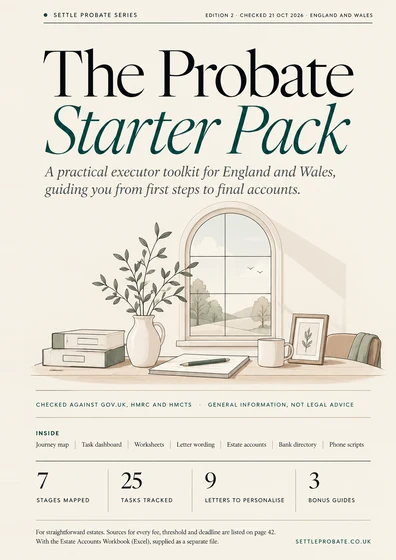
Starter Pack · £4.99 — a 44-page printable executor toolkit with a 25-step checklist, nine letters to personalise and an Excel estate accounts workbook.
See what’s inside →Free
Check what applies to this estate
Answer 7 questions and get a free probate assessment. No account needed.
Start free assessment →Secure Workspace · £9.99
Know you are ready before you apply
The Workspace's readiness check shows what is in place and what is still missing before you apply on GOV.UK, and your task list keeps everything else in order.
See how the Workspace works →