How to Register a Death in England and Wales
Checked against current GOV.UK probate and Inheritance Tax guidance for England & Wales (2026/27).
- You must register the death within five days in England and Wales, at the register office for the district where it happened.1
- Bring the medical certificate of cause of death — without it (or a coroner's form) the registrar cannot proceed.1
- Certified death certificates cost £12.50 each — order at least ten, as banks, HMRC and the registry each want an original.1
- You leave with the certificates, the green form for the funeral, and a Tell Us Once reference.3
Quick answer
Register the death within five days at the register office for the district where the person died. Take the medical certificate of cause of death and, if you have them, their birth and marriage certificates. You will receive certified death certificates (£12.50 each — order at least ten), the green form for the funeral, and a Tell Us Once reference.
This is the first official step, and it unlocks everything that follows — you cannot arrange the funeral or start on the estate without it. It is usually a calm, half-hour appointment. The one decision that matters is ordering enough death certificates while you are there.
In England and Wales, you are legally required to register the death within five days.1 It takes place at the local register office and is straightforward in most cases — here is exactly what to do.
Which register office to use
You must register the death at the register office in the district where the death occurred – not where the deceased lived, if those are different. If the person died in hospital, the hospital will be in a specific district and you must use that district's register office. Search gov.uk to find your nearest register office and book an appointment. Most offices require an appointment rather than allowing walk-ins.
The five-day rule
Since 9 September 2024 the five days run from when the register office is notified that a medical examiner has confirmed the cause of death, not from the date of death itself.2 In practice, GOV.UK tells you to wait for the medical examiner's office to confirm you can register, then register within five days of getting that confirmation. Weekends and bank holidays count.
- If the death has been referred to a coroner, you cannot register until the coroner's investigation is discontinued or the coroner sends the paperwork the registrar needs.
- If you need more than five days, GOV.UK says you must tell the register office immediately.
In practice, if you cannot register within five days due to a bank holiday or other genuine difficulty, contact the register office – they will advise you. The five-day requirement is a legal obligation and failing to comply without good reason is a criminal offence.
Who can register the death
The following people are entitled to register the death, in order of priority:
- A relative of the deceased who was present at the death
- A relative present during the deceased's last illness
- A relative living in the district where the death occurred
- Any other relative
- A person present at the death who is not a relative
- The occupier of the premises where the death occurred (if they knew of the death)
- The person responsible for arranging the funeral
A relative should register if at all possible. In the absence of any relative, the executor or funeral director may be able to register, but check with the register office first.
What to bring
The only document you are legally required to bring is the medical certificate of cause of death, which is issued by the doctor who attended the deceased. Without this (or a coroner's certificate), the registrar cannot register the death.
You should also bring the following documents if available, as they help the registrar complete the registration accurately:
- The deceased's birth certificate
- Their marriage or civil partnership certificate
- Their NHS number or medical card
- Their passport
- Any document showing their national insurance number
You do not need all of these – they are supplementary. If you cannot find them, the registration can still proceed.
What you receive
After registration, the registrar will give you:
- Certified copies of the death certificate – these are the official, certified copies you need to send to banks, HMRC, investment platforms, pension providers, the Land Registry, and others. Each copy costs £12.50. You can order additional copies later, but it is cheaper and faster to order everything you need at the same time.
- Certificate for Burial or Cremation (the green form) – this is given to the funeral director to authorise the burial or cremation. Without it, the funeral cannot go ahead.
- A unique reference number for Tell Us Once – this allows you to notify multiple government departments at once.
How many death certificates to order
Order at least ten certified copies at the time of registration, and ideally fifteen for larger estates. Organisations that typically require an original certified copy include:
- Each bank or building society holding a sole account
- HMRC (for the estate and for any outstanding personal tax)
- The Land Registry (if property needs to be transferred or sold)
- Each pension provider
- Each investment platform or stockbroker
- Any life insurance company
- National Savings and Investments (Premium Bonds, etc.)
- The Probate Registry when you apply for probate
Some institutions will return the original; others keep it. Assuming none are returned avoids being caught short. Running out and ordering more later adds cost and causes delays at a time when you need documents returned quickly.
Tell Us Once
Tell Us Once is a free government service that allows you to notify multiple government departments of the death in a single step. The registrar will give you a unique reference number and you can complete Tell Us Once online or by phone immediately after registering.
Tell Us Once notifies HMRC, the Department for Work and Pensions (which stops any benefits or State Pension payments), the DVLA, the Passport Office, the local council, and the Veterans UK armed forces pension. This does not replace separate notifications to private banks, insurance companies, or pension providers – those still need to be done individually. See our dedicated guide to Tell Us Once for the full list of what it covers.
Deaths referred to the coroner
If the death was sudden, unexpected, violent, or the cause is unknown, the death will be referred to the coroner. The coroner investigates and may hold an inquest. In this situation, you cannot register the death in the normal way until the coroner releases the case. The coroner's office will give you a different form that you take to the register office in place of the medical certificate. This process can take weeks or months if an inquest is required.
Deaths abroad
If the person died outside England and Wales, the death must be registered in the country where it occurred under that country's rules. You can also register a death abroad voluntarily at a British consulate, which produces a UK death certificate. You may need a certified translation of any foreign death certificate for use in England and Wales. Contact the Foreign, Commonwealth and Development Office for guidance.
Your next steps
Once the death is registered, your immediate next tasks are to use Tell Us Once, notify close family, and begin the estate administration process. See our guide to what to do in the first week after someone dies for a full priority list, and the probate checklist to track the full administration process. Two of the first practical jobs are dealing with the deceased's bank accounts and any property: see how to close a bank account when someone dies and, if there was a mortgage, what happens to a mortgage when someone dies. If you are not sure whether probate is needed, use our guide to who to contact after a death and take the free Settle assessment.
Sources & references
The figures and rules in this guide are drawn from the official UK government pages below. Each link opens the relevant GOV.UK page. Always confirm current figures on GOV.UK before you act, as fees and thresholds can change.
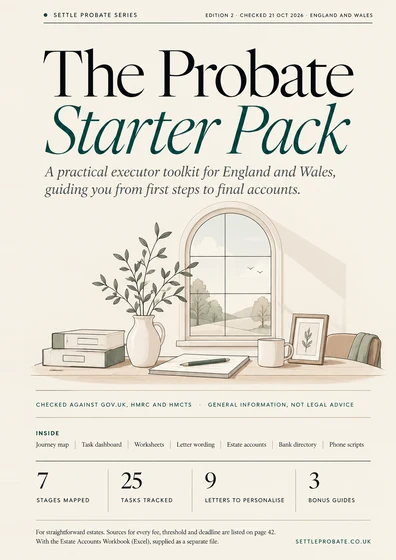
Verified against published GOV.UK guidance.Starter Pack · £4.99 — a 44-page printable executor toolkit with a 25-step checklist, nine letters to personalise and an Excel estate accounts workbook.
See what’s inside →Free
Find out exactly what you need to do
Answer 7 questions and get a free probate assessment. No account needed.
Start free assessment →Secure Workspace · £9.99
Know what comes next, from the first phone call to the final estate accounts
Your own private account with a task list built from your answers, a bank and institution tracker, and estate accounts. Includes the Starter Pack.
See how the Workspace works →