Who Do Executors Need to Contact After a Death?
Checked against current GOV.UK probate and Inheritance Tax guidance for England & Wales (2026/27).
- Do the urgent ones first: DWP and the banks, to stop payments and freeze accounts.3
- Tell Us Once covers the government side in one step; it does not tell banks or private firms.2
- The Death Notification Service notifies several banks at once, free.
- Get a date-of-death balance from each institution as you go — you will need it for the estate accounts and any IHT.1
Quick answer
Notify the urgent contacts first — DWP and the banks — then work through government (via Tell Us Once), financial institutions, utilities, insurers, pensions and subscriptions. Tell Us Once handles the government departments in one step; everything private has to be contacted individually.
The list is long, but you do not have to do it all at once — and you do not have to do it alone. A couple of free services do the heavy lifting for the government departments and the big banks. Get those going first, then work steadily down the rest by category.
Executors are responsible for contacting every institution that held assets or provided services to the deceased, stopping payments that should no longer be made, and ultimately closing or transferring each account or contract.3 Here is the full list, organised by category, so you can work through it systematically.
Timeline: some contacts are urgent, others can wait
Not everything needs to happen on day one. As a rough guide:
- Urgent (within days): DWP (to stop pension and benefit payments), banks (to freeze accounts and prevent further transactions), any employer if the person was still working
- Early (within a few weeks): HMRC, insurance providers (to avoid lapsed cover on the property), mortgage lender, utilities
- After probate is granted: Formally closing accounts, transferring assets, cancelling subscriptions - most financial institutions will not release funds until you have the grant
1. Government and official bodies
Department for Work and Pensions (DWP)
The DWP should be notified as soon as possible. If the deceased was receiving the State Pension, pension credit, or any other DWP benefit, payments must stop from the date of death. Any overpayment made after that date will need to be repaid to the DWP from the estate. You can notify the DWP via the Tell Us Once service (see below) or by calling them directly.
HMRC
HMRC needs to know about the death to close the deceased's tax record, process any outstanding Self Assessment returns, and issue a final tax calculation. If the person was self-employed or filed Self Assessment returns, these will need to be completed for the year of death. The executor is responsible for any outstanding tax liability of the estate. Contact HMRC's deceased person helpline or use the Tell Us Once service.
Local council
Notify the council to stop council tax payments (the deceased's property may be exempt for a period) and to cancel any council benefits such as council tax support or housing benefit. If the deceased was a tenant in a council property, this should also be handled urgently to avoid ongoing rent liability.
DVLA
Return the deceased's driving licence to the DVLA. If a vehicle is part of the estate, you will also need to notify the DVLA of the change of registered keeper once you have authority to transfer it. Contact the DVLA by post using the relevant section of the V5C logbook.
Passport Office (HM Passport Office)
You can surrender the deceased's passport to HM Passport Office by post. This is not legally required but is good practice to prevent fraudulent use.
Tell Us Once
When you register the death at the register office, ask about the Tell Us Once service. This allows you to notify multiple government departments simultaneously - including DWP, HMRC, DVLA, the Passport Office, and your local council - in a single step. It saves significant time and is free to use. Note that Tell Us Once does not notify banks or private institutions; those must be contacted separately.
2. Banks and financial institutions
Banks and building societies should be notified promptly so accounts can be frozen and no further payments are made. At this stage you are notifying and freezing - you do not need to close accounts or transfer funds until after probate is granted (if required) and you have the legal authority to do so.
The Death Notification Service (available at deathnotificationservice.co.uk) is a free service that allows you to notify multiple participating banks and building societies simultaneously with a single online form. It covers many major UK banks and is worth using where possible.
For each institution, you should also obtain a date-of-death balance statement - you will need this for the estate accounts and for any inheritance tax assessment.
For a full guide to the process, see how to notify banks after someone dies. For guidance on whether you will need the grant to release funds, see bank probate thresholds explained.
Also contact:
- Investment and share platforms - freeze and obtain valuations as at the date of death
- ISA providers - notify of death; surviving spouse may wish to claim the Additional Permitted Subscription (APS)
- Mortgage lender - to notify of death and discuss what happens to the mortgage (life insurance may clear it; otherwise the lender needs to know about the estate's plans)
- NS&I - for Premium Bonds, savings accounts, and investment accounts; note that NS&I has a low threshold (~£5,000) for releasing funds without probate
- Credit card providers - to freeze accounts and establish any outstanding balance
Not sure whether this applies to your estate? Take the free Settle assessment - it asks about your specific situation and gives a personalised checklist of next steps.
3. Insurance providers
- Life insurance: Contact the insurer to make a claim. If the policy was written in trust, the payout goes directly to the named beneficiaries and does not form part of the estate. If it was not written in trust, it forms part of the estate and passes under the will or intestacy rules.
- Buildings and contents insurance: Contact the insurer promptly. An unoccupied property can affect the validity of an existing policy - insurers may impose conditions (e.g., regular checks, draining water systems) or may refuse cover altogether for a vacant property. Do not assume existing cover continues unchanged.
- Car insurance: Notify the insurer. If a vehicle in the estate is still being used (e.g., by a family member to collect belongings), check whether existing cover extends to that use.
- Private health insurance: Cancel the policy and check whether any refund of premium is due.
- Payment protection insurance (PPI): If the deceased had any outstanding loans or credit cards with PPI attached, make a claim if the policy covers death.
4. Pension providers
- State Pension: Notify the DWP (via Tell Us Once or directly). Payments stop from the date of death.
- Workplace pension: Contact the scheme administrator. Pension death benefits do not pass under the will - they are paid at the discretion of the scheme trustees, based on a nomination of beneficiaries form the deceased may have completed. Contact the provider to find out what is held and how to claim.
- Personal pension / SIPP: As above - contact the provider. Ask whether a nomination of beneficiaries was in place and how to trigger the death benefit process.
To write to a pension scheme or employer, copy our pension provider letter template. For banks, there is a separate letter to a bank after a death.
5. Property and utilities
- Mortgage lender: As noted above - notify and discuss the estate's plans for the property.
- Landlord (if renting): If the deceased was a tenant, notify the landlord promptly to avoid accruing additional rent liability. You will need to give notice in line with the tenancy agreement and arrange for the property to be vacated and returned.
- Gas and electricity suppliers: Notify of the death. Accounts will need to be transferred to the executor's name or to a new occupier. Take meter readings on the date of death.
- Water supplier: As above.
- Broadband and TV: Cancel or transfer. Check whether there is an early termination fee and whether this is a valid estate liability.
- Council tax: Notify the local council to cancel or transfer liability.
6. Other practical contacts
- Employer: If the deceased was still working, notify the employer immediately. They will stop salary payments, issue a final payslip, and may have a death-in-service benefit to claim through the HR or pension team.
- Royal Mail: Consider arranging a mail redirect from the deceased's address to your own. This is paid for by the estate and helps ensure you do not miss important correspondence during the administration period.
- GP, dentist, optician: Cancel any regular appointments and notify the practice so patient records can be updated.
- Clubs, subscriptions, and memberships: Cancel direct debits and subscriptions - streaming services, gym memberships, magazine subscriptions, AA/RAC, clubs. Check bank statements for regular payments and work through them one by one.
- Digital accounts: Email accounts, social media, and online services. Platforms have different policies on memorialisation or deletion - some (like Facebook) allow the family to memorialise the account; others simply require closure on sight of a death certificate.
For a structured approach to tracking all of these, the executor duties guide and the probate checklist set out the full sequence of tasks in order.
Closing bank accounts versus notifying
It is worth being clear on one important distinction: notifying a bank of the death is not the same as closing the account. When you notify a bank, they freeze the account - no further payments go in or out. But you cannot formally close the account and receive the funds until you have the Grant of Probate (if the balance is above the bank's threshold) or until the bank is satisfied you have authority to act. Do not assume that because you have told the bank about the death, you are now entitled to the money. See closing bank accounts after death for the full process.
Is the surviving parent protected? See our free LPA guide →
Sources & references
The figures and rules in this guide are drawn from the official UK government pages below. Each link opens the relevant GOV.UK page. Always confirm current figures on GOV.UK before you act, as fees and thresholds can change.
- What to do when someone dies: step by step — GOV.UK
- Tell Us Once — GOV.UK
- Dealing with the estate of someone who's died — GOV.UK
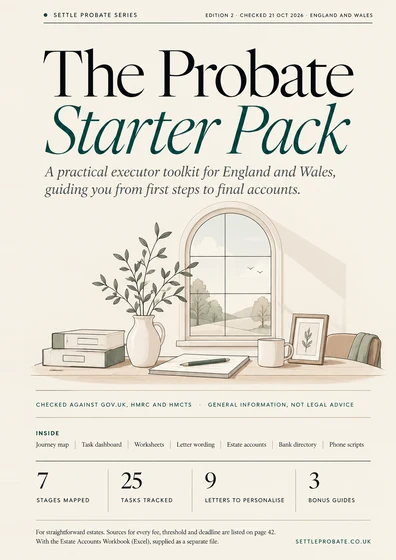
Starter Pack · £4.99 — a 44-page printable executor toolkit with a 25-step checklist, nine letters to personalise and an Excel estate accounts workbook.
See what’s inside →Free
Not sure probate is needed yet?
Answer 7 questions and get a free probate assessment. No account needed.
Start free assessment →Secure Workspace · £9.99
Send the letters, then track every bank
Your Workspace fills in a notification letter for each bank with the estate's details, and keeps a record of who you have contacted, what is still outstanding and each balance at the date of death.
See how the Workspace works →