What to Do in the First Week After Someone Dies
Checked against current GOV.UK probate and Inheritance Tax guidance for England & Wales (2026/27).
- Get the medical certificate of cause of death, then register the death (within five days).2
- Use Tell Us Once to notify government departments in one step.3
- Secure the property, redirect post, and check for pets and perishables.1
- Notify the bank to freeze accounts, and find the will to confirm the executor.1
The first week is about a handful of urgent, practical jobs — not the whole estate. Get the medical certificate, register the death, secure the home, tell the bank, and find the will. Everything else can wait.1
The days immediately after a bereavement are overwhelming. There is grief to manage, family to contact, and a list of practical tasks that cannot wait. This guide sets out what needs to happen in the first week, roughly in the order you should tackle things, so you are not left wondering what to prioritise.
Days 1 and 2: the essentials
Register the death
In England and Wales you must register the death within five days at the register office in the district where the death occurred. You will need the medical certificate of cause of death, which the doctor issues. At the register office you will receive death certificates and a unique reference number for the Tell Us Once service.
Order at least ten certified copies of the death certificate when you register – each one costs £12.50 and you will need to send originals to banks, HMRC, the Land Registry, pension providers, and investment platforms. Running out and having to order more later causes delays. See our full guide to how to register a death for everything you need to bring.
Use Tell Us Once
The register office will give you a unique reference number that allows you to use the government's Tell Us Once service. This notifies HMRC, the Department for Work and Pensions, the DVLA, the Passport Office, the local council, and the Veterans UK armed forces pension scheme (if applicable) in a single step. Do this before you leave the register office or online shortly afterwards. Our Tell Us Once guide explains exactly what it covers and what you still need to do separately.
Notify immediate family and close contacts
Let close family members know as soon as possible – both so they are not left uninformed and so they can offer practical support. If the deceased had a personal address book, phone, or email contacts list, work through it methodically. Ask family members to help: dividing the calls makes this more manageable.
Secure the property
If the deceased lived alone, their home is now unoccupied. Notify the buildings and contents insurer immediately. Most home insurance policies contain a clause requiring the insurer to be told when a property becomes vacant – failure to notify can invalidate cover. Change the locks if you have any concern about who has a key. Cancel any milk or newspaper deliveries, which would otherwise signal that the property is empty.
Contact the funeral director
If the deceased had pre-paid funeral plans or named a preferred funeral home, contact them now. If not, the executor has legal authority to arrange the funeral. The funeral director will guide you through the process. Funeral costs are paid as a priority from the estate, before debts and before any distribution to beneficiaries.
Locating the will
Finding the will is a priority in the first couple of days if possible. Check obvious places first: a filing cabinet, an important documents folder, a home safe, or a bedside drawer. If you cannot find it at home, contact any solicitor the deceased used – solicitors often store original wills for clients. Banks with safe deposit boxes are another possibility.
If the will still cannot be found, the National Will Register (operated by Certainty at certainty.co.uk) maintains a database that many solicitors use to register wills. A search costs a small fee but is worth doing before assuming there is no will. Our guide to finding a will after someone dies covers all the places to look and what to do if there is no will at all.
Days 3 to 7
Contact the main bank
Write to or visit the main bank to notify them of the death. The bank will note the death on their records, freeze sole accounts, and provide a date-of-death balance. You will need this figure for the estate valuation and for any inheritance tax calculation. Do not delay this step – banks need time to process bereavement notifications and will not release funds without probate in most cases.
If the deceased held a joint account with a surviving spouse or partner, the account usually passes to the surviving holder without probate. Notify the bank with a death certificate and the account continues in the survivor's name. See our guide to joint bank accounts after death for how the balance is treated for inheritance tax purposes.
For a thorough explanation of the full bank notification and closure process, see our guide to closing bank accounts after death. If you are wondering whether accounts are immediately frozen — and what frozen actually means in practice — see are bank accounts frozen when someone dies and how long bank accounts stay frozen. For a complete list of what each bank will ask for, see documents required to close a bank account after death.
Notify the employer
If the deceased was employed, contact their employer as soon as possible. The employer will stop salary payments, calculate any final pay or outstanding holiday entitlement, and can provide details of any death-in-service benefit or occupational pension. Death-in-service benefits are often written in trust and paid directly to a nominated beneficiary outside the estate.
Cancel regular payments and redirect post
Go through the deceased's bank statements to identify standing orders and direct debits. Contact each company in turn to cancel or close the account. Subscriptions – streaming services, gym memberships, magazines – should all be cancelled. Set up a mail redirect with Royal Mail so that correspondence sent to the deceased's address reaches you – this often reveals accounts and subscriptions you were not aware of.
Keep a record of everything
From day one, keep a log of every letter you send, every phone call you make, and every document you receive. You will be asked to account for the administration of the estate by the beneficiaries, and a clear paper trail protects you as executor. Our guide to executor duties explains what records you need to keep throughout the process.
What not to do in the first week
It is just as important to know what to avoid as what to do:
- Do not distribute anything yet. Assets cannot be distributed to beneficiaries until probate is granted and all debts are paid. Distributing early creates personal liability for the executor.
- Do not sell or transfer property. Estate property cannot be sold or transferred until the Grant of Probate gives the executor legal authority to deal with it.
- Do not close bank accounts. Freeze them and get balances, but wait for probate before closing and transferring funds.
- Do not throw away any paperwork. Even documents that seem unimportant may be needed later for tax, valuation, or tracing unknown assets.
Your next steps after the first week
Once the immediate tasks are done, you move into the estate valuation and probate application phase. Use our probate checklist to track where you are in the process. If you are not sure whether probate is even required for this estate, take the free Settle assessment – it takes two minutes and tells you exactly what applies to your situation.
Common mistakes to avoid
- Trying to do the whole estate at once. The first week is triage — the urgent, practical tasks only.1
- Missing the five-day registration window. Register promptly unless the coroner is involved.2
- Leaving the home unsecured. Check insurance still covers an empty property.1
Frequently asked questions
What should I do first when someone dies?
Get the medical certificate of cause of death, then register the death. Arrange the funeral and secure the person's home.2
How soon must I register the death?
Within five days in England and Wales, unless the death has been referred to a coroner, which can extend it.2
What is Tell Us Once?
A service that notifies HMRC, DWP, DVLA, the Passport Office and the council of a death in one step after you register it.3
Do I need to tell the bank straight away?
Yes — notify the bank to freeze the sole accounts and stop direct debits, but redirect essential payments first.1
What if I can't find the will?
Check with the person's solicitor or bank and the National Will Register. The original is needed to confirm the executors and apply for probate.1
Is the surviving parent protected? See our free LPA guide →
Sources & references
The figures and rules in this guide are drawn from the official UK government pages below. Each link opens the relevant GOV.UK page. Always confirm current figures on GOV.UK before you act, as fees and thresholds can change.
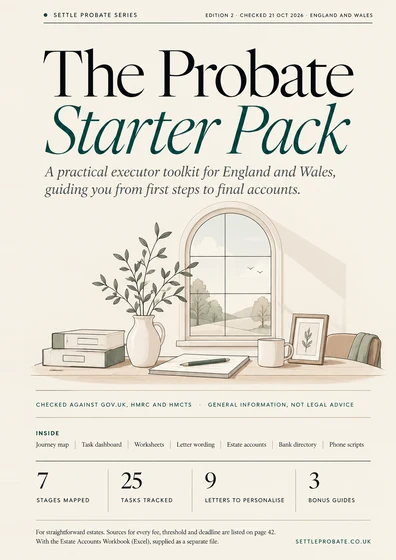
Verified against published GOV.UK guidance.Starter Pack · £4.99 — a 44-page printable executor toolkit with a 25-step checklist, nine letters to personalise and an Excel estate accounts workbook.
See what’s inside →Free
Find out exactly what you need to do
Answer 7 questions and get a free probate assessment. No account needed.
Start free assessment →Secure Workspace · £9.99
Know what comes next, from the first phone call to the final estate accounts
Your own private account with a task list built from your answers, a bank and institution tracker, and estate accounts. Includes the Starter Pack.
See how the Workspace works →