How to Find a Will After Someone Dies
Checked against current GOV.UK probate and Inheritance Tax guidance for England & Wales (2026/27).
Start with the obvious places — a home safe, files, the person's solicitor or bank — then search the National Will Register. Finding the original matters: probate needs it, and the latest valid will is the one that counts.1
Finding the will is one of the first practical tasks after someone dies. Without it, you cannot confirm who the executor is, who inherits, or whether any specific wishes have been left regarding the funeral. This guide explains where to look, how to search official registers, and what to do if no will can be found.
Where to look first: at home
Many people keep their will at home. Methodically check the following places before concluding it is not there:
- Filing cabinets and document folders, especially anything labelled "important documents" or "legal"
- A home safe or lockbox
- A bedside drawer or bureau
- The top shelf of a wardrobe
- An envelope kept with insurance documents or property deeds
Wills are typically stored in an A4 envelope, sometimes with the name of the solicitor who prepared it printed on the outside. If you find an envelope from a solicitor, contact that firm even if the envelope is empty – the solicitor may hold the original.
Contact any solicitor the deceased used
Solicitors routinely hold original wills for safekeeping on behalf of clients. If you know which solicitor the deceased used for legal matters, contact them. Even if the deceased used different solicitors at different times, it is worth contacting all of them. The solicitor is not permitted to disclose the contents of the will to someone who has not been named in it, but they can confirm whether they hold a will and release it to the executor or next of kin.
Bank safe deposit boxes
Some people store their will in a bank safe deposit box. If you know the deceased had a safe deposit box, contact the bank and explain the situation. The bank will need to see a death certificate. Accessing a safe deposit box belonging to a deceased person requires a specific procedure that varies by bank – contact the bank's bereavement team directly.
The National Will Register
The National Will Register, operated by Certainty (certainty.co.uk), is a database that solicitors and will-writers use to register the existence and location of wills. Registration does not mean the will is stored there – it simply records where the original is held. A search costs a small fee (currently around £95 for a comprehensive search) but is well worth doing before assuming no will exists.
Certainty searches multiple databases including its own register, the Certainty Master Register, and the records of several major will-storage providers. The search result tells you whether a will has been registered and, if so, where the original is held.
Searching probate records for previous wills
If the deceased has been involved in a previous estate – for example, they were a beneficiary in a parent's estate – they may have made their own will around that time. Once a will has been through probate, it becomes a public document. You can search the Probate Registry's online will search (gov.uk) for grants issued in England and Wales since 1858. This is useful for confirming whether an earlier will exists, but note that a more recent will may have superseded it.
Checking a will is legally valid
Once you have found a document that appears to be the will, check the following before treating it as valid:
- Written: the will must be in writing. A verbal will is not legally valid in England and Wales.
- Signed by the testator: the person making the will (the testator) must have signed it at the end, or directed someone else to sign it in their presence.
- Witnessed: the signature must have been made or acknowledged in the presence of two witnesses, who must both have been present at the same time and who must both have signed the will in the testator's presence.
- Witnesses must be independent: a witness who is also a beneficiary (or the spouse of a beneficiary) cannot inherit under the will. Their signature is valid for the purposes of execution, but their gift fails.
If any of these requirements are not met, the will is not legally valid and the estate will be administered under intestacy rules as if no will existed.
Codicils: amendments to a will
A codicil is a formal amendment to a will. It is a separate document that changes specific provisions without replacing the whole will. Codicils must be executed in the same way as a will – signed by the testator and witnessed by two independent witnesses. If you find a codicil, it must be read and applied alongside the main will. Look carefully for codicils whenever you find a will – they are sometimes kept in the same envelope, but not always.
Multiple wills: which one applies?
If you find more than one will, the most recently executed valid will normally takes precedence. However, some wills contain a clause expressly revoking all previous wills – in that case, only the most recent will applies. If the most recent will does not contain a revocation clause, the earlier will applies to the extent it is not contradicted by the later one. If there is any uncertainty about which will applies, take legal advice before proceeding.
Marriage automatically revokes a previously made will in England and Wales – so a will made before the deceased married is very likely no longer valid. Divorce does not revoke a will but does cancel any gifts to, and the appointment of, an ex-spouse.
If no will can be found
If after exhausting all the above searches you cannot find a will, the estate is treated as if no will exists. The estate must be administered under the intestacy rules, which prescribe a strict order of who inherits and in what proportions. Instead of applying for a Grant of Probate, the administrator applies for Letters of Administration from the Probate Registry.
Our guide to probate without a will explains the Letters of Administration process in full. Our guide to intestacy rules and who inherits sets out exactly how the estate would be distributed if no valid will exists.
If the will is disputed
If there are concerns that the will does not reflect the deceased's true wishes – for example, because of suspected undue influence or questions about capacity – it may be possible to contest the will. This is a complex area and requires legal advice promptly. See our guide to contesting a will for an overview of the grounds and process.
Not sure what to do next? Take the free Settle assessment – it takes two minutes and gives you a personalised summary of the steps that apply to your situation, including whether probate is needed and who can apply.
Once you have confirmed the will and identified the executor, the next step is for the executor to begin the estate administration process. Our guide to executor duties explains exactly what that involves.
Common mistakes to avoid
- Accepting a photocopy. Probate needs the original; a copy raises questions about whether it was revoked.2
- Stopping at home. Many people leave wills with a solicitor or bank — ask them.1
- Assuming the newest note is the will. Only a properly executed will (or codicil) counts.1
Frequently asked questions
Where do people usually keep their will?
At home with important papers, with their solicitor, at their bank, or lodged for safekeeping. Many are registered on the National Will Register.1
What is the National Will Register?
A searchable register (Certainty) that records where wills are held, so executors can trace a will they cannot find.1
Do I need the original will for probate?
Yes. The Probate Registry needs the original, not a photocopy. A missing original can raise questions about revocation.2
What if no will exists?
The estate is distributed under the intestacy rules, and an administrator applies for Letters of Administration.3
How do I know a will is valid?
It must be in writing, signed by the person and witnessed by two people. The latest valid will revokes earlier ones.1
Sources & references
The figures and rules in this guide are drawn from the official UK government pages below. Each link opens the relevant GOV.UK page. Always confirm current figures on GOV.UK before you act, as fees and thresholds can change.
- Wills, probate and inheritance — GOV.UK
- Applying for probate — GOV.UK
- Dealing with the estate of someone who's died — GOV.UK
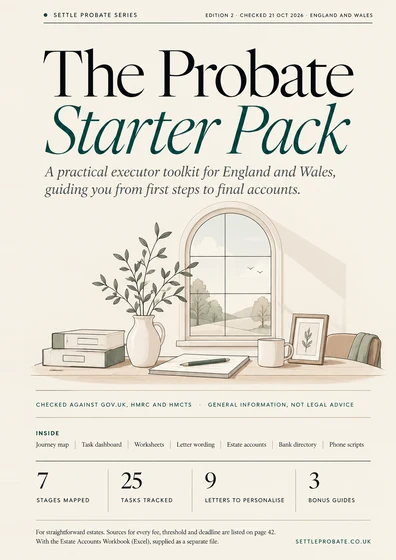
Starter Pack · £4.99 — a 44-page printable executor toolkit with a 25-step checklist, nine letters to personalise and an Excel estate accounts workbook.
See what’s inside →Free
Find out exactly what you need to do
Answer 7 questions and get a free probate assessment. No account needed.
Start free assessment →Secure Workspace · £9.99
Know what comes next, from the first phone call to the final estate accounts
Your own private account with a task list built from your answers, a bank and institution tracker, and estate accounts. Includes the Starter Pack.
See how the Workspace works →