How to Contest a Will in England and Wales
Checked against current GOV.UK probate and Inheritance Tax guidance for England & Wales (2026/27).
- Grounds include lack of capacity, undue influence, fraud, or improper execution.2
- Entering a caveat stops a grant being issued while you investigate.1
- There are also claims under the Inheritance (Provision for Family and Dependants) Act for reasonable provision.3
- Time limits are tight and vary by claim — take advice quickly.2
A will can be challenged, but only on specific legal grounds — lack of capacity, undue influence, fraud, or improper execution. If you think a grant should not be issued, entering a caveat buys time to investigate.1
Quick answer
You can contest a will on grounds such as lack of mental capacity, undue influence, fraud, or improper signing. You must have legal standing to challenge and act promptly — Inheritance Act claims must be made within six months of probate being granted. Contested probate is expensive and can take years, so weigh the realistic prospects carefully before proceeding.
Contesting a will means challenging its legal validity. It is a significant step that involves court proceedings, can take years, and often costs more than the estate is worth. That said, there are circumstances where a will genuinely should not stand, and the law provides clear routes for those who have solid grounds to challenge.
This guide covers the grounds on which a will can be contested in England and Wales, the process for raising a challenge, claims under the Inheritance Act 1975, time limits, and the realistic picture on costs.
Who can contest a will
Not everyone has the legal standing to contest a will. To bring a challenge, you typically need to be:
- A named beneficiary in the will being challenged
- A named beneficiary in an earlier will
- Someone who would inherit under the intestacy rules if the will were found invalid
- A creditor of the estate in limited circumstances
A challenge brought by someone without standing will be dismissed. Legal advice at an early stage is important to establish whether you have standing before committing to the process.
Ground 1: lack of testamentary capacity
For a will to be valid, the person making it (the testator) must have had the required mental capacity at the time of signing. The legal test for testamentary capacity was established in Banks v Goodfellow (1870) and requires that the testator:
- Understood the nature of making a will and its effects
- Understood the extent of the property they were leaving
- Understood the claims of those who might reasonably expect to benefit
- Was not suffering from any disorder of the mind that poisoned their affections, perverted their sense of right, or prevented the exercise of their natural faculties
The Mental Capacity Act 2005 applies to decisions made during life but the Banks v Goodfellow test remains the standard for testamentary capacity challenges. Evidence typically comes from medical records, GP notes, hospital records, and witness accounts of the testator's behaviour around the time the will was made.
Dementia, serious mental illness, or the effects of medication can all potentially affect capacity, but a diagnosis alone is not sufficient to void a will. The capacity test is specific to the moment the will was executed.
Ground 2: undue influence or coercion
A will can be contested if the testator was coerced into making it by someone who exerted such pressure that the will reflects the coercer's wishes rather than the testator's own. This is a high bar. The courts distinguish between legitimate persuasion or appeals to the testator's affection, which are acceptable, and coercion that overpowered the testator's free will, which is not.
Undue influence in the context of wills is not presumed, even where there was a relationship of trust and dependency. The person alleging it must prove it. Evidence might include witness accounts, patterns of isolation, financial control, or the fact that the testator changed a longstanding will shortly before death following a period of dependence on a particular person.
Ground 3: fraud or forgery
If the will itself was forged, or if the testator was deceived into signing a document they did not understand to be a will, the will is void. Fraud includes situations where someone made false representations to the testator that influenced the contents of the will. Forensic document examination and handwriting analysis are commonly used as evidence in forgery cases.
Ground 4: improper execution
The formal requirements for making a valid will are set out in the Wills Act 1837. For a will to be valid in England and Wales:
- It must be in writing
- It must be signed by the testator (or by someone else in their presence and at their direction)
- The testator must intend by their signature to give effect to the will
- The signature must be made or acknowledged in the presence of two witnesses who are present at the same time
- Each witness must sign the will (or acknowledge their earlier signature) in the presence of the testator
A will is invalid if these requirements are not met. Additionally, a witness (or the spouse or civil partner of a witness) cannot benefit under the will. If a beneficiary was a witness, the will itself remains valid but that beneficiary loses their gift. If the issue is with execution rather than content, the rest of the estate may still be distributed under the valid parts of the will or under a previous will.
Ground 5: lack of knowledge and approval
Even if the testator had capacity and the will was properly executed, it can still be challenged if the testator did not know and approve of the will's contents at the time of signing. This ground is most relevant where the testator had a physical disability affecting communication, where someone else drafted the will in unusual circumstances, or where the will was read to someone who did not fully understand it.
Inheritance Act 1975 claims: a separate route
A claim under the Inheritance (Provision for Family and Dependants) Act 1975 is distinct from contesting the validity of a will. Under this Act, certain people can apply to the court for reasonable financial provision from the estate even if the will (or intestacy rules) does not provide for them.
Those who can make a claim include:
- A spouse or civil partner
- A former spouse or civil partner who has not remarried
- A cohabitee who lived with the deceased for at least two years immediately before the death
- A child of the deceased
- A person treated as a child of the family by the deceased
- Any person who was financially maintained by the deceased
The court considers several factors including the applicant's financial needs and resources, the size of the estate, the obligations owed to other beneficiaries, and the deceased's reasons (if known) for making the provision they did. Inheritance Act claims do not invalidate the will; they adjust how the estate is distributed.
Time limit: Inheritance Act claims must be issued within six months of the Grant of Probate or Letters of Administration. This is a strict deadline and the court has limited discretion to extend it.
How to enter a caveat
The first practical step in contesting a will is usually to enter a caveat at the Probate Registry. A caveat prevents a Grant of Probate or Letters of Administration from being issued, which stops the estate being administered while the dispute is live.
A caveat lasts for six months, after which it can be extended for a further six months. Check the current fee on GOV.UK ('Stop a probate application') before you apply — court fees changed in July 2026. To enter a caveat, you submit a written application to the Probate Registry naming the deceased and your interest. Once the caveat is in place, the executor cannot obtain a grant until the caveat is removed or the dispute resolved.
The executor can challenge a caveat by issuing a "warning." If the caveator does not respond within eight days with an "appearance," the caveat lapses. If they do respond with an appearance, the dispute formally enters the litigation process and must proceed to court.
Note: A caveat should not be entered lightly. If you enter one without proper grounds and cause the estate to be needlessly delayed, the court may order you to pay costs.
The court process
Will disputes are heard in the Chancery Division of the High Court (or in the County Court for lower-value estates). The process involves issuing a claim, exchanging evidence, witness statements, and potentially a full trial. Many disputes settle before reaching trial through mediation or negotiation.
Time limits vary by ground. Challenges based on validity (capacity, execution, fraud) can technically be brought at any time while the estate remains open, though delay weakens evidence and courts may decline to hear stale claims. Practically, the general limitation period is 12 years from the date the cause of action arose, though claims should be brought as promptly as possible.
Costs
Will disputes are expensive. Solicitor costs for a contested probate matter can easily reach £50,000 to £150,000 or more per side in a High Court trial. The general principle is that costs follow the event: the losing party pays both sides' costs. However, in probate disputes the court has broader discretion and may order costs from the estate if it finds the litigation was reasonably necessary.
Before proceeding, weigh the realistic prospects of success against the likely legal costs. Most contentious probate solicitors offer an initial assessment. Mediation is often a faster and cheaper alternative, and courts actively encourage it.
What happens if a challenge succeeds
If a will is found to be invalid, the estate is administered either under a previous valid will (if one exists) or under the intestacy rules if no valid earlier will can be found. The invalid will is set aside entirely and plays no part in distribution.
Related guides
- Intestacy rules: who inherits without a will
- Deed of variation: redirecting an inheritance
- Letters of administration explained
- Executor duties explained
Not sure where you stand?
The free Settle assessment tells you whether probate is needed and what your next steps are.
Start free assessmentCommon mistakes to avoid
- Waiting too long. Some claims have strict deadlines; a caveat and early advice protect your position.1
- Challenging on feelings, not grounds. Disappointment is not a legal ground; capacity, influence, fraud or execution are.2
- Underestimating costs. Contentious probate can be expensive — weigh the value at stake.3
Frequently asked questions
On what grounds can a will be contested?
Lack of testamentary capacity, undue influence, fraud or forgery, lack of knowledge and approval, or improper execution.2
How do I stop probate while I investigate?
Enter a caveat at the Probate Registry. It prevents a grant being issued for six months and can be renewed.1
What if I was left out but depended on the deceased?
You may have a claim under the Inheritance (Provision for Family and Dependants) Act 1975 for reasonable financial provision.3
Is there a time limit?
Yes, and it varies by claim type — 1975 Act claims are usually within six months of the grant. Get advice quickly.2
How much does contesting a will cost?
It varies widely and can be significant. Many disputes settle through negotiation or mediation before trial.3
Sources & references
The figures and rules in this guide are drawn from the official UK government pages below. Each link opens the relevant GOV.UK page. Always confirm current figures on GOV.UK before you act, as fees and thresholds can change.
- Stop a probate application (enter a caveat) — GOV.UK
- Wills, probate and inheritance — GOV.UK
- Applying for probate — GOV.UK
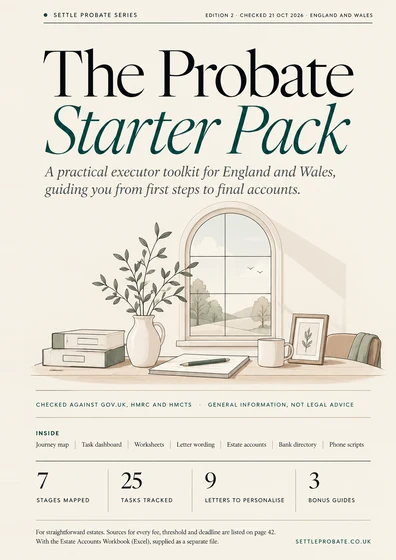
Starter Pack · £4.99 — a 44-page printable executor toolkit with a 25-step checklist, nine letters to personalise and an Excel estate accounts workbook.
See what’s inside →Free
Check what applies to this estate
Answer 7 questions and get a free probate assessment. It flags the things that usually need a solicitor.
Start free assessment →Professional advice
This may need a solicitor
Disputes, insolvency, overseas assets, businesses and similar issues usually need advice from a regulated professional. The Law Society lists probate solicitors near you.
Find a solicitor (Law Society) →