The Probate Registry: What It Does and How to Apply
Checked against current GOV.UK probate and Inheritance Tax guidance for England & Wales (2026/27).
- The Probate Registry (part of HMCTS) issues the grant that gives you legal authority over the estate.1
- Apply online through GOV.UK or on paper (PA1P / PA1A); online is usually faster.1
- The court fee is £526 over £5,000, nothing at or below; grant copies are £2 each with the application.2
- A complete application is usually granted in about 12 weeks; respond to any "requisition" fast.1
Quick answer
The Probate Registry, part of HMCTS, is the office that issues Grants of Probate and Letters of Administration. You apply online through the GOV.UK online service or on paper, send the original will and death certificate, pay the £526 fee for estates over £5,000, and usually receive the grant within about 12 weeks of a complete application.
Behind the word "probate" sits a single office doing one job: checking your paperwork and issuing the grant that unlocks the estate. Knowing how the Probate Registry works — what it wants, how to send it, and what its queries mean — is most of what you need to get through the application without avoidable delays.
The Probate Registry issues Grants of Probate and Letters of Administration in England and Wales, as part of His Majesty's Courts and Tribunals Service (HMCTS).1 Without a grant, executors and administrators have no formal legal authority to deal with many estate assets, and most banks will not release funds.
What the Probate Registry does
The Probate Registry receives probate applications, verifies the submitted documents, and issues the official grant once it is satisfied that the application is in order. It also:
- Holds a record of all grants issued, which is publicly searchable
- Deals with caveats (formal objections that prevent a grant being issued)
- Processes any queries or requisitions raised during the application
The Registry does not advise on how to administer an estate, interpret a will, or resolve family disputes about inheritance. Those matters sit with solicitors, the courts, and the parties themselves.
Online application versus paper application
There are two routes to apply.
Online: Most applicants now use the HMCTS online probate service, accessible via gov.uk. You complete the application form digitally, upload supporting documents, and pay the court fee by card. The online route is generally faster and simpler than the paper route, and HMCTS recommends it.
Paper (PA1P or PA1A): If you prefer, or if the estate is particularly complex, you can submit a paper application using form PA1P (where there is a will) or PA1A (intestate estates). Paper applications are posted to the HMCTS Probate service address in Sheffield. Processing tends to be slower for paper submissions.
What you need to submit
Regardless of which route you use, you will need to provide:
- The original will (if there is one), including any codicils. The Registry retains the original permanently - do not send it unless you are ready to part with it.
- The original death certificate (or a certified copy issued by the register office).
- IHT confirmation: for excepted estates this is confirmation within the application form itself; for taxable estates, the IHT400 reference number issued by HMRC after accepting the return.
- The completed application form (PA1P or PA1A, or the online equivalent).
- The court fee: £526 for estates worth more than £5,000. There is no fee for estates of £5,000 or less.
Note: HMRC must accept your IHT position before the Probate Registry will issue the grant. If IHT is due, it must also be paid (or a payment arrangement confirmed) first. This is a separate step from the probate application and often takes longer. See our documents needed for probate guide for the full checklist.
Not sure what applies to this estate? Take the free Settle assessment to get a personalised picture of next steps.
What happens after you submit
Once the Probate Registry receives your application, a caseworker reviews the submitted documents. If everything is in order, the application moves towards grant. If there is a problem, you will receive a requisition: a written request for additional information or documents. Common reasons for requisitions include:
- Missing or unclear signatures on the will
- Discrepancies between names on the will and the death certificate
- Missing supporting forms
- Queries about IHT confirmation
Respond to requisitions promptly. Delays at this stage extend the overall timeline. If you do not understand what is being asked, contact HMCTS Probate directly.
How long it takes
HMCTS publishes an indicative processing time on gov.uk. As of 2026, the standard expectation is around 12 weeks from the date the Probate Registry receives a complete application. In practice, straightforward applications with no requisitions are sometimes faster. Complex estates or those requiring additional IHT work can take considerably longer.
The 12-week figure starts from the point the Registry has received everything it needs, not from the date you begin gathering documents. If IHT needs to be resolved first, that adds time before the clock starts.
Receiving the grant
When the Probate Registry is satisfied, it issues the Grant of Probate (or Letters of Administration). You receive the original grant document plus any sealed copies you have paid for. Sealed copies cost £2 each when ordered with the application (£16 each if ordered later).
Order enough copies at the time of application. Most estates need at least four to six copies: one for each bank or financial institution, one for the Land Registry if property is involved, and one to keep for your records. It is cheaper and faster to order them upfront than to request additional copies later.
Once you have the grant, you can begin formally collecting assets. Present a sealed copy to each institution - they will not accept a photocopy.
How do I track my probate application?
If you applied online, sign in to your probate account on GOV.UK to see the status of your application. If you applied by post, GOV.UK says you should get a letter or email within 12 weeks; if nothing arrives, contact the probate helpline below. The grant itself usually arrives within 12 weeks of applying, longer if the registry needs more information. There is no deadline to apply in the first place: see probate time limits.
Contact details for HMCTS Probate
- Phone: 0300 303 0648 (Monday to Friday, 9am to 1pm, closed on bank holidays)
- Email: contactprobate@justice.gov.uk
Related guides
Sources & references
The figures and rules in this guide are drawn from the official UK government pages below. Each link opens the relevant GOV.UK page. Always confirm current figures on GOV.UK before you act, as fees and thresholds can change.
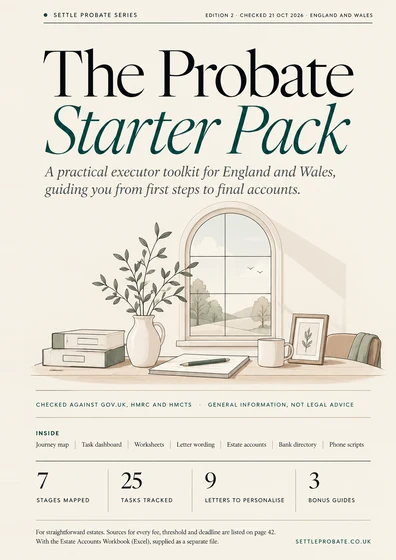
Verified against published GOV.UK guidance.Starter Pack · £4.99 — a 44-page printable executor toolkit with a 25-step checklist, nine letters to personalise and an Excel estate accounts workbook.
See what’s inside →Free
Check what applies to this estate
Answer 7 questions and get a free probate assessment. No account needed.
Start free assessment →Secure Workspace · £9.99
Know you are ready before you apply
The Workspace's readiness check shows what is in place and what is still missing before you apply on GOV.UK, and your task list keeps everything else in order.
See how the Workspace works →