IHT38: property sold for less than its probate value
Loss on sale of land relief · sales within 3 years, or at a loss in the fourth year · claim within 7 years of the death
Rules checked against sections 190 to 198 of the Inheritance Tax Act 1984, HMRC's Inheritance Tax Manual and form IHT38 (HMRC 05/26) on 27 November 2026 (how we check).
Quick answer
If the executors sell a house, flat or land from the estate for less than its probate value within three years of the death (or at a loss in the fourth year), and Inheritance Tax was paid on it, they can claim on form IHT38 to use the sale price instead. A £450,000 house sold for £400,000 cuts the estate's value by £50,000, which is at most £20,000 less tax at 40%. It is not automatic: every property they sell in those years counts, including any sold at a gain, and a claim cannot be withdrawn.
1. The estate
2. Every property the executors sold
Include gains as well as losses. Use the date contracts were exchanged (in Scotland, when the offer and qualified acceptance were agreed in writing), and the gross price before fees.
3. Purchases
4. Anything unusual?
Estimate only. Nothing you enter leaves this page.
Loading.
How the checker works
- Which sales count. Section 191 covers an interest in land sold by the "appropriate person" (usually the executors) within three years of the death. Once a claim is made, the sale price replaces the probate value of every interest they sold in that capacity in those years, including any sold for more. A sale in the fourth year counts only if it is at a loss (section 197A).
- Sales left out. A sale is ignored if its price differs from the probate value by less than £1,000 or 5% of the probate value, whichever is lower (section 191(2)). Sales by the executors to someone who was entitled to the property, or to their spouse, civil partner, child or grandchild, or to a trust for them, are excluded (section 191(3)).
- Purchases. If the executors buy land between the death and four months after the last sale, each sale price moves back towards its probate value by purchases ÷ total sale prices × (probate value − sale price). If purchases equal or exceed the sale prices, there is no relief (section 192; HMRC manual IHTM33162). Fourth-year sales are left out of this step.
- Tax. The relief is the fall in value. The tax it saves is at most that fall × 40% (36% at the charity rate), and never more than the tax paid. If no tax was due on the estate, nobody can claim (IHTM33050).
- Deadlines. Claim within four years of the end of the three-year period, so within seven years of the death (section 191(1A)). HMRC treats relief as provisional until four years and four months after the death unless no further change is possible (IHTM33044).
Worked examples
1. One house, sold eight months after the death (the default figures)
Probate value £450,000, sold for £400,000, £80,000 tax paid. The difference is £50,000, well above the lower of £1,000 and 5% (£22,500). The estate's value falls by £50,000, so the tax falls by up to £20,000, and HMRC repays the overpayment once the claim is agreed.
2. A second property sold at a gain
The same executors also sell a flat valued at £200,000 for £230,000 within the three years. The flat's £30,000 gain counts too, so the net relief is £20,000 (£8,000 of tax). If the flat had sold for £260,000, the claim would raise the estate's value. Do not claim then: HMRC says a claim cannot be withdrawn (IHTM33013).
3. The estate owned half, and the whole house was sold
HMRC's own example (IHTM33182): the whole property was worth £200,000 at death, and the deceased's half share was valued at £90,000 after a joint-ownership discount. The whole was sold for £190,000. The sale value of the half is £95,000, more than £90,000, so a claim would cost tax even though the property sold for less than its full value.
4. Small difference
A garage valued at £15,000 sells for £14,400. The lower of £1,000 and 5% (£750) is £750, and the £600 difference is under it, so the sale is ignored.
What the checker does not cover
- Price below the best you could get. If a property was sold for less than the best price reasonably obtainable, the best price is used instead (IHTM33072). Expenses such as estate agents' fees and legal costs are not deducted.
- Changes, leases, compensation and exchanges. HMRC adjusts the price if the property changed between the death and the sale (IHTM33121), for leases with under 50 years left, statutory compensation, and exchanges (IHTM33111 to IHTM33150). The checker flags these but does not work them out.
- Sold by a beneficiary. If the executors pass the property to a beneficiary who then sells, neither can claim (IHTM33050), unless the beneficiary is the one paying the tax on it.
- Compulsory purchase. Can qualify after three years where a notice to treat was served within them (IHTM33091). HMRC refers these to its technical team.
- Lifetime gifts. Land given away in the seven years before death has separate rules (IHTM14621). See the gifts calculator.
- Capital Gains Tax. If the relief is agreed, the revised value is usually the starting point for Capital Gains Tax too. See the estate Capital Gains Tax calculator.
- Scotland and Northern Ireland. Inheritance Tax and this relief apply across the UK. In Scotland the date of sale is when the offer and acceptance are agreed in writing (form IHT38, note 5).
Send the completed IHT38 to HMRC at the address printed on the form. Applying for probate is a separate step: in England and Wales it goes to HMCTS centrally (online, or by post to the national address on GOV.UK).
Sources
- Inheritance Tax: claim for relief, loss on sale of land (IHT38) — GOV.UK, updated 1 October 2026 (read 27 November 2026)
- Inheritance Tax Act 1984, section 191 — legislation.gov.uk (read 27 November 2026)
- Inheritance Tax Act 1984, section 192 (purchases) — legislation.gov.uk (read 27 November 2026)
- Inheritance Tax Act 1984, section 197A (fourth year) — legislation.gov.uk (read 27 November 2026)
- IHTM33011: Loss on sale of land, outline of the relief — HMRC (read 27 November 2026)
- IHTM33072: Loss on sale of land, sale price — HMRC (read 27 November 2026)
- IHTM33162: Purchases, formula for adjusting the sale price — HMRC (read 27 November 2026)
- IHTM33182: Joint property, disadvantageous claim — HMRC (read 27 November 2026)
- IHTM33050: The appropriate person — HMRC (read 27 November 2026)
- How to value an estate for Inheritance Tax: if there's tax to pay — GOV.UK (read 27 November 2026)
Frequently asked questions
What is IHT38 used for?
Form IHT38 claims Inheritance Tax relief when land or buildings from the estate are sold for less than their probate value. The sale price replaces the value at death.
How long after the death can the property be sold?
Sales within 3 years of the death count, and a sale in the fourth year counts if it is at a loss. The claim must be made within 4 years of the end of the 3 years.
Can I claim if no Inheritance Tax was paid?
No. HMRC says the claim must be made by the person liable for the tax, and if no tax is due there is no such person.
Why could a claim make things worse?
Once you claim, the sale price replaces the probate value of every property the executors sold in that period, including any sold for more. A claim cannot be withdrawn.
Selling property from an estate?
Once the sale and the tax are sorted, the next job is the estate accounts and paying the beneficiaries. Pick the level of help that suits you.

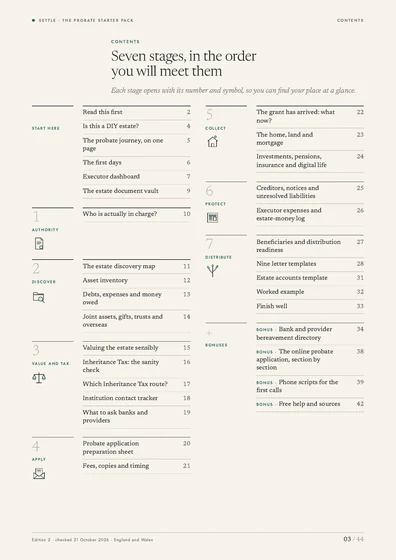
Starter Pack
£4.99
A 44-page printable toolkit to get organised and start probate yourself.
- 25-step executor checklist
- 9 ready-to-personalise letters
- Excel estate accounts workbook
Instant download · 30-day full refund
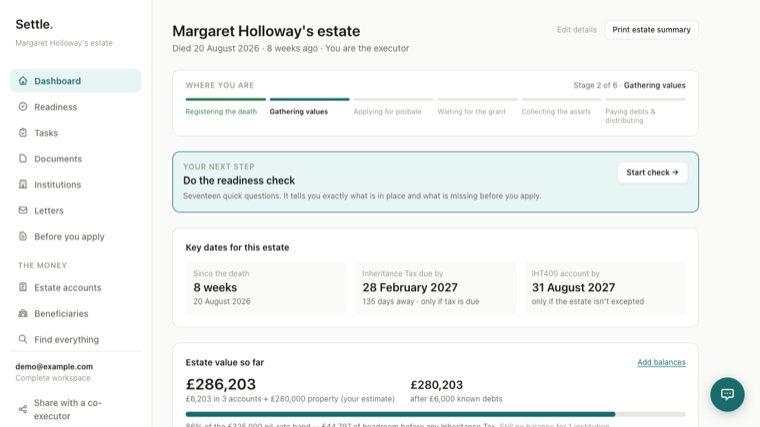
Secure Workspace
£9.99
Keep every probate task, document and deadline organised online.
- Your own secure probate Workspace
- Track tasks, organisations and deadlines
- Starter Pack included
One-off · no subscription · 30-day full refund · not legal advice