Estate Capital Gains Tax Calculator
When the estate sells a house or shares · cost = value at death · £3,000 allowance for three tax years · 24% · 60-day report date
Rules checked against HMRC helpsheet HS282 and GOV.UK on 26 November 2026 (how we check).
1. Dates
2. The asset
3. Compare: beneficiaries sell instead
Estimate only. Nothing you enter leaves this page. Private residence relief for personal representatives (section 225A) is not calculated; see below.
Loading.
How the calculator works
It follows HMRC's helpsheet HS282 for personal representatives, step by step:
- Cost. Everything the person owned passes to the personal representatives at its market value on the date of death, and that is the estate's cost. Growth during their lifetime is not taxed.
- Deductions. Selling costs such as agent's and solicitor's fees, and the cost of improvements (not repairs or decorating), come off the gain. HMRC also accepts a deduction for the costs of establishing title, either the actual cost or its published scale (Statement of Practice SP02/04).
- Allowance. Personal representatives get the full annual exempt amount, £3,000 in 2025 to 2026 and 2026 to 2027, for the period from the death to the next 5 April and for the two tax years after that. After that, none. The calculator works out which tax year the completion falls in and whether the allowance is still there.
- Rate. 24% on the taxable gain, the rate for personal representatives on all assets for disposals from 30 October 2024.
- Deadline. For a UK home with tax to pay, the report is due 60 days after completion; the estate cannot pay through the online account, and HMRC writes with how to pay. If the person lived abroad, the report is due even with no tax.
- Comparison. If the executors transfer the asset to the beneficiaries first, that transfer is not taxed. Each beneficiary takes their share at the date-of-death value and, if they sell, uses their own £3,000 allowance and pays 18% within their unused basic rate band or 24% above it. They cannot use the estate's costs of establishing title.
Worked examples
1. A house sold eleven months after the death (the default figures)
Death on 14 March 2026, house valued at £320,000, sale completing on 9 February 2027 for £345,000 with £5,200 of selling costs. Gain £19,800, less the £3,000 allowance for 2026 to 2027, leaves £16,800. At 24%, the estate pays £4,032, reported by 10 April 2027. If the two children had taken the house in equal shares and sold it themselves, each would have a gain of £9,900, taxable £6,900, and pay £1,242 at 18% or £1,656 at 24%: £2,484 to £3,312 in total.
2. The same house, sold too late for an allowance
If the sale completes on 6 April 2028, it is in 2028 to 2029, the third tax year after the year of death. The estate has no allowance left, so the whole £19,800 is taxable: £4,752.
3. Shares sold below the probate value
Shares worth £40,000 at the death are sold for £36,500. That is a £3,500 loss. There is no tax, and the loss can be set against other gains the estate makes in the administration, but it cannot be handed on to the beneficiaries.
Things the calculator cannot know
- An ascertained Inheritance Tax value. If HMRC agreed a value for Inheritance Tax, that value must be used as the cost.
- Private residence relief. Under section 225A of the Taxation of Chargeable Gains Act 1992, a sale by personal representatives can get the relief if, immediately before and after the death, the home was the main residence of people entitled as legatees to 75% or more of the net proceeds, and the personal representatives claim it.
- The beneficiaries' own tax position. The comparison assumes each beneficiary has their full allowance and no other gains in the year.
- Practical reasons to sell in the estate. Debts, Inheritance Tax or an unwilling co-owner can make a sale by the executors the only sensible route.
Sources
- HS282 Death, personal representatives and legatees (2026) — HMRC, GOV.UK (read 26 November 2026)
- Capital Gains Tax rates and allowances — HMRC, GOV.UK (read 26 November 2026)
- Report and pay Capital Gains Tax on UK property — GOV.UK (read 26 November 2026)
- Capital Gains Tax: rates — GOV.UK (read 26 November 2026)
- Tax when you sell property: work out your gain — GOV.UK (read 26 November 2026)
- Taxation of Chargeable Gains Act 1992, section 225A — legislation.gov.uk (read 26 November 2026)
Frequently asked questions
What rate of Capital Gains Tax does an estate pay?
Personal representatives pay 24% on gains from all assets sold on or after 30 October 2024, with no lower band (GOV.UK rates and allowances).
Does the estate get the £3,000 Capital Gains Tax allowance?
Yes, in full, for the tax year of death (however short) and for each of the two tax years after it. A sale in any later tax year gets no allowance (HMRC HS282).
Is the probate value the cost for Capital Gains Tax?
The cost is the asset's market value at the date of death. Where that value was ascertained for Inheritance Tax, the same figure must be used.
Can I use HMRC's Capital Gains Tax calculator for an estate?
No. GOV.UK says its property calculator cannot be used by a personal representative, which is why this one follows the HS282 rules for estates.
Facing the admin, not just the maths?
Once you know the numbers, the next job is organising the estate. Pick the level of help that suits you.

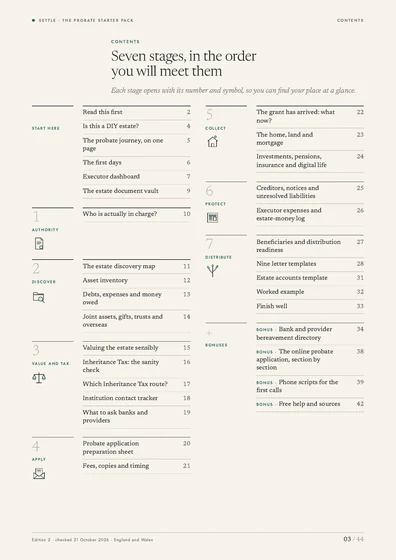
Starter Pack
£4.99
A 44-page printable toolkit to get organised and start probate yourself.
- 25-step executor checklist
- 9 ready-to-personalise letters
- Excel estate accounts workbook
Instant download · 30-day full refund
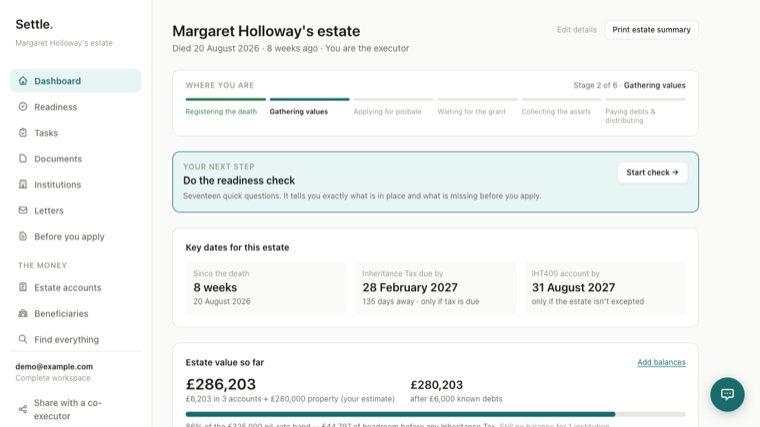
Secure Workspace
£9.99
Keep every probate task, document and deadline organised online.
- Your own secure probate Workspace
- Track tasks, organisations and deadlines
- Starter Pack included
One-off · no subscription · 30-day full refund · not legal advice