IHT35: shares sold at a loss within 12 months
Loss on sale of shares relief · listed shares, gilts, unit trusts and OEICs · overall loss across every sale · claim within 5 years of the death
Rules checked against sections 178 to 189 of the Inheritance Tax Act 1984, HMRC's Inheritance Tax Manual and form IHT35 (HMRC 08/22) on 27 November 2026 (how we check).
Quick answer
If the executors sell listed shares, gilts, unit trusts or OEICs from the estate within 12 months of the death and, taken together, the sales raise less than the probate values, they can claim the overall loss on form IHT35. Every qualifying sale in those 12 months counts, not just the losers. Buying other listed investments up to two months after the last sale reduces the relief, AIM and unlisted shares do not qualify, and if no Inheritance Tax was paid there is nothing to claim.
1. The estate
2. Every holding the executors sold
Use the contract note date and the gross proceeds before commission.
3. Purchases
4. Anything unusual?
Estimate only. Nothing you enter leaves this page.
Loading.
How the checker works
- What qualifies. Shares or securities quoted at the date of death (including on a recognised foreign exchange), UK gilts, authorised unit trusts, OEICs and common investment funds (IHTM34131; IHT35 note 3). AIM and other unlisted shares, loan notes and most unit-linked bonds do not (IHTM34011, IHTM34132). Shares in an ISA are part of the estate and count (IHTM34164).
- Overall loss. Section 179 compares the probate values of all qualifying investments the appropriate person sold within 12 months of the death with what they sold for (or the best price reasonably obtainable, if higher). Relief is the excess. Gains on some holdings reduce it, and if the total is a gain there is no relief.
- Purchases. If the executors buy qualifying investments between the death and two months after the last sale, the loss is reduced by purchases ÷ sale proceeds; if purchases equal or exceed the proceeds, it is wiped out (section 180; IHTM34212).
- Cancelled and suspended shares. Shares cancelled without replacement within 12 months count as sold for £1 (section 186A). Shares still suspended at the 12-month anniversary count as sold then at their value (section 186B).
- Tax and deadline. The tax saved is at most the relief × 40% (36% at the charity rate), never more than the tax paid. Claim within four years of the end of the 12 months, so within five years of the death (section 179(2A)).
Worked examples
1. HMRC's example (the default figures)
From IHTM34212: shares valued at £12,000 are sold within 12 months for £9,000, a £3,000 loss. Within two months the executor buys other qualifying shares for £5,000. The loss is reduced by (£5,000 ÷ £9,000) × £3,000 = £1,667, leaving £1,333 of relief, which saves up to £533 at 40%.
2. Winners cancel out losers
The executors sell a bank share holding valued at £20,000 for £14,000 and a fund valued at £30,000 for £37,000. The overall result is a £1,000 gain, so there is no relief, even though one holding fell by £6,000. Selling only the fallen holding within the year, and keeping the fund until later, would have left a £6,000 loss to claim.
3. AIM shares
A £40,000 AIM holding sold for £25,000 gives no IHT35 relief, because AIM shares do not meet HMRC's definition of listed. Check whether Business Relief applied to them instead.
What the checker does not cover
- Exchanges and appropriations. An exchange made when the investments are worth more than their probate value counts as a sale at market value (IHTM34154). Shares given to a beneficiary to meet a cash legacy count as a sale only if the legatee had to consent (IHTM34153).
- Takeovers, rights and bonus issues. The new holding is treated as the old one, with its own formula for the value of what is sold (IHTM34181 to IHTM34183).
- Beneficiaries selling. Once investments are transferred to a beneficiary, only someone actually paying the tax on them can claim (IHTM34161). IHT35 note 12 warns that relief may not be available after distribution.
- Investment managers. Purchases made by an investment manager under an investment management agreement are not purchases by the appropriate person (IHTM34213).
- Two separate claims. Executors (for the free estate) and trustees (for trust property) each work out their own overall loss (IHTM34162).
- Capital Gains Tax. After relief, the reduced value is the value at death for Capital Gains Tax (IHT35 note 11). See the estate Capital Gains Tax calculator.
The relief and form are the same in England, Wales, Scotland and Northern Ireland. Send the IHT35 to HMRC at the address printed on the form.
Sources
- Inheritance Tax: claim for relief, loss on sale of shares (IHT35) — GOV.UK (read 27 November 2026)
- Inheritance Tax Act 1984, section 179 — legislation.gov.uk (read 27 November 2026)
- Inheritance Tax Act 1984, section 180 (purchases) — legislation.gov.uk (read 27 November 2026)
- IHTM34011: Loss on sale of shares, basic conditions — HMRC (read 27 November 2026)
- IHTM34131: What are qualifying investments? — HMRC (read 27 November 2026)
- IHTM34212: Restrictions on relief for purchases — HMRC (read 27 November 2026)
- IHTM34156 and IHTM34157: Suspended and cancelled shares — HMRC (read 27 November 2026)
Frequently asked questions
What shares qualify for IHT35 relief?
Shares and securities listed on a recognised stock exchange at the death, UK gilts, unit trusts and OEICs. AIM and other unlisted shares and loan notes do not qualify.
Do I include shares sold at a profit?
Yes. Every qualifying investment sold within 12 months of the death goes on the form, not just those sold at a loss, and the relief is the overall loss.
What if the executors reinvest the money?
Buying qualifying investments between the death and two months after the last sale reduces the relief in proportion to the sale proceeds, and wipes it out if the purchases equal or exceed them.
What is the deadline for IHT35?
The sales must be within 12 months of the death, and the claim within 4 years after the end of those 12 months.
Selling investments from an estate?
Once the sales and the tax are sorted, the next job is the estate accounts and paying the beneficiaries. Pick the level of help that suits you.

Starter Pack
£4.99
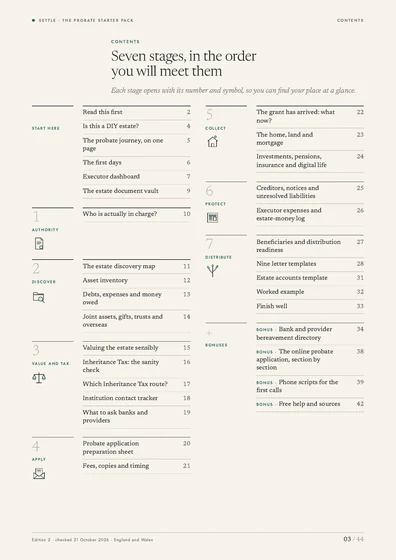
A 44-page printable toolkit to get organised and start probate yourself.
- 25-step executor checklist
- 9 ready-to-personalise letters
- Excel estate accounts workbook
Instant download · 30-day full refund
Secure Workspace
£9.99
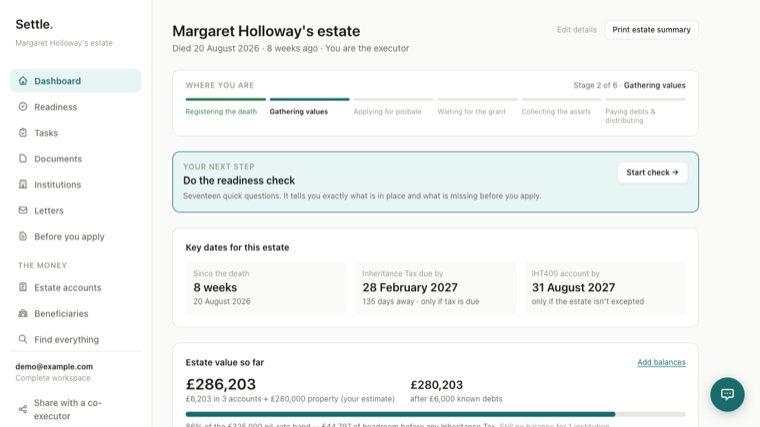
Keep every probate task, document and deadline organised online.
- Your own secure probate Workspace
- Track tasks, organisations and deadlines
- Starter Pack included
One-off · no subscription · 30-day full refund · not legal advice