Do I need to tell HMRC about a change to the estate?
Corrective account (C4) · final values or 18 months · the six changes to report sooner · excepted estates that stop qualifying
Rules checked against GOV.UK and HMRC's Inheritance Tax Manual on 27 November 2026 (how we check).
Quick answer
If you sent an IHT400, tell HMRC about changes on a corrective account (form C4) once the values are final or 18 months after the death, whichever is sooner. Before then, only tell HMRC straight away about six kinds of change, including a change in the value of land or unlisted shares, a sale at a loss, or a change of more than £50,000. If the estate was excepted and a change takes it over the nil rate band, it is no longer excepted: send a full IHT400 within 6 months of finding out.
1. The estate
2. The change
3. Does any of this apply?
2. The change
Nothing you enter leaves this page.
Loading.
How the checker works
- Estates reported on an IHT400. GOV.UK says to tell HMRC about any changes once the values are final or 18 months after the death, whichever is sooner. Before that, you only need to tell HMRC if: the value of land, buildings or unlisted shares changes; you sold land or shares at a loss; you sold assets you were paying tax on by instalments; the estate's value rises or falls by more than £50,000 before exemptions and reliefs; there was a gift with reservation or the deceased was a beneficiary of a trust; or HMRC is already carrying out further checks.
- The form. Use the corrective account, form C4 (with the C4(C) continuation sheet if needed). In Scotland, use the corrective inventory and account; form C4(S) is also used where extra confirmation is needed for assets left out or described differently.
- Paying. Work out any extra tax and make a payment on account to stop interest building up. HMRC sends final figures when it has everything.
- Excepted estates. HMRC's manual (IHTM06034) says an estate stops being excepted if a change takes the chargeable estate over the nil rate band, a deed of variation means it no longer qualifies, or (for an exempt excepted estate) a debt that was deducted is not paid. The executors must then send an IHT400 within 6 months of finding out. If a claim to a late spouse's or civil partner's unused nil rate band keeps it excepted, for deaths from 1 January 2022 you write to HMRC in England, Wales and Northern Ireland, or use form C4(S) in Scotland.
Worked examples
1. A forgotten account, nine months in (the default figures)
An IHT400 was sent; a £12,000 savings account turns up nine months after the death. None of the six triggers applies and the change is under £50,000, so there is nothing to send yet: report it on a C4 once the values are final, or 18 months after the death at the latest. If tax is due on it, a payment on account stops interest.
2. The house sells for less
The house sold for £50,000 below its probate value five months after the death. A sale of land at a loss is one of the six triggers, so tell HMRC now, and claim the relief on IHT38 if it helps. Our IHT38 checker shows whether it does.
3. An excepted estate tips over
Probate was granted on a £300,000 excepted estate. Shares worth £60,000 are found, taking it over £325,000. It is no longer excepted, so an IHT400 is due within 6 months of finding out, unless the late husband's unused nil rate band can be claimed, which keeps it excepted: then a letter to HMRC (or C4(S) in Scotland) does the job.
Things to watch
- Falls in value count too. A C4 is for paying too much as well as too little; a fall can mean a repayment.
- Clearance. Apply for a clearance certificate (IHT30) once all the tax is paid and values are settled. HMRC will not issue one while loss relief is still provisional.
- Compliance checks. If you have not heard from HMRC 14 weeks after sending the IHT400, GOV.UK says no further checks will be carried out.
- Probate is separate. A corrective account goes to HMRC at the address on the form. You do not apply for probate again for most changes; in England and Wales probate applications go to HMCTS centrally.
- Deeds of variation. A variation that changes the tax can need its own reporting. See our deed of variation guide.
Sources
- How to value an estate: telling HMRC about changes to the value of an estate — GOV.UK (read 27 November 2026)
- Inheritance Tax: corrective account (C4) — GOV.UK (read 27 November 2026)
- IHTM06034: Excepted estates, notifying amendments — HMRC (read 27 November 2026)
- IHTM33044: Loss on sale of land, provisional relief — HMRC (read 27 November 2026)
Frequently asked questions
What is form C4?
The corrective account. You use it to tell HMRC about changes after sending an IHT400, whether the estate has paid too much or too little Inheritance Tax.
When do I have to tell HMRC about a change?
Once the values are final or 18 months after the death, whichever is sooner. Some changes, such as a sale at a loss or a change of more than £50,000, should be reported straight away.
What if an excepted estate turns out to owe tax?
It is no longer excepted. HMRC's manual says the executors must send an IHT400 within 6 months of finding out.
Should I pay extra tax before HMRC replies?
GOV.UK says to work out any additional tax and make a payment on account to stop interest building up.
Keeping the estate figures straight?
Changes are easier to report when every asset and value is in one place. Pick the level of help that suits you.

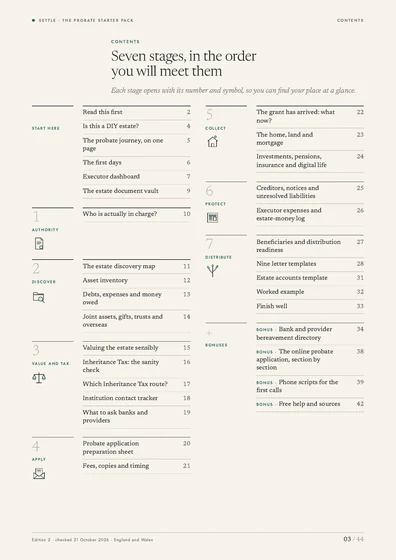
Starter Pack
£4.99
A 44-page printable toolkit to get organised and start probate yourself.
- 25-step executor checklist
- 9 ready-to-personalise letters
- Excel estate accounts workbook
Instant download · 30-day full refund
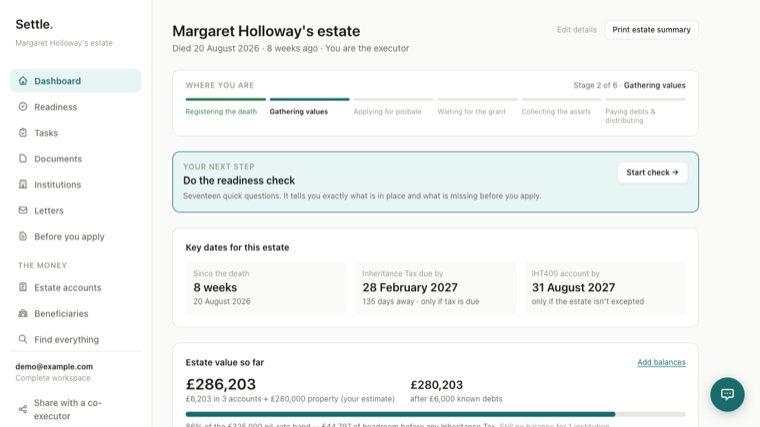
Secure Workspace
£9.99
Keep every probate task, document and deadline organised online.
- Your own secure probate Workspace
- Track tasks, organisations and deadlines
- Starter Pack included
One-off · no subscription · 30-day full refund · not legal advice