How Long Does Probate Take in 2026? A Realistic Timeline
Checked against current GOV.UK probate and Inheritance Tax guidance for England & Wales (2026/27).
Most estates follow the same rhythm: a few weeks to register the death and gather information, then the grant (usually within 12 weeks of applying), then several months to collect, pay and distribute. Simple estates can be quicker; taxable ones take longer.1
Quick answer
A straightforward estate in 2026 usually takes around 6 to 9 months from death to final distribution. A larger or complex estate — one that has to report inheritance tax on an IHT400, or sell a property — more often takes 9 to 18 months. The grant of probate itself is usually issued within 12 weeks of a complete application, but that is only one stage in a longer journey.
If you have just been asked to sort out someone's estate, one of the first things you will want to know is how long it is all going to take. It is a fair question, and an anxious one — there are often bills to pay, a house to think about, and family waiting for answers. The honest answer is that probate takes as long as the estate needs, but the good news is that the process follows a fairly predictable path. Once you understand the stages, you can see where you are, what is coming next, and roughly how long each part tends to last.
This guide walks through that journey gently, one step at a time, with realistic time ranges for 2026. Nothing here is legal advice — it is a plain-English map so you know what to expect. Where an estate is simple, things move faster; where it is larger or more complicated, each stage takes a little longer. We will point out both as we go.
Step 1 — Registering the death and the first few weeks
The timeline really begins with registering the death, which must normally be done within five days in England and Wales (unless the coroner is involved, which can pause things). When you register, you can order certified copies of the death certificate — order several, because almost every institution will want to see one. Our guide on how to register a death explains exactly how this works.
In these first two to four weeks there is no rush to apply for anything. The practical jobs are gentle ones: finding the will, securing the property, notifying the bank, and letting the main organisations know. You do not need to have everything worked out — you simply need to begin. If you would like a calm checklist for this stage, our free guide, The First Two Weeks After a Death, walks through it step by step.
Step 2 — Valuing the estate (2 to 8 weeks, sometimes longer)
Before you can apply for probate, you need a picture of what the estate is worth on the date of death — everything owned, minus everything owed. This means writing to banks, building societies, pension providers and investment platforms for date-of-death balances, and getting a valuation for any property. Our guide to estate valuation for probate explains what to include and how the date-of-death rule works.
For a simple estate — a single bank account or two and perhaps a home — you can often have the full picture within a few weeks. Where there are many accounts, shareholdings, or assets that are hard to value, it can stretch to a couple of months. The single most useful thing you can do here is write to every institution at the same time rather than one after another, because waiting for replies is usually the slowest part.
Step 3 — Dealing with inheritance tax, if it applies (this is often the longest stage)
Most estates do not pay inheritance tax, but every estate has to work out whether it needs to report it. If the estate qualifies as an "excepted estate" — broadly, a smaller or simpler estate below the reporting thresholds — you usually do not need a separate tax form and can move fairly quickly to applying for the grant. Our inheritance tax guide for executors explains the nil-rate bands and when an estate is excepted.
If the estate is larger or more complex, you will need to complete form IHT400 and send it to HMRC. HMRC then sends the code you need for the probate application, usually within 20 working days of receiving the IHT400 or any tax payment, whichever is later, and you usually need to pay some of any tax due before the grant can be issued. Valuing a taxable estate and raising the money for the tax is why it takes longer than a simple one. It is not a delay you have done anything wrong to cause; it is simply how the system works, and knowing it in advance takes away a lot of the worry.
Step 4 — Applying for the grant (usually issued within 12 weeks)
Once the estate is valued and any inheritance tax has been dealt with, you apply for the grant of probate — the legal document that proves you have authority to act. Our step-by-step guide on how to apply for probate covers the forms and documents you will need.
GOV.UK says the Probate Registry usually issues a grant within 12 weeks of receiving a complete application. Online applications tend to move a little faster than paper ones, and clean applications with no discrepancies come in at the shorter end. If the registry raises a query — a small mismatch in the will, or a missing detail — it can add several weeks, so it is worth double-checking everything before you submit. When you apply you will pay the court application fee: currently £526 for estates worth more than £5,000 (there is no fee for estates of £5,000 or less), plus £2 for each extra sealed copy of the grant ordered with the application (£16 each if ordered later). Fees do change, so please confirm the current figures on GOV.UK before you apply.
Step 5 — Collecting assets, paying debts and distributing the estate (3 to 12+ months after the grant)
The grant is a milestone, but it is not the finish line — it is the point at which the real administration can begin. With the grant in hand you can close accounts, cash in investments, sell or transfer property, settle any outstanding debts and bills, and finalise any tax. Only once everything is collected and all debts and tax are paid can the estate be distributed to the beneficiaries. Our guide on what happens after probate is granted covers these post-grant steps in full.
For a simple estate with no property, this stage can be wrapped up in three to six months. Where a property has to be sold, the timeline is largely set by the housing market and the conveyancing process, which can add several months on its own. Careful executors often wait a little before making the final payments — placing a notice for creditors and allowing time for any claims is a sensible protection, and many advisers suggest not distributing everything until around ten months after the grant. It feels slow, but it is there to protect you as much as the estate.
Realistic totals for 2026: A simple estate — valid will, no inheritance tax to report, no property to sell — commonly takes 6 to 9 months from death to final distribution. A larger or complex estate — an IHT400, a property sale, or many assets — more often takes 9 to 18 months. Contested or disputed estates can take considerably longer. These are typical ranges, not promises; every estate is different.
For every deadline on one page (Inheritance Tax, the Gazette notice, the 6-month claims window and the executor's year), see how long does probate take.
What makes probate faster — or slower
Two estates of similar size can take very different lengths of time. A few things tend to make the biggest difference:
- Whether inheritance tax has to be reported. An excepted estate skips the longest stage; an IHT400 adds months.
- Whether there is a property to sell. Property ties the timeline to the market and the conveyancing process.
- How organised the paperwork is. Finding all the accounts, policies and the original will quickly keeps things moving.
- How responsive the institutions are. Some banks reply in days, others in weeks — writing to them all at once helps.
- Whether anyone disputes the will or the estate. A dispute can pause everything until it is resolved.
You cannot control all of these, but you can control the paperwork and the order you do things in — and that is often where weeks are saved.
Not sure which of these apply to the estate you are dealing with? Take the free Settle assessment — seven questions, about two minutes, and you will get a personalised picture of what probate is likely to involve and roughly how long it may take.
For what each stage costs, from the £526 fee to sealed copies of the grant, see how much probate costs.
A gentle word on the wait
Probate can feel frustratingly slow, especially when you are grieving and just want things settled. Please try not to measure your progress against someone else's — an estate that took a neighbour three months and one that takes you a year can both be entirely normal, depending on what is involved. Much of the waiting is simply built into the system: HMRC's processing times, the registry's queue, the housing market. You are not doing anything wrong by waiting.
What helps most is knowing where you are in the journey and what comes next, so the time passing feels like progress rather than limbo. Keep a simple record of what you have done and what you are waiting on, deal with each stage as it comes, and ask for professional help if HMRC or the registry raises queries you are unsure about, if the estate involves overseas assets, or if the administration is taking much longer than you expected and you cannot see why. A good probate solicitor can often clear a blockage quickly, and that can shorten the process rather than lengthen it.
Common mistakes to avoid
- Applying before the estate is valued. Missing values and tax stall the application.3
- Distributing before the timeline is complete. Debts, tax and claims come first.2
- Expecting a fixed date. Registry queries and complex assets move the timeline.1
Frequently asked questions
How long does probate take?
The grant usually issues within 12 weeks of a complete application. A full administration typically runs 6–18 months.1
What slows probate down?
An Inheritance Tax bill, missing documents, property sales, disputes, or Registry queries about the will or valuation.4
Can I speed it up?
Value the estate accurately, deal with tax early, and submit a complete, error-free application. Online applications tend to be quicker.3
When can beneficiaries be paid?
After debts and tax are settled and any claim period has passed — often towards the end of the administration.2
Is there a deadline to apply for probate?
There is no strict deadline, but delay can cause problems with property, tax interest and beneficiaries, so it is best not to leave it.1
Sources & references
The figures and rules in this guide are drawn from the official UK government pages below. Each link opens the relevant GOV.UK page. Always confirm current figures on GOV.UK before you act, as fees and thresholds can change.
- Applying for probate — GOV.UK
- Dealing with the estate of someone who's died — GOV.UK
- How to value an estate for Inheritance Tax and report its value — GOV.UK
- How Inheritance Tax works: thresholds, rules and allowances — GOV.UK
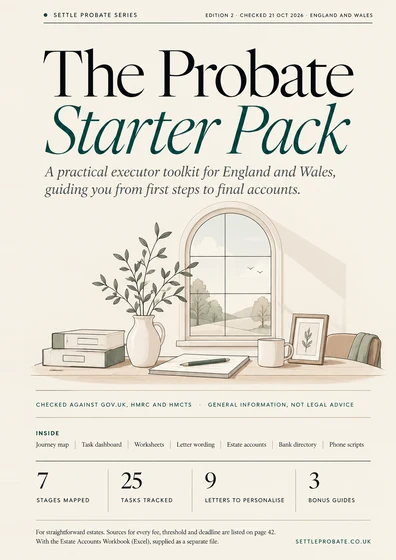
Starter Pack · £4.99 — a 44-page printable executor toolkit with a 25-step checklist, nine letters to personalise and an Excel estate accounts workbook.
See what’s inside →Free
Check what applies to this estate
Answer 7 questions and get a free probate assessment. No account needed.
Start free assessment →Secure Workspace · £9.99
Know you are ready before you apply
The Workspace's readiness check shows what is in place and what is still missing before you apply on GOV.UK, and your task list keeps everything else in order.
See how the Workspace works →