Inherited ISA allowance (APS) calculator
The extra ISA allowance a surviving spouse or civil partner gets · value at death or at closure · one limit per ISA manager · the dates to use it by
Rules checked on GOV.UK on 28 November 2026 (how we check).
Quick answer
When someone dies on or after 3 December 2014, their husband, wife or civil partner can pay extra into their own ISA on top of the normal allowance. This is the additional permitted subscription (APS). For deaths from 6 April 2018 it equals the higher of the ISAs' combined value at the date of death and their combined value when they stopped being a "continuing account of a deceased investor", worked out separately for each ISA manager. Cash must go in within 3 years of the death, or 180 days after the estate's administration is complete if that is later. You must have been living together when they died.
1. The death
2. Their ISAs
Give each ISA manager a number. ISAs with the same manager share one allowance. Leave the closing value blank if the ISA is still open.
3. Dates for the deadlines (optional)
Nothing you enter leaves this page. The example figures are illustrations, not HMRC's.
Loading.
How the calculator works
An ISA cannot be left to anyone as an ISA: the investments or cash pass under the will or intestacy like anything else, and count towards the estate for Inheritance Tax. What a surviving spouse or civil partner inherits is an allowance. GOV.UK's guidance for ISA managers sets the rules, and the calculator follows them in this order.
- Was there a qualifying death? GOV.UK: "You cannot inherit someone's ISA allowance if they died before 3 December 2014." The deceased and the survivor "must have been living together at the date of death", which excludes a separation under a court order or a deed of separation, or where the relationship had broken down.
- Which values count? For a death between 3 December 2014 and 5 April 2018, the ISA ended on the date of death and the allowance is up to its value then. For a death on or after 6 April 2018, the ISA became a "continuing account of a deceased investor" and stays tax-free until it is closed. The allowance is the value at death or the value when it ceased to be a continuing account, "whichever is the higher".
- One limit per manager. If the deceased had ISAs with several managers, the survivor has a separate allowance with each. Where one manager held more than one ISA, the limit is based on their combined values, and GOV.UK says it "should not be worked out using a mix of account values". So the calculator compares the total at death with the total at closure and takes the higher total, never the best value of each account.
- Deadlines. Cash must be paid in within 3 years of the death or, if later, 180 days after the administration of the estate is complete. Shares or funds passed to the survivor can be paid in "in specie" within 180 days of being distributed, and each staged distribution gets its own 180 days.
The calculator does not ask for anyone's name or account numbers and sends nothing anywhere. If a closing value is not known yet, it shows the value at death as the allowance so far, because the final figure can only be the same or higher.
Worked examples
These are our illustrations of GOV.UK's rules, using the calculator's default figures (death on 10 March 2025).
1. Two ISAs with the same manager: no mixing
Manager 1 held a stocks and shares ISA worth £50,000 at death and £46,000 when it closed, and a cash ISA worth £10,000 at death and £10,500 at closure. The totals are £60,000 at death and £56,500 at closure, so the allowance with manager 1 is £60,000. Picking the best of each account (£50,000 plus £10,500 = £60,500) is the "mix of account values" GOV.UK rules out.
2. A cash ISA that grew after the death
Manager 2 held a cash ISA worth £20,000 at death. Interest kept being added tax-free while it was a continuing account, and it was worth £20,600 when the executors closed it. The allowance with manager 2 is £20,600. Together with manager 1 the survivor can add £80,600 to their ISAs, on top of their normal allowance.
3. When the deadline moves
With a death on 10 March 2025, cash can go in until 10 March 2028. If the administration is not completed until 1 December 2027, 180 days after that is 29 May 2028, which is later, so the deadline becomes 29 May 2028. If the administration finishes on 20 January 2026, 180 days after that (19 July 2026) is earlier than the third anniversary, so 10 March 2028 still applies.
Things to know
- You do not have to inherit the ISA money. GOV.UK: the allowances "are available whether or not the surviving spouse or civil partner inherited the deceased's ISA assets". If the ISA went to the children under the will, you can still pay in your own money up to the limit.
- Choose the manager carefully. You can use the deceased's manager or another manager that agrees to accept the subscription. After the first payment, the rest of that manager's allowance has to go to the same manager: "Any unused balance cannot be used with another manager." Once paid in, you can transfer under the normal ISA rules.
- Lifetime and Junior ISAs. An APS cannot be made to or from a Junior ISA. It can go into a Lifetime ISA only if you are UK resident and under 50, and it counts towards the £4,000 Lifetime ISA limit for the year.
- What the manager will ask for. The deceased's full name, address at death, date of birth, date of death, National Insurance number if known, the date of your marriage or civil partnership and who managed their ISA, plus your declarations that you were living together and are claiming under the rules.
- Tax-free for a limited time. For deaths from 6 April 2018 GOV.UK says the ISA investments "form part of their estate but stay tax-free until it's closed", which happens when the executor closes it, when the administration is completed, or three years after the death.
- Inheritance Tax still applies. The ISA's value at death is part of the estate. GOV.UK: there is normally no Inheritance Tax if everything above the £325,000 threshold goes to a spouse, civil partner or charity. Left to anyone else, it counts towards the threshold. Use the Inheritance Tax calculator.
- Getting the money out. Most ISA managers want a death certificate and, above their own limit, the grant of probate before releasing the investments. See do you need probate for an ISA and our bank thresholds.
ISA rules are UK-wide, so this applies in Scotland and Northern Ireland too. Probate is called confirmation in Scotland: see applying for confirmation.
Sources
- How to manage additional permitted subscriptions — GOV.UK (HMRC), updated 6 April 2024 (read 28 November 2026)
- Inheritance Tax — GOV.UK (read 28 November 2026)
- Individual Savings Accounts: inheriting an ISA from your spouse or civil partner — GOV.UK (read 28 November 2026)
Frequently asked questions
What happens to an ISA when someone dies?
For deaths from 6 April 2018 it becomes a continuing account of a deceased investor: it stays tax-free until it is closed, the administration is completed or three years pass. It is part of the estate for Inheritance Tax, and a surviving spouse or civil partner gets an extra ISA allowance.
How much is the additional permitted subscription?
The higher of the ISAs' combined value at the date of death and their combined value when they stopped being continuing accounts, worked out separately for each ISA manager. For deaths from 3 December 2014 to 5 April 2018 it is the value at death.
Do you need probate to use a spouse's ISA allowance?
No. The allowance is available whether or not you inherit the ISA itself, and you can pay in your own money. The ISA manager may still need the grant before releasing the deceased's investments.
How long do you have to use an inherited ISA allowance?
Cash must go in within 3 years of the death, or 180 days after the administration of the estate is complete if that is later. Shares passed to you can go in within 180 days of being distributed.
Closing ISAs and bank accounts for an estate?
Letters, a valuation tracker and a checklist for every account. Pick the level of help that suits you.

Starter Pack
£4.99
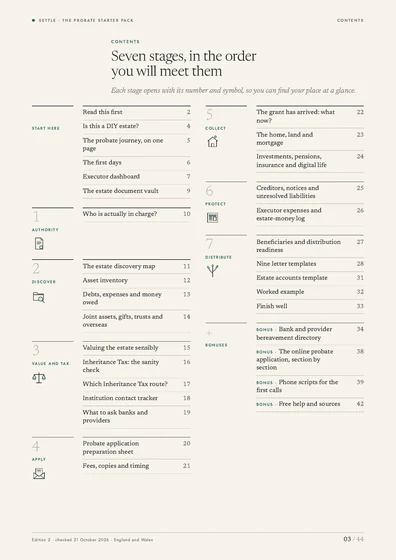
A 44-page printable toolkit to get organised and start probate yourself.
- 25-step executor checklist
- 9 ready-to-personalise letters
- Excel estate accounts workbook
Instant download · 30-day full refund
Secure Workspace
£9.99
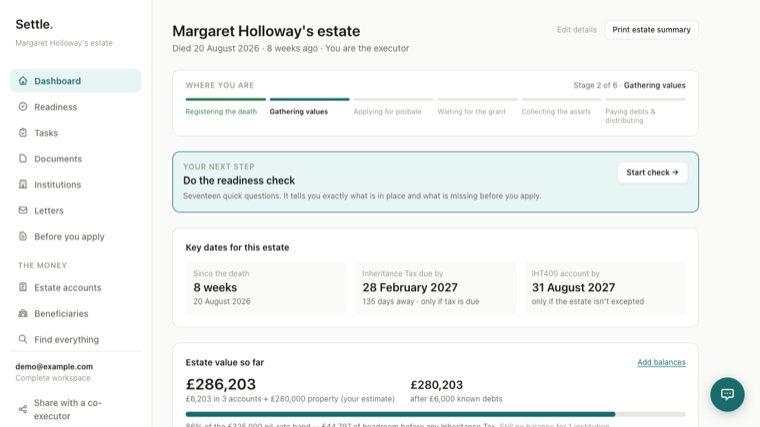
Keep every probate task, document and deadline organised online.
- Your own secure probate Workspace
- Track tasks, organisations and deadlines
- Starter Pack included
One-off · no subscription · 30-day full refund · not legal advice