What Happens to an ISA When Someone Dies?
Checked against current GOV.UK probate and Inheritance Tax guidance for England & Wales (2026/27).
- The ISA stays free of income tax and CGT after death until the estate is settled, the account closes or 3 years pass (whichever is first), but the money still forms part of the estate for inheritance tax.1
- A surviving spouse or civil partner can claim an Additional Permitted Subscription (APS) equal to the ISA value.1
- The ISA value counts towards the estate for Inheritance Tax, though spousal transfers are usually exempt.2
- Whether the provider needs probate depends on the balance and their own threshold.3
An ISA does not automatically pass tax-free to family. Its tax-free status ends, but a surviving spouse or civil partner can claim an Additional Permitted Subscription (APS) worth the ISA's value, so the tax shelter is not lost.1
Quick answer
After death the ISA keeps its income tax and CGT exemption as a 'continuing account' until the estate is settled, the account closes or 3 years pass, whichever comes first, but the assets form part of the estate and can be subject to inheritance tax like any other asset. A surviving spouse or civil partner can claim an Additional Permitted Subscription (APS): an extra ISA allowance equal to the higher of the ISA's value at death and its value when it stops being a continuing account.
Many people assume that because an ISA is tax-free during life, it is also tax-free on death. This is a common misconception. The income tax and CGT exemption carries on for a while after death, but the ISA is part of the estate in the normal way for inheritance tax. This guide explains what actually happens, what the Additional Permitted Subscription means for surviving spouses, and how executors should deal with ISAs in practice.
What happens to the ISA's tax-free status at death
For deaths on or after 6 April 2018, the ISA becomes a 'continuing account of a deceased investor'. Interest, dividends and gains inside it stay free of income tax and CGT until the earliest of: the administration of the estate being completed, the account being closed, or the third anniversary of the death. After that, any further income is taxable as estate income. The ISA provider continues to hold and administer the account in the meantime, and the ISA's value still counts towards the estate for inheritance tax.
The assets held inside the ISA form part of the deceased's estate. They are subject to inheritance tax in the same way as any other asset, and must be included in the estate valuation submitted to HMRC.
Inheritance tax on ISA assets
There is no special inheritance tax treatment for ISAs. The full value of the ISA at the date of death is included in the taxable estate. If the total estate exceeds the nil-rate band (currently £325,000 per person, or up to £500,000 with the residence nil-rate band for qualifying estates), inheritance tax at 40% applies to the amount above the threshold.
The spousal exemption applies as normal: if the ISA passes to a surviving spouse or civil partner, whether through the will or intestacy, no inheritance tax is due on that transfer. See our guide to inheritance tax for a full explanation of the thresholds and reliefs available.
The Additional Permitted Subscription
Although ISA assets are subject to inheritance tax in the same way as other assets, surviving spouses and civil partners benefit from a valuable concession: the Additional Permitted Subscription (APS). This allows the surviving spouse or civil partner to invest an amount equal to the value of the deceased's ISA into their own ISA, without this counting toward their annual ISA allowance (which is currently £20,000 per year).
The APS is a subscription allowance, not a direct transfer of assets. The surviving spouse does not have to move the actual assets – they can invest their own money in the APS amount. The effect is that the surviving spouse can maintain a larger ISA portfolio than would otherwise be possible under the annual allowance alone.
How to claim the APS
The APS must be claimed from the ISA provider within three years of the date of death, or within 180 days of the completion of the administration of the estate, whichever is later. This deadline is firm – if you miss it, the allowance is lost. The ISA provider will have an APS claim form. You will need to provide the death certificate and confirm the value of the ISA at the date of death.
The APS can be used with the same ISA provider as the deceased or a different one – the surviving spouse can choose which provider to use for their additional subscription. This flexibility is useful if the survivor wants to consolidate ISAs or move to a more suitable product.
How executors should deal with ISAs
As executor, your responsibilities regarding ISAs are as follows:
- Notify the provider: write to the ISA provider as soon as possible after death, enclosing a death certificate. Most major platforms have a bereavement team. The provider will note the death and explain their process.
- Obtain a date-of-death valuation: the ISA must be valued as at the date of death for the estate valuation and IHT form. For cash ISAs this is straightforward. For stocks and shares ISAs, the provider will calculate the market value of the holdings at the date of death.
- Include the ISA in the estate valuation: the full value of all ISAs held by the deceased must be included in the estate accounts and on the IHT form submitted to HMRC.
- Do not sell holdings until probate is granted: you do not have authority to instruct the sale of stocks and shares ISA holdings until the Grant of Probate has been obtained. Attempting to sell without the grant can create legal complications.
- Close the ISA and pay proceeds to the estate: once probate is granted, provide the grant to the ISA provider and instruct them to close the account. The proceeds are paid into the estate account and distributed to beneficiaries in the normal way.
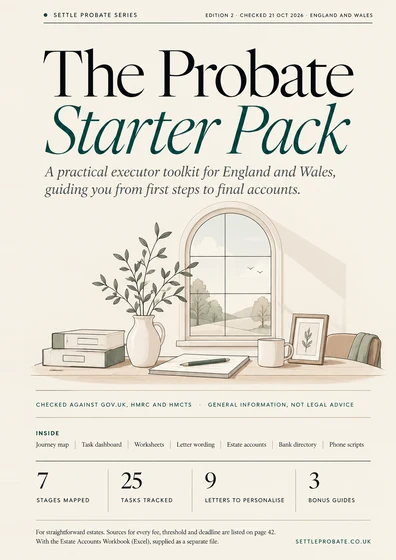
For each ISA provider, template 2 in the Probate Starter Pack is a letter asking for the value of the holdings at the date of death, any income or dividends since, and what the provider needs before it can sell or transfer them.
Cash ISAs
Cash ISAs are straightforward to deal with. The provider holds the cash during the administration period, continues to pay the ISA rate, and closes the account and transfers the balance once you provide the grant of probate. The process is similar to closing a standard bank savings account.
Stocks and Shares ISAs
Stocks and shares ISAs require a little more care. The investments must be valued at the date-of-death market price for the estate valuation – for quoted shares this is the "quarter-up" price: the lower closing price plus a quarter of the gap to the higher one. The ISA provider will usually provide this valuation on request.
Once probate is granted, you can instruct the provider to sell the holdings and pay cash into the estate account, or – if the will or intestacy rules mean the beneficiary will receive the ISA proceeds directly – you may be able to transfer holdings "in specie" (without selling). Check with the provider whether in-specie transfer to a beneficiary's own account is possible.
For detailed guidance on how shares and investment portfolios are handled more generally in an estate, see our guide to shares and investments after death.
Dealing with investment platforms
All major investment platforms – including Hargreaves Lansdown, Vanguard, AJ Bell, and Fidelity – have dedicated bereavement teams. The process is broadly the same for each: write to the bereavement team with a death certificate, wait for the account to be noted and valued, then provide the grant of probate to authorise closure. Most platforms accept documents by post; some now accept certified copies electronically.
Allow plenty of time. ISA platforms are thorough in their bereavement procedures, and the process from notification to closure typically takes six to twelve weeks. Factor this into your estate administration timeline.
Lifetime ISAs and Junior ISAs
Lifetime ISAs (LISAs) and Junior ISAs (JISAs) have slightly different rules on death. A LISA can be closed without the 25% government withdrawal charge if the account holder dies – contact the provider for their specific process. A JISA becomes the child's own account when they turn 18; if the child dies before 18, the JISA is closed and the proceeds paid to the estate.
Not sure how ISAs and other assets affect whether probate is needed? Take the free Settle assessment – it considers the full picture and gives you a clear next-steps summary.
See also our guide to executor duties for a full overview of the estate administration process, and our guide to closing bank accounts after death for how other financial accounts are handled.
Common mistakes to avoid
- Missing the APS deadline. The allowance has time limits — claim it with the provider in good time.1
- Assuming ISAs are Inheritance-Tax-free. They are not; only the income-tax and capital-gains shelter is special.2
- Forgetting to claim continuing tax relief. Providers can offer a 'continuing ISA' status until the estate is settled.
Frequently asked questions
Does an ISA pass tax-free when someone dies?
The ISA's own tax shelter ends, and the value forms part of the estate. But a surviving spouse or civil partner can claim an Additional Permitted Subscription to keep an equivalent amount sheltered.1
What is the Additional Permitted Subscription?
It is a one-off extra ISA allowance for a surviving spouse or civil partner, equal to the value of the deceased's ISA, on top of their normal annual allowance.1
Is an ISA subject to Inheritance Tax?
Yes, its value is part of the estate. Transfers to a spouse or civil partner are normally exempt from Inheritance Tax.2
Do I need probate to access an ISA?
It depends on the provider's threshold. Larger ISAs generally need the grant before the money is released.3
What happens to a Stocks and Shares ISA?
The investments can be sold or transferred to the estate. The APS can be taken as cash or, with some providers, in specie (as the investments themselves).1
Sources & references
The figures and rules in this guide are drawn from the official UK government pages below. Each link opens the relevant GOV.UK page. Always confirm current figures on GOV.UK before you act, as fees and thresholds can change.
- Individual Savings Accounts (ISAs): If you die — GOV.UK
- How Inheritance Tax works: thresholds, rules and allowances — GOV.UK
- Dealing with the estate of someone who's died — GOV.UK
Starter Pack · £4.99 — a 44-page printable executor toolkit with a 25-step checklist, nine letters to personalise and an Excel estate accounts workbook.
See what’s inside →Free
Check what applies to this estate
Answer 7 questions and get a free probate assessment. No account needed.
Start free assessment →Secure Workspace · £9.99
Keep every value in one place
Record each balance at the date of death, the property estimate and known debts. The Workspace adds them up into an estate value, an Inheritance Tax allowance estimate and the probate fee.
See how the Workspace works →