How to Stop the State Pension and Benefits After a Death
Checked against current GOV.UK probate and Inheritance Tax guidance for England & Wales (2026/27).
- Use Tell Us Once to notify DWP and stop the State Pension and benefits.1
- Payments made after the date of death are overpayments and must be repaid.2
- A surviving spouse or partner may be entitled to Bereavement Support Payment or an inherited pension amount.3
- Notify promptly to keep any overpayment small and easy to settle.1
Tell the DWP quickly so the State Pension and any benefits stop — Tell Us Once does this in one step. Overpayments after the date of death have to be repaid from the estate, so the sooner you notify, the less there is to unpick.1
When someone dies, their state pension and any benefits they were receiving must be stopped immediately. Payments made after the date of death are overpayments that the estate will be required to repay. Acting quickly reduces the risk of overpayments building up. This guide explains what to cancel, who to contact, and what surviving spouses may be entitled to receive.
The Urgency: Why Speed Matters
State pension is paid weekly in arrears. This means the DWP pays at the end of each week for the week just passed. If the death is not reported quickly, payments can continue for several weeks before being stopped, and every payment made after the date of death must be repaid.
Aim to notify the DWP within a few days of the death. This is one of the most time-sensitive tasks in the first week.
Tell Us Once
If Tell Us Once was used when registering the death, the DWP will have been notified automatically. Tell Us Once is offered by most register offices at the point of registration and covers a wide range of government departments including the DWP and local council.
Even if Tell Us Once was used, it is worth following up with the DWP directly to confirm that payments have been stopped and to ask about any overpayment position.
If Tell Us Once Was Not Used
Contact the DWP Bereavement Service directly: 0800 151 2012 (Welsh language 0800 731 0453; Monday to Friday, 8am to 6pm). This is a free call. For questions about the State Pension itself, the Pension Service is on 0800 731 0469 (Monday to Friday, 8am to 6pm). The DWP can notify multiple benefits in a single call, which is more efficient than contacting each benefit separately.
Have the following ready when you call:
- The deceased's National Insurance number
- The date of death
- The deceased's date of birth and address
- Your name and relationship to the deceased
- Details of any benefits you know they were receiving
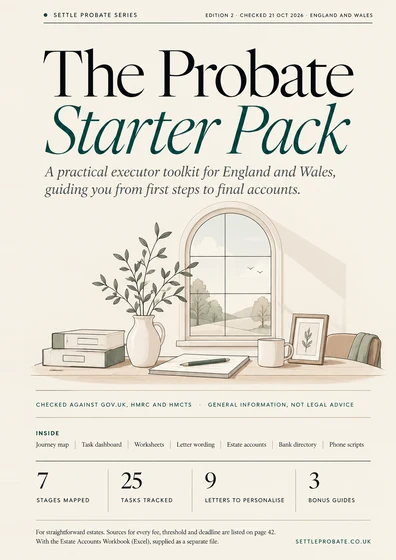
If you are phoning yourself, Bonus 3 in the Probate Starter Pack includes a script for the call to the DWP Bereavement Service (0800 151 2012), including asking whether an overpayment is likely so you can keep money back for it.
Benefits to Cancel
The DWP handles most central government benefits, but some must be notified separately:
| Benefit | Who to notify |
|---|---|
| State pension | DWP (via Tell Us Once or bereavement line) |
| Pension credit | DWP |
| Universal credit | DWP |
| Employment and Support Allowance (ESA) | DWP |
| Personal Independence Payment (PIP) | DWP |
| Disability Living Allowance (DLA) | DWP |
| Housing benefit | Local council (notify separately) |
| Council tax support/reduction | Local council (notify separately) |
| Attendance allowance | DWP |
The local council must be contacted separately for housing benefit and council tax support, even if Tell Us Once was used for central government benefits.
Dealing With Overpayments
An overpayment occurs when the DWP or a local council continues to pay a benefit after the date of death. These payments must be returned, and they are treated as a debt of the estate. This means they are paid from estate funds before any distribution to beneficiaries.
The DWP will write to the executor (or the next of kin) to confirm the overpayment and request repayment. Do not ignore these letters. The overpayment is a liability that must appear in the estate accounts.
In practice, where payments were made directly into a bank account and the bank has frozen the account on notification of death, the DWP may be able to recover overpayments directly from the bank. If funds have already been withdrawn, the position is more complicated.
What the Surviving Spouse May Be Entitled To
Losing a spouse can affect their own benefit entitlements, and there may be payments the surviving spouse can claim. The main ones are:
Bereavement Support Payment (BSP)
BSP replaced the old bereavement allowance and widow's payment in 2017. It is available to surviving spouses or civil partners who are under state pension age when their partner dies, where the deceased had paid enough National Insurance contributions.
BSP is paid in two parts: a lump sum followed by up to 18 monthly payments. The amount depends on whether the survivor has dependent children. Claims must be made within 3 months of the death to receive the full amount, and no later than 21 months after the death.
Inherited State Pension
Surviving spouses and civil partners may be able to inherit part of the deceased's state pension, depending on when each person reached state pension age and when they married or formed a civil partnership. The rules differ between the old (pre-2016) and new (post-April 2016) state pension systems.
Under the new state pension, the amount that can be inherited is more limited than under the old system. The DWP will write to the surviving spouse setting out what they will receive.
Older Bereavement Benefits (Pre-2017)
For deaths before 6 April 2017, different rules applied. Widow's pension and bereavement allowance were available to surviving spouses in certain circumstances. If dealing with an older estate or a claim relating to a death before 2017, contact the DWP directly to establish what may be available.
Step-by-Step: What Executors Should Do
- Days 1 to 3: Confirm whether Tell Us Once was used when registering the death. If not, call the DWP bereavement line immediately.
- Within the first week: Contact the local council to notify them of the death and cancel any housing benefit or council tax support.
- Within two weeks: Request written confirmation from the DWP that all benefits have been cancelled and ask for details of any overpayment.
- Before distributing the estate: Confirm that any overpayment debt has been repaid and record it in the estate accounts.
- Advise the surviving spouse: Ensure they are aware of Bereavement Support Payment and that they need to claim it within three months to receive the maximum amount.
Common Mistakes to Avoid
- Assuming Tell Us Once covers everything: It notifies the DWP, but not the local council, and does not resolve overpayments automatically.
- Delaying notification: Every week of delay can result in another week of overpayment that the estate must repay.
- Forgetting Bereavement Support Payment: This is a time-sensitive claim. If the surviving spouse is under state pension age, they need to claim within three months for the full entitlement.
- Not recording overpayments in the estate accounts: Any repayment to the DWP is a debt of the estate and must appear in the accounts before beneficiaries receive anything.
Find out exactly what you need to do
The free Settle assessment gives you a personalised checklist of every task, in the right order.
Start free assessmentFrequently asked questions
How do I stop the State Pension after a death?
Tell the DWP, most easily through Tell Us Once when you register the death, which stops the pension and other benefits in one step.1
What happens to pension paid after the death?
Payments covering time after the date of death are overpayments and must be repaid to the DWP from the estate.2
Is there any bereavement help?
A surviving spouse or civil partner under State Pension age may qualify for Bereavement Support Payment.3
Does Tell Us Once cover the pension?
Yes. It notifies the DWP along with HMRC, DVLA and the council, so you do not have to contact each separately.1
Can a spouse inherit any State Pension?
Depending on the pension type and when they reached State Pension age, a surviving spouse may inherit an additional amount — check with the Pension Service.3
Sources & references
The figures and rules in this guide are drawn from the official UK government pages below. Each link opens the relevant GOV.UK page. Always confirm current figures on GOV.UK before you act, as fees and thresholds can change.
- Tell Us Once — GOV.UK
- What to do when someone dies: step by step — GOV.UK
- Bereavement Support Payment — GOV.UK
Starter Pack · £4.99 — a 44-page printable executor toolkit with a 25-step checklist, nine letters to personalise and an Excel estate accounts workbook.
See what’s inside →Free
Not sure probate is needed yet?
Answer 7 questions and get a free probate assessment. No account needed.
Start free assessment →Secure Workspace · £9.99
Send the letters, then track every bank
Your Workspace fills in a notification letter for each bank with the estate's details, and keeps a record of who you have contacted, what is still outstanding and each balance at the date of death.
See how the Workspace works →