Scottish Legal Rights Calculator
Spouse or civil partner: one third or one half of the moveable estate · children (legitim): one third or one half, shared equally · will or legal rights, not both
Rules checked against the Succession (Scotland) Act 1964 and the Scottish Government's "What to do after a death in Scotland" on 27 November 2026 (how we check).
Quick answer
In Scotland, even with a will, a husband, wife or civil partner can claim one third of the moveable estate if there are children, or one half if not. The children can claim legitim: one third between them if there is a spouse, one half if not. Moveable estate means money, shares, cars, furniture and the like; land and buildings are not included. Claiming legal rights means giving up what the will leaves you.
1. Family
2. The estate
Leave out land and buildings: they are heritable and outside legal rights.
3. What the will gives (optional)
Estimate only. Nothing you enter leaves this page.
Loading.
How the calculator works
- The fund. Legal rights are calculated on the net moveable estate (section 10(2), Succession (Scotland) Act 1964). "The moveable estate can include things like money, shares, cars, furniture and jewellery"; the heritable estate "covers land and buildings".
- Spouse or civil partner. "one third of the moveable estate if the person who died left children or descendants of children"; "one half of the moveable estate if the person who died left no children or descendants of children."
- Children. "one third of the moveable estate between them if the person who died left a spouse or civil partner"; "one half of the moveable estate if the person who died did not leave a spouse or civil partner." "Each child has an equal claim." A late child's own children can claim in their place by representation.
- The choice. "If someone has rights under a will and legal rights, he or she cannot have both. Such a person must choose between them." The calculator compares the two where you enter the will's gifts.
This tool is for estates with a will. With no will, the spouse's prior rights (the home up to £473,000, furnishings up to £29,000 and £50,000 or £89,000 in cash) come first; the intestacy calculator handles that.
Worked examples
1. Second marriage, children left out (the default figures)
£180,000 of moveable estate, a widow and two children, and a will that leaves the children nothing. Legitim is one third, £60,000, so £30,000 each. The widow's own legal right would be £60,000, less than the £120,000 the will gives her in moveable gifts, so she keeps to the will.
2. No spouse, three children
A widower leaves £90,000 of moveable estate to a charity. With no spouse, legitim is one half: £45,000, or £15,000 for each of his three children if they all claim. The charity keeps the rest, and any house.
3. Married, no children
A wife leaves her £100,000 of savings to her sister. Her husband can claim one half, £50,000, instead of anything the will gives him.
Where to be careful
- Sorting heritable from moveable. A house is heritable; the money from a house sold before the death is moveable. Get it right before working out claims.
- Some children claim, some don't. The split can then change, and lifetime gifts to a child can matter. Take advice.
- Grandchildren. The calculator treats a late child's family as one share; the grandchildren divide it.
- Where the person lived. Legal rights apply to people who lived in Scotland. Elsewhere in the UK, see contesting a will.
Sources
- What to do after a death in Scotland (2016), section 20: Legal rights — gov.scot (read 27 November 2026)
- What to do after a death in Scotland (2016), section 23: Where the person left a will — gov.scot (read 27 November 2026)
- Succession (Scotland) Act 1964, section 10 — legislation.gov.uk (read 27 November 2026)
- Succession (Scotland) Act 1964, section 8 (prior rights in the dwelling house) — legislation.gov.uk (read 27 November 2026)
- Succession (Scotland) Act 1964, section 9 (prior right to financial provision) — legislation.gov.uk (read 27 November 2026)
Frequently asked questions
What is legitim in Scotland?
The children's legal right to part of a parent's moveable estate: one third between them if there is a surviving spouse or civil partner, one half if not. Each child has an equal claim.
Can a will override legal rights in Scotland?
No. A will cannot take legal rights away, but someone who has rights under a will and legal rights must choose between them (gov.scot).
Are legal rights paid out of the house?
No. Legal rights come only from the moveable estate, such as money, shares, cars, furniture and jewellery. Land and buildings are heritable and are not included.
What does a spouse get under legal rights?
One third of the moveable estate if the person who died left children or their descendants, or one half if not.
Dealing with an estate in Scotland?
Once you know who can claim, the next job is organising the estate. Pick the level of help that suits you.

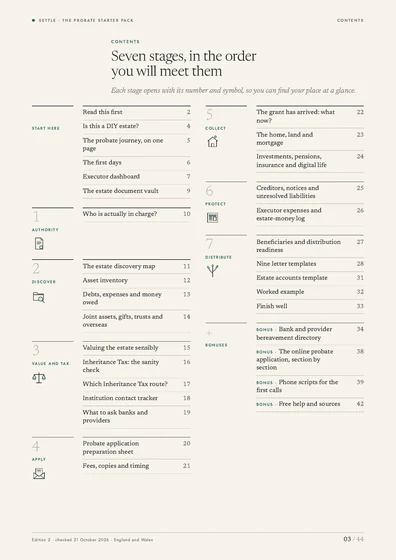
Starter Pack
£4.99
A 44-page printable toolkit to get organised and start probate yourself.
- 25-step executor checklist
- 9 ready-to-personalise letters
- Excel estate accounts workbook
Instant download · 30-day full refund
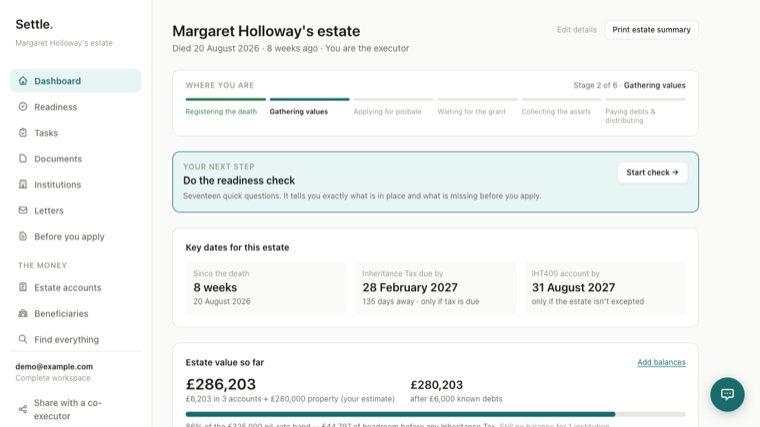
Secure Workspace
£9.99
Keep every probate task, document and deadline organised online.
- Your own secure probate Workspace
- Track tasks, organisations and deadlines
- Starter Pack included
One-off · no subscription · 30-day full refund · not legal advice