Residence nil-rate band downsizing calculator
For a home sold, given away or swapped for a cheaper one on or after 8 July 2015 · HMRC's own steps · claim on form IHT435
Rules checked on legislation.gov.uk and the HMRC Inheritance Tax Manual on 28 November 2026 (how we check).
Quick answer
If someone sold their home, gave it away or moved somewhere cheaper on or after 8 July 2015, their estate can still get some or all of the residence nil-rate band (up to £175,000) it lost by the move. The extra amount, the downsizing addition, is the lower of the band lost and the value of other assets left to children, grandchildren or other direct descendants. HMRC's example: a £500,000 house swapped for a £105,000 flat gives an addition of £70,000, restoring the full £175,000. Executors must claim it on form IHT435.
1. The death
2. The former home
3. What they left
Nothing you enter leaves this page. The example figures are HMRC's own (IHTM46063, example 1).
Loading.
How the calculator works
The residence nil-rate band normally needs a home in the estate that passes to direct descendants. The downsizing rules in sections 8FA to 8FE of the Inheritance Tax Act 1984 replace band lost because the person sold or gave away a home, or moved to a cheaper one, on or after 8 July 2015. HMRC says they are "not designed to replace RNRB that has been lost because a residential property interest in the estate on death is not closely inherited". The calculator follows HMRC's steps in IHTM46062 and IHTM46065:
- Allowance on death. The residence band for the tax year of death (£100,000 in 2017-18, £125,000 in 2018-19, £150,000 in 2019-20, £175,000 from 2020-21), plus any band brought forward from a late spouse or civil partner. If the estate is over £2,000,000, it falls by £1 for every £2 above that.
- Former allowance. The band in force when the sale or gift completed, plus any brought-forward band the person would have had then, plus any increase in that brought-forward band by the death. For a sale between 8 July 2015 and 5 April 2017 the band is treated as £100,000 and the brought-forward part as nil.
- Percentage lost. The former home's value as a percentage of the former allowance (capped at 100%), less the home at death as a percentage of the allowance on death (capped at 100%). With no home at death, the second figure is nil.
- Lost relievable amount. That percentage times the allowance on death.
- Downsizing addition. The lower of the lost amount and the value of other assets (not the home) left to direct descendants. It is added to any band on the home itself.
Values are the person's own share. Use the value of the former home when the sale or gift completed, and for the home at death GOV.UK says to use "the open market value of the home, less any debts such as a mortgage".
HMRC also has an online RNRB calculator that partly completes form IHT435. This page shows each step of the working, so you can check a figure, compare scenarios or see why an estate gets nothing.
Residence nil-rate band by tax year
| Tax year | Band | Used for |
|---|---|---|
| 8 July 2015 to 5 April 2017 | £100,000 | Treated amount for a sale or gift in this period (s.8FE(6)) |
| 2017 to 2018 | £100,000 | Deaths, sales and gifts in the year |
| 2018 to 2019 | £125,000 | Deaths, sales and gifts in the year |
| 2019 to 2020 | £150,000 | Deaths, sales and gifts in the year |
| 2020 to 2021 onwards | £175,000 | HMRC's manual gives £175,000 up to 2027-28 |
The £2,000,000 taper threshold applies to the estate after debts but before reliefs and exemptions. The calculator stops at deaths on 5 April 2028 because the band for later years has not been set.
Worked examples from HMRC's manual
1. Downsizing to a flat (the default figures)
In May 2018 Maurice moved from a £500,000 house to a flat worth £105,000 when he died in September 2020. He left the flat to his son and £200,000 to his daughters. Former allowance £125,000; £500,000 is 400% of that, capped at 100%. The flat is 60% of £175,000. 100% less 60% is 40%, and 40% of £175,000 is £70,000. The daughters' £200,000 covers it, so the addition is £70,000 and the total band is £175,000. Had the daughters received only £50,000, the addition would be £50,000 and the total £155,000.
2. No home at death
Jason sold a £90,000 flat in May 2019 to move in with his daughter and died in January 2021, leaving £600,000 to her. £90,000 is 60% of the £150,000 band in 2019-20, and 60% of £175,000 is £105,000: the addition.
3. The home goes to a husband
Mrs Clarke's half of a £300,000 house was sold in March 2016. She died in December 2019, leaving her half of a flat (£105,000) to her husband and £80,000 to her step-daughter. The 2016 sale uses the treated £100,000; £150,000 is capped at 100%; the flat is 70% of £150,000; the addition is 30% of £150,000, £45,000. Of her £150,000 allowance, £105,000 is unused and can pass to her husband's estate.
4. A widow who moved into care
Sam's husband died in July 2017 without using his band. She sold her home for £104,000 in July 2019 and died in December 2020, leaving half to her daughter. Former allowance £150,000 + £150,000 brought forward + £25,000 increase = £325,000; £104,000 is 32%. Her allowance on death is £350,000, so the addition is £112,000. Tick "They died before the home was sold" and enter 100%.
Things that catch executors out
- It must be claimed. The basic band is automatic, but the downsizing addition and any brought-forward band are not. Claim on form IHT435 with the IHT400 within 2 years from the end of the month of death, or 3 months from when the executors first act if later. HMRC may accept a late claim.
- Other assets must go to direct descendants. GOV.UK lists children, grandchildren and other lineal descendants and their spouses or civil partners, including step-children, adopted and fostered children and children for whom the person was a guardian or special guardian. Nephews, nieces and siblings do not count, and nor does a gift to a surviving spouse.
- Only one former home. HMRC says there can only be one qualifying former residential interest. If there were several moves, the executors nominate one; gifts of parts of the same home on different days cannot be added together.
- Cheaper does not always mean lost band. If the home at death is worth at least the allowance on death, or the former home was not worth more than it, there is no addition. A home left to someone other than a descendant loses band through the will, not the move.
- The taper still applies. An estate over £2,000,000 has a smaller allowance on death, and the addition is worked out from that smaller figure.
- Unused band can pass on. Anything not used on the first death can be claimed by the estate of a surviving spouse or civil partner on form IHT436.
Inheritance Tax applies across the UK, so these rules apply in Scotland and Northern Ireland as well, even though applying for confirmation in Scotland and probate in Northern Ireland follow their own processes.
Sources
- Inheritance Tax Act 1984, section 8FE — legislation.gov.uk (read 28 November 2026)
- Inheritance Tax Act 1984, section 8D — legislation.gov.uk (read 28 November 2026)
- IHTM46061 to IHTM46066, downsizing calculations — HMRC (read 28 November 2026)
- IHTM46022 to IHTM46026, the residential enhancement, taper and allowances — HMRC (read 28 November 2026)
- IHTM46053, qualifying former residential interest — HMRC (read 28 November 2026)
- Work out and apply the residence nil rate band for Inheritance Tax — GOV.UK (read 28 November 2026)
- Check if an estate qualifies for the residence nil rate band — GOV.UK (read 28 November 2026)
- Claim the residence nil rate band (IHT435) — GOV.UK (read 28 November 2026)
Frequently asked questions
What is the residence nil-rate band downsizing addition?
Extra residence nil-rate band for an estate whose owner sold or gave away a home, or moved to a cheaper one, on or after 8 July 2015. It is the lower of the band lost by the move and the value of other assets left to direct descendants.
Does downsizing to a care home lose the residence nil-rate band?
Not necessarily. If the home was sold on or after 8 July 2015 and other assets go to children or grandchildren, the estate can claim a downsizing addition. HMRC's example: a home sold for £285,000 in 2018 gave the full £175,000.
How do you claim the downsizing addition?
On form IHT435 with the IHT400, within 2 years from the end of the month of death (or 3 months from when the executors first act, if later). It is not given automatically.
What if the former home was sold before 6 April 2017?
The band at the time of the sale is treated as £100,000 for the calculation, and any brought-forward band from a late spouse at that time as nil.
Dealing with the estate yourself?
Keep the valuation, the IHT400 and every claim in one place. Pick the level of help that suits you.

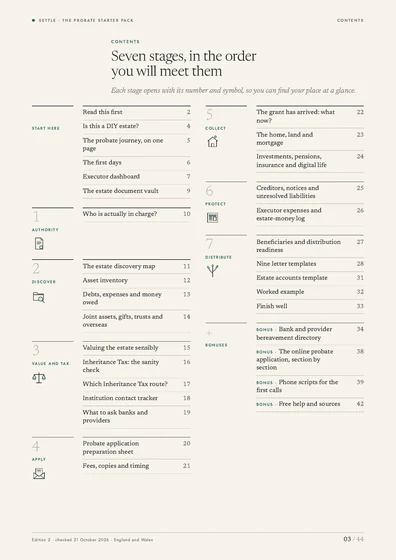
Starter Pack
£4.99
A 44-page printable toolkit to get organised and start probate yourself.
- 25-step executor checklist
- 9 ready-to-personalise letters
- Excel estate accounts workbook
Instant download · 30-day full refund
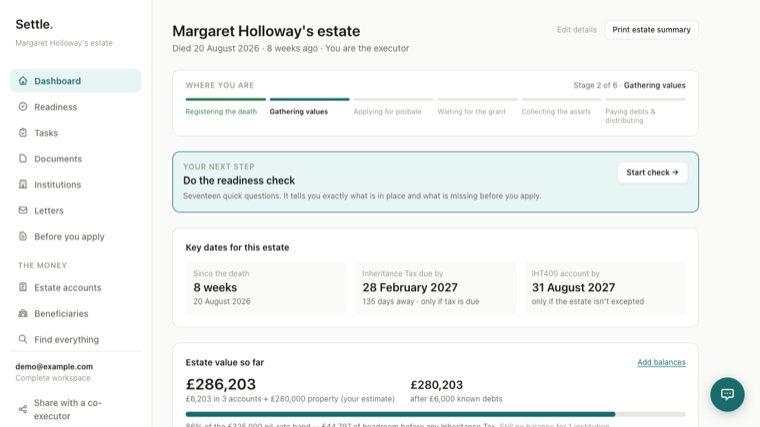
Secure Workspace
£9.99
Keep every probate task, document and deadline organised online.
- Your own secure probate Workspace
- Track tasks, organisations and deadlines
- Starter Pack included
One-off · no subscription · 30-day full refund · not legal advice