Quick Succession Relief Calculator
Two deaths within 5 years · relief of 100%, 80%, 60%, 40% or 20% of the earlier tax · HMRC formula (A ÷ D) × B × C
Rules checked against section 141 of the Inheritance Tax Act 1984 and HMRC's Inheritance Tax Manual on 26 November 2026 (how we check).
Quick answer
Quick succession relief cuts the Inheritance Tax on someone's estate if they inherited from an estate that paid Inheritance Tax in the five years before they died. The relief is a share of the tax paid the first time: 100% if the gap is a year or less, 80% up to two years, 60% up to three, 40% up to four and 20% up to five. It comes off the tax on the whole second estate, but never more than that tax.
1. Dates
2. The first estate
3. The second estate
Estimate only. Nothing you enter leaves this page.
Loading.
How the calculator works
- Percentage (C). Section 141(3): 100% if the earlier transfer was one year or less before the death; 80% if more than one year but not more than two; 60% for two to three; 40% for three to four; 20% for more than four years. HMRC: none after five years, and a death on an anniversary gets the higher percentage.
- Formula. HMRC's manual (IHTM22051) gives the relief as (A ÷ D) × B × C: A is the amount by which the earlier transfer increased the deceased's estate, B the tax charged on the earlier transfer, D its value.
- Limit. The relief comes off the tax on the whole death estate. It cannot be more than that tax, and any excess is not repaid (IHTM22045).
Worked examples
1. Eighteen months apart (the default figures)
The first estate was £500,000 and paid £70,000 tax. It was shared between two sisters, one of whom received £215,000 and died 18 months later with an estate owing £60,000. A ÷ D is 43%; 43% × £70,000 × 80% = £24,080 relief, leaving £35,920 to pay.
2. Within a year, small second bill
The same figures, but she died within the year and her estate owed £10,000. The formula gives £30,100, but the relief is limited to £10,000: no tax, and nothing repaid.
3. Everything to a spouse first
If the first estate went to a spouse and paid no tax, B is nil, and there is no relief on the spouse's death. The transferable nil-rate band does that job instead.
Where the formula needs care
- What A is. HMRC's manual has detailed rules on the increase in the estate, depending on whether the legacy bore its own tax and whether it was a share of residue (IHTM22061 to IHTM22076). The calculator takes the figure you enter.
- Settled property and lifetime gifts. Relief can apply to failed gifts and trust property too, with their own rules.
- Several earlier transfers. Each gives its own relief.
- The paperwork. Keep the first estate's Inheritance Tax figures: the second estate's executors need them to claim the relief.
Sources
- Inheritance Tax Act 1984, section 141 — legislation.gov.uk (read 26 November 2026)
- IHTM22051: Calculating QSR, summary and formula — HMRC Inheritance Tax Manual (read 26 November 2026)
- IHTM22052: Calculating QSR, the appropriate percentage — HMRC Inheritance Tax Manual (read 26 November 2026)
- IHTM22045: Quick succession relief, what the relief does — HMRC Inheritance Tax Manual (read 26 November 2026)
Frequently asked questions
What is quick succession relief?
Relief from Inheritance Tax on someone's estate when they inherited from an estate, or received a gift, that paid Inheritance Tax in the five years before they died (section 141, Inheritance Tax Act 1984).
How much is quick succession relief?
A percentage of the tax charged on what was inherited: 100% if one year or less, 80% up to two years, 60% up to three, 40% up to four and 20% up to five years.
Does it matter which part of the second estate is taxable?
No. HMRC's manual says the relief comes off the tax on the whole death estate, and it does not matter what part of the estate is chargeable.
Can quick succession relief create a refund?
No. It cannot be more than the tax on the second estate, and HMRC says any excess cannot be paid to the taxpayer.
Dealing with two estates at once?
Once you know the dates and figures, the next job is organising the estate. Pick the level of help that suits you.

Starter Pack
£4.99
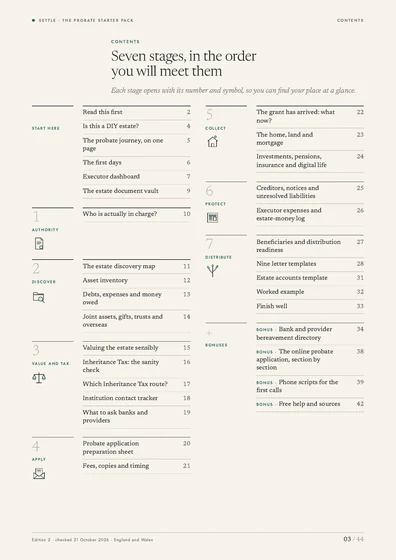
A 44-page printable toolkit to get organised and start probate yourself.
- 25-step executor checklist
- 9 ready-to-personalise letters
- Excel estate accounts workbook
Instant download · 30-day full refund
Secure Workspace
£9.99
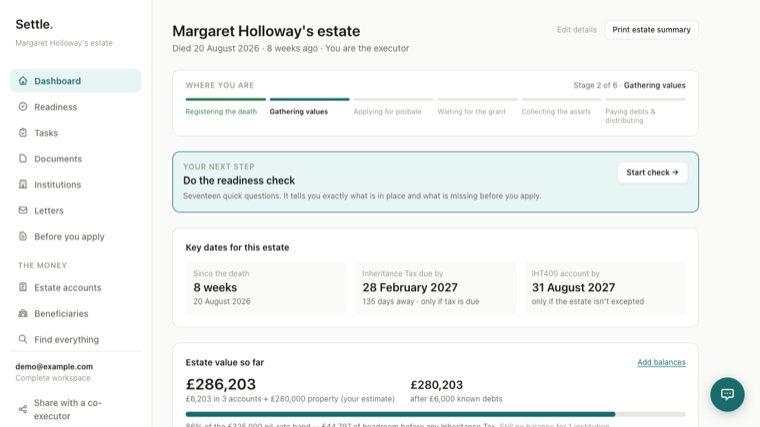
Keep every probate task, document and deadline organised online.
- Your own secure probate Workspace
- Track tasks, organisations and deadlines
- Starter Pack included
One-off · no subscription · 30-day full refund · not legal advice