Legacies and Residue Calculator
Specific gifts · cash legacies · residue shared by percentage · abatement when the estate is short
Rules checked against the Administration of Estates Act 1925 and HMRC's Inheritance Tax Manual on 28 November 2026 (how we check).
Quick answer
Debts, the funeral and the costs of dealing with the estate are paid first, and by default they come out of the residue. Cash legacies are paid next, in full if there is enough. Whatever is left is the residue, shared in the percentages the will sets. If there is not enough for the cash legacies, the residuary beneficiaries get nothing and every cash legacy is cut by the same proportion. Only after that do specific gifts, such as a house or a ring, bear the debts, again in proportion to their value. The will can change this order.
1. The estate
2. Specific gifts (an item or a property)
3. Cash legacies
4. The residue
Estimate only. Nothing you type is sent or saved: it stays in this page.
Loading.
The order the law uses
Section 34(3) of the Administration of Estates Act 1925 says a solvent estate pays the funeral, testamentary and administration expenses, debts and liabilities in the order set out in Part II of its First Schedule. For a will that disposes of everything, that order is:
| Step | Pays the debts and costs | Schedule 1, Part II |
|---|---|---|
| 1 | The residue, keeping back enough to pay the cash legacies | Paragraph 2 |
| 2 | The fund kept back for cash legacies (each legacy is cut by the same proportion) | Paragraph 5 |
| 3 | Specific gifts, rateably according to value | Paragraph 6 |
- Types of gift. HMRC's manual: a specific legacy is "a gift of a particular asset" such as a gold watch; a pecuniary legacy is "a gift of a sum of money"; the residue is what remains after debts, liabilities, expenses and other legacies.
- Cut in proportion. HMRC: legacies are paid specific, general, residuary, so when there is not enough they abate in reverse order, and "within each category of gifts, the various legacies will abate rateably".
- Mortgages. Section 35: a property charged with a mortgage bears that mortgage itself, unless the will or another document shows a different intention. Enter a mortgaged house left as a specific gift at its value less the mortgage.
- The will comes first. Paragraph 8(a): the order can be varied by the will. Some wills say legacies are paid "free of tax" or from a particular fund.
- Inheritance Tax. Enter any tax the estate pays with the debts. Where the will sets a different burden for tax, follow the will.
Worked examples
1. Enough for everyone (the default figures)
| Who | Gets | Why |
|---|---|---|
| Sam | The car (£8,000) | Specific gift |
| Amy and Ben | £10,000 each | Cash legacies in full |
| Chris and Dana | £55,000 each | £150,000 − £20,000 debts − £20,000 legacies = £110,000 residue, half each |
2. Not enough for the cash legacies
The residue is £50,000 and the debts are £20,000, leaving £30,000. The will leaves £20,000 to Amy and £25,000 to Ben, £45,000 in all. The residuary beneficiary gets nothing and each legacy is paid at £30,000 ÷ £45,000 = two-thirds:
| Legacy | Left in the will | Paid |
|---|---|---|
| Amy | £20,000 | £13,333.33 |
| Ben | £25,000 | £16,666.66 |
3. Specific gifts bear the shortfall
£10,000 of residue, £16,000 of debts, a £5,000 cash legacy, a house worth £200,000 left to one child and a £20,000 painting to another. The residue and the cash legacy are used up, and the £6,000 still owed is shared between the specific gifts in proportion to value: the house bears £5,454.54 and the painting £545.45. In practice the beneficiary pays that share or the executor sells something; agree it in writing.
When this calculator is not enough
- No will, or a will that misses something. Property not given by the will passes under the intestacy rules: see the intestacy calculator. The shares in this calculator must total 100%.
- Insolvent estates. If debts exceed everything, a different order applies and beneficiaries get nothing. Read insolvent estates.
- Scotland. Children and a spouse have legal rights whatever the will says: use the Scottish legal rights calculator.
Sources
- Administration of Estates Act 1925, section 34 — legislation.gov.uk (read 28 November 2026)
- Administration of Estates Act 1925, Schedule 1 Part II: order of application of assets where the estate is solvent — legislation.gov.uk (read 28 November 2026)
- Administration of Estates Act 1925, section 35: charges on property of the deceased — legislation.gov.uk (read 28 November 2026)
- IHTM12086: Legacies and devises, abatement — HMRC Inheritance Tax Manual (read 28 November 2026)
- IHTM12082: Legacies and devises, types of legacy — HMRC Inheritance Tax Manual (read 28 November 2026)
- IHTM12081: Legacies and devises, background — HMRC Inheritance Tax Manual (read 28 November 2026)
Frequently asked questions
What gets paid first, legacies or debts?
Debts, the funeral and the costs of administering the estate. Section 34(3) of the Administration of Estates Act 1925 says they are paid in the order in its First Schedule: out of the residue first, then out of the money kept back for cash legacies, then out of specific gifts. The will can change that order.
What happens if there is not enough money to pay all the legacies?
The legacies abate. The residuary beneficiaries lose out first. If the cash legacies still cannot be paid in full, each one is cut by the same proportion: HMRC's manual says that within each category the legacies abate rateably.
Who pays the mortgage on a house left in a will?
Under section 35 of the Administration of Estates Act 1925 the house itself bears the mortgage, unless the will or another document shows a different intention. A general direction in the will to pay debts is not enough on its own.
How is the residue of an estate divided?
In the shares the will sets, after debts, costs and legacies. If a will leaves the residue to two children equally, each gets half of what is left. Any part of the residue the will does not dispose of passes under the intestacy rules.
Ready to pay the beneficiaries?
Keep a record of every payment and get each beneficiary's receipt. Pick the level of help that suits you.

Starter Pack
£4.99
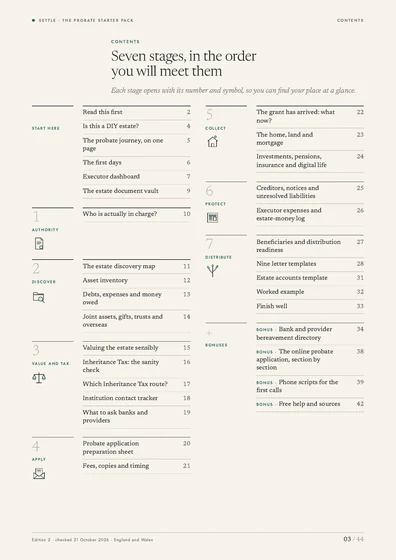
A 44-page printable toolkit to get organised and start probate yourself.
- 25-step executor checklist
- 9 ready-to-personalise letters
- Excel estate accounts workbook
Instant download · 30-day full refund
Secure Workspace
£9.99
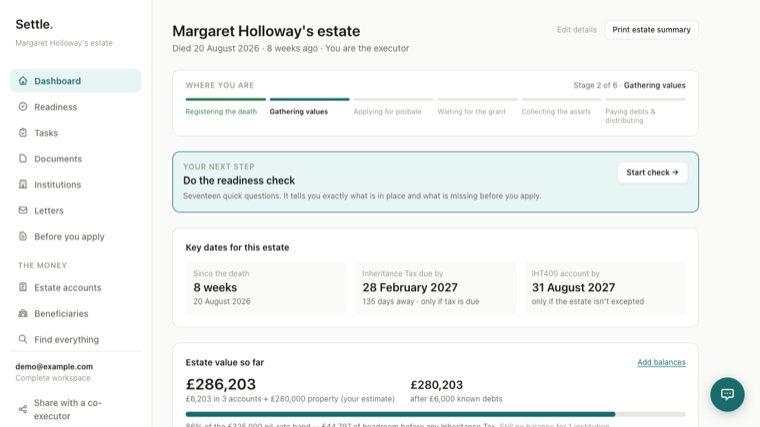
Keep every probate task, document and deadline organised online.
- Your own secure probate Workspace
- Track tasks, organisations and deadlines
- Starter Pack included
One-off · no subscription · 30-day full refund · not legal advice