The 36% Inheritance Tax rate for leaving 10% to charity
The smallest gift that qualifies · the baseline amount step by step · what the family gets with and without it
Rules checked in the HMRC Inheritance Tax Manual and on GOV.UK on 28 November 2026 (how we check).
Quick answer
Inheritance Tax on a death is charged at 36% instead of 40% if at least 10% of the "baseline amount" goes to charity. The baseline is roughly the estate above the nil-rate band, with the charity gift added back; the residence nil-rate band is not taken off. In practice the smallest qualifying gift is 10% of the estate's value above the available nil-rate band. HMRC's example: a £750,000 estate with a full £325,000 band needs £42,500 for charity, and a £50,000 gift cuts the tax from £150,000 to £135,000.
1. The estate
2. The gift
Nothing you enter leaves this page. The example figures are HMRC's own (IHTM45011).
Loading.
How the calculator works
Schedule 1A to the Inheritance Tax Act 1984 sets the rule, for deaths on or after 6 April 2012. HMRC's manual (IHTM45009) gives three steps for the baseline amount:
- Step 1. The value transferred on death, after exemptions and reliefs, including the charity exemption.
- Step 2. Less the available nil-rate band: £325,000, plus any band transferred from a late spouse or civil partner, less what gifts in the 7 years before death used. HMRC: it "is not increased by any residential nil-rate band (RNRB)".
- Step 3. Add back the charity gift. The result is the baseline amount.
The estate qualifies if the gift (the "donated amount") is at least 10% of the baseline. Because the gift is taken off at step 1 and added back at step 3, the baseline is the same whatever the gift, as long as some tax would be due. So the smallest gift is 10% of the estate above the nil-rate band, which the calculator rounds up to the next penny. It then shows the tax and what everyone else receives with no gift, your gift and the smallest qualifying gift. The residence nil-rate band still reduces the tax; it just does not reduce the baseline.
The Inheritance Tax calculator applies the same test as part of a full estimate. Use this page when the question is how much to leave, or whether a top-up is worth it.
Worked examples from HMRC's manual
1. A gift that qualifies (IHTM45010)
Robert's estate is £750,000 after liabilities and he leaves £50,000 to charity. Chargeable transfer £700,000, less the £325,000 band, is £375,000; add back £50,000 and the baseline is £425,000. £50,000 is more than £42,500, so the rate is 36%: tax £135,000 instead of £150,000.
2. Just short, fixed by a top-up (IHTM45011, the default figures)
James also leaves £750,000 and £50,000 to charity, but gave his daughter £150,000 four years before he died, so only £175,000 of band is left. The baseline is £575,000 and 10% is £57,500, so £50,000 fails and the tax is £210,000. HMRC notes the beneficiaries could add £7,500 by deed of variation: the tax then falls to £186,300, "a tax saving of £23,700, which more than pays for the additional payment to charity". The family receives £506,200 instead of £490,000.
3. Does the gift cost the family anything?
For Robert, with no charity gift the tax would be £170,000 and the family would get £580,000. With the smallest qualifying gift of £42,500 the tax is £137,700 and the family gets £569,800. So the £42,500 to charity costs the family £10,200. The tax saving pays for most of the gift, not all of it.
Things to know
- Separate parts of the estate. HMRC splits an estate into components: joint property passing by survivorship, settled property (a trust the person had an interest in), gifts with reservation and the rest. Each is tested separately unless the executors elect to merge them. This calculator handles the general component only; for more than one, use HMRC's own reduced rate calculator.
- Send form IHT430. Use it with the IHT400 to claim the reduced rate, to opt out of it, or to merge components.
- Wills worded to hit 10%. A will can leave "whatever is needed" to meet the test. HMRC says the amount must be recalculated whenever the estate's value changes.
- Opting out. Executors can elect to pay 40% instead, for example where valuing land left to charity would cost more than the saving. The election, or a merger of components, must be made within 2 years of the death.
- Lifetime gifts. The reduced rate applies only to tax charged on death. Gifts in the last 7 years use up the nil-rate band first, which can make the test harder to pass, as in James's case.
- What counts as charity. HMRC includes registered community amateur sports clubs and organisations that meet the requirements for being a charity.
Inheritance Tax is UK-wide, so the 36% rate applies to estates in Scotland and Northern Ireland as well.
Sources
- IHTM45001 and IHTM45002, reduced rate for gifts to charity — HMRC (read 28 November 2026)
- IHTM45009 to IHTM45013, calculating the baseline amount — HMRC (read 28 November 2026)
- IHTM45040 and IHTM45043, opting out and time limits — HMRC (read 28 November 2026)
- Inheritance Tax: reduced rate of Inheritance Tax (IHT430) — GOV.UK (read 28 November 2026)
- Inheritance Tax reduced rate calculator — GOV.UK (read 28 November 2026)
Frequently asked questions
How much do you need to leave to charity to pay 36% Inheritance Tax?
At least 10% of the baseline amount, which works out as 10% of the estate above the available nil-rate band. For a £750,000 estate with a £325,000 band that is £42,500.
Does the residence nil-rate band count in the 10% test?
No. HMRC says the nil-rate band used for the baseline is not increased by the residence nil-rate band, although that band still reduces the tax.
Can beneficiaries increase a charity gift after death to get 36%?
Yes. A deed of variation can increase the gift. HMRC's example: adding £7,500 cut the tax by £23,700.
Which form claims the 36% rate?
Schedule IHT430, sent with the IHT400. It is also used to opt out of the reduced rate or merge parts of the estate, within 2 years of the death.
Reporting an estate with a charity gift?
Keep the IHT400, its schedules and the charity's receipt in one place. Pick the level of help that suits you.

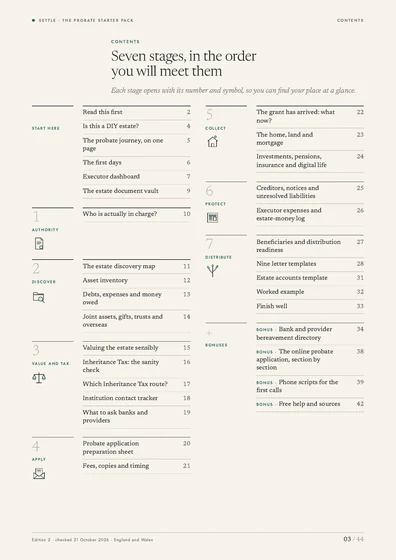
Starter Pack
£4.99
A 44-page printable toolkit to get organised and start probate yourself.
- 25-step executor checklist
- 9 ready-to-personalise letters
- Excel estate accounts workbook
Instant download · 30-day full refund
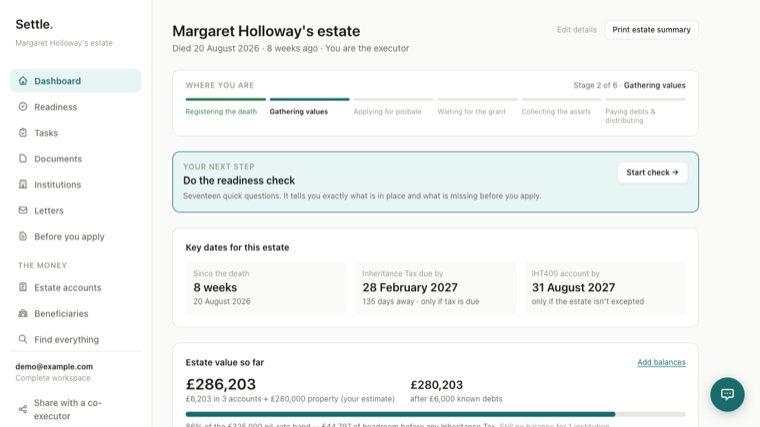
Secure Workspace
£9.99
Keep every probate task, document and deadline organised online.
- Your own secure probate Workspace
- Track tasks, organisations and deadlines
- Starter Pack included
One-off · no subscription · 30-day full refund · not legal advice