Closing a Virgin Money Account After Death
Checked against current GOV.UK probate and Inheritance Tax guidance for England & Wales (2026/27).
- Tell Virgin Money early — the account is frozen from the date they are notified, and direct debits and standing orders stop.1
- You will need a certified copy of the death certificate and your own photo ID to open the bereavement case; a Grant of Probate is only needed later, if the balance is above the bank's release limit.2
- The balance at which the bank asks for probate varies by institution and can change without notice — confirm the current figure directly with them rather than relying on any published number.
- A joint account normally passes to the surviving holder by survivorship, so probate is not needed to keep using it — but you still tell the bank so the name is removed.3
Notify Virgin Money as soon as you can, send a certified copy of the death certificate, and let the bereavement team freeze the accounts and give you a date-of-death balance.1 Whether you need a Grant of Probate before the money is released depends on how much was held — and that threshold is set by the bank, not by law.2
Quick answer
To close a Virgin Money account after a death, call Bereavement Services on 0800 0121590 (Mon–Fri 8am–6pm, Sat 8am–3pm) or use the online form if you already have the death certificate. Virgin Money's own bereavement page says you need a Grant of Probate (or Letters of Administration) if the balance is £50,000 or more; below that they send a form instead. Joint accounts pass to the surviving holder without probate. Confirm the current threshold with Virgin Money, as figures change. This is general guidance, not legal advice.
Virgin Money is a UK retail bank with branches, a telephone service, and an online presence. The current Virgin Money came about through the merger of Clydesdale Bank, Yorkshire Bank, and the original Virgin Money business, all of which now operate under the Virgin Money name. If the person who has died held a current account, savings account, cash ISA, or any other product with Virgin Money, you will need to notify the bank so that the accounts can be frozen, a date-of-death balance obtained, and funds released to the estate in due course. Virgin Money has a bereavement hub online and a dedicated team to handle these cases. This guide covers everything an executor needs to know.
How to notify Virgin Money of a death
Virgin Money offers the following routes for the initial bereavement notification:
- Online bereavement hub: Virgin Money provides a dedicated bereavement hub on its website. This allows you to start the notification process online, without needing to call or visit a branch.
- By telephone: You can call Virgin Money's bereavement team to begin the process. They can freeze the accounts and tell you which documents to provide.
- In branch: You can visit a Virgin Money branch with the death certificate and your own identification. Branch staff will take the notification and pass it to the bereavement team internally.
Whichever route you use, follow up any telephone or in-person notification in writing. An email or letter confirming the date of notification and any case reference number creates a useful record for the estate.
If the deceased held accounts at several banks, the free Death Notification Service (deathnotificationservice.co.uk) can notify its member banks and building societies through a single online form. Virgin Money was not on that member list when we checked its member list on 20 October 2026, so contact Virgin Money directly as well.
A note on previous Clydesdale Bank and Yorkshire Bank accounts
If the deceased previously held accounts with Clydesdale Bank or Yorkshire Bank, those accounts are now part of Virgin Money following the merger. If you are unsure which brand the accounts sit under, Virgin Money's bereavement team will be able to identify them. You do not need to contact Clydesdale or Yorkshire Bank separately.
Documents you will need
Virgin Money will need documents at two stages: first to confirm the death and freeze the accounts, and later to authorise the release of funds. Have the following ready before you make contact:
- Original death certificate or a certified copy issued by the register office. When you register the death, order at least eight to ten certified copies upfront. They are much cheaper at that stage than obtaining additional copies later, and you will need one per institution.
- Proof of your identity: a current passport or driving licence.
- Proof of your address: a utility bill or bank statement issued within the last three months.
- The original will (if one exists): Virgin Money may ask to see this to confirm your status as executor, particularly where the balance is near or above their threshold.
- Grant of Probate or Letters of Administration: required if the combined balance across all Virgin Money accounts exceeds the probate threshold. Virgin Money will advise you on this when you make the initial notification.
You do not need the Grant of Probate to begin the notification. It becomes relevant only at the later stage of releasing funds, and only if the threshold is exceeded.
Virgin Money's probate threshold
Like all UK banks, Virgin Money sets its own internal threshold for the maximum amount it will release from an estate without a Grant of Probate. Below this figure, they will typically release funds on sight of a death certificate, identification, and a small estates declaration form. Above it, accounts remain frozen until the executor provides a sealed Grant of Probate.
Virgin Money's bereavement page (checked October 2026) says a Grant of Probate, Letters of Administration or Certificate of Confirmation is needed if the balance is £50,000 or more. Below that, they provide a form to complete instead. Confirm the current figure when you notify them. The threshold applies to the combined balance across all accounts held with Virgin Money, not to each account individually. A current account, a savings account, and an ISA held at Virgin Money would all count towards the same threshold total.
Note: Probate thresholds can change without public notice. Always confirm the current figure with Virgin Money directly before assuming funds can be released without probate. Confirm it before making decisions about the estate.
For a comparison of approximate thresholds across major UK banks and building societies, see our guide to bank probate thresholds. For more on the probate process itself, see our guide to do I need probate?
What happens to direct debits and standing orders
Once Virgin Money is notified of the death and the account is frozen, all direct debits and standing orders will be cancelled. No further automatic payments will be collected or sent.
The practical consequences of this are worth considering in advance:
- Any bills paid by direct debit from the deceased's Virgin Money account, including utilities, subscriptions, and insurance policies, will stop. Contact each relevant company to advise them of the death and to arrange alternative payments where needed.
- If regular payments were covering ongoing property costs such as buildings insurance or council tax, make sure those payments continue from the estate to avoid coverage gaps or penalties.
- A standing order paying rent or a mortgage will also stop. If the estate includes a property with a mortgage, check whether that mortgage payment was coming from this account.
Request a statement from Virgin Money showing all active direct debits and standing orders as at the date of death. This will help you build a complete list of creditors and companies to contact during the estate administration.
Keeping track of every institution, document sent and response received is one of the core things the Settle workspace helps with. Start the free assessment to get your personalised checklist.
Joint accounts
If the deceased held a Virgin Money account jointly with another person, the account typically passes to the surviving account holder by right of survivorship. Virgin Money will update the account to the survivor's sole name on receipt of the death certificate. The surviving holder retains access to the funds throughout the notification process. No Grant of Probate is required for this.
The notification still needs to be made formally, even for a joint account. The account does not update automatically. The surviving account holder should contact Virgin Money's bereavement team with the death certificate and their own identification.
For inheritance tax purposes, the balance in a joint account at the date of death may still be assessable as part of the estate, depending on how the account was funded. This is a separate matter from the bank notification process and should be considered when preparing the estate accounts.
ISAs held with Virgin Money
A Virgin Money ISA held in the deceased's sole name forms part of the estate and is subject to the same probate threshold as any other account. If the combined balance including the ISA exceeds the threshold, the ISA will remain frozen until the Grant of Probate is produced.
A surviving spouse or civil partner may be able to use the Additional Permitted Subscription (APS) rule. This allows the survivor to invest an additional amount into their own ISA equal to the value of the deceased's ISA at the date of death, without it counting against their annual ISA allowance. This preserves the tax-free benefit of those savings even after the original ISA has been closed.
There is a time limit for claiming the APS from the date of death. The surviving spouse or civil partner should raise this with Virgin Money early in the process to avoid missing the deadline.
How long does it take
The overall timescale depends primarily on whether the total Virgin Money balance exceeds their probate threshold:
- Below the threshold: Once Virgin Money has received all necessary documents, they will typically aim to process the account closure and release funds within a few weeks.
- Above the threshold: Accounts remain frozen until the Grant of Probate is issued. Applying for probate can take several months depending on the complexity of the estate and current Probate Registry waiting times. Once Virgin Money receives the sealed grant, they should process the release within a few weeks.
Delays most commonly occur when documents are missing or incorrect. If you have not received an update within four weeks of sending documents, contact Virgin Money's bereavement team to follow up.
Virgin Money bereavement contact details
Contact Virgin Money's dedicated bereavement team rather than the general customer service line. The bereavement team has the authority and access needed to move the case forward.
- Bereavement Services: 0800 0121590 (Monday to Friday 8am to 6pm, Saturday 8am to 3pm)
- Accounts first opened with Clydesdale Bank or Yorkshire Bank: 0800 011 3238 (Monday to Friday, 9am to 5pm)
- Online: uk.virginmoney.com/service/bereavement, with an online notification form if you already have the death certificate
Phone numbers and web addresses can change. Always confirm current contact details on the Virgin Money website before calling. The bereavement team can confirm exactly which documents are required and advise on timescales for the specific accounts held.
For a comparison of probate thresholds across all major UK banks and building societies, see our guide to bank probate thresholds. For a full walkthrough of closing accounts across multiple institutions, see closing bank accounts after death. Our guides on notifying banks after death and do I need probate? are also useful at this stage.
Need to notify multiple banks?
The free assessment gives you a personalised checklist of every institution to contact.
Start free assessmentCommon mistakes to avoid
- Assuming a published threshold is current. Banks change these limits quietly. Ask the bereavement team what applies to this estate before deciding whether to apply for probate.
- Letting property bills lapse. When the account freezes, buildings insurance or council tax paid by direct debit stops too. Move essential payments so cover does not drop.
- Ordering too few death certificates. Each institution wants its own certified copy. Order several when you register the death — they are far cheaper up front than requested later.
- Waiting for probate before notifying. You notify first; probate (if needed at all) comes later. Freezing the account early protects the estate.1
Frequently asked questions
Do I need probate to close a Virgin Money account?
Only if the balance is above the bank's own release limit. Below it, most banks pay out on the death certificate, your ID and a short estate declaration; above it they hold the money until you produce a sealed Grant of Probate.2
How long does it take to release the money?
For balances under the threshold, usually a few weeks once the paperwork is in. Above the threshold the account stays frozen until probate is granted, which itself is usually within 12 weeks of a complete application, then a short release window after.
What happens to a joint account?
It passes automatically to the surviving account holder by right of survivorship, so it is not frozen and does not need probate. You still notify the bank so the deceased's name is removed.3
Can I use the Death Notification Service instead of calling?
Not for Virgin Money. Virgin Money was not a member of the free Death Notification Service when we checked its member list on 20 October 2026, so tell Virgin Money directly. The service is still worth using for the person's other banks if they are members, such as Barclays, HSBC, Lloyds, NatWest, Nationwide or Santander.
What documents will they ask for?
A certified copy of the death certificate, your photo ID and proof of address, the will if there is one, and — for larger balances — the Grant of Probate or Letters of Administration once you have it.2
Sources & references
The figures and rules in this guide are drawn from the official UK government pages below. Each link opens the relevant GOV.UK page. Always confirm current figures on GOV.UK before you act, as fees and thresholds can change.
- Dealing with the estate of someone who's died — GOV.UK
- Applying for probate — GOV.UK
- What to do when someone dies: step by step — GOV.UK
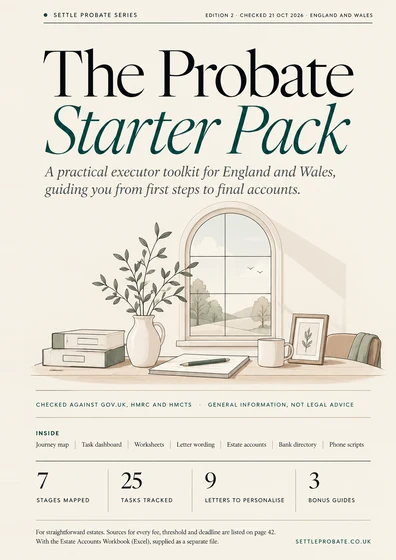
Starter Pack · £4.99 — a 44-page printable executor toolkit with a 25-step checklist, nine letters to personalise and an Excel estate accounts workbook.
See what’s inside →Free
Not sure probate is needed yet?
Answer 7 questions and get a free probate assessment. No account needed.
Start free assessment →Secure Workspace · £9.99
Send the letters, then track every bank
Your Workspace fills in a notification letter for each bank with the estate's details, and keeps a record of who you have contacted, what is still outstanding and each balance at the date of death.
See how the Workspace works →