What Happens to a Private Tenancy When Someone Dies?
Checked against current GOV.UK probate and Inheritance Tax guidance for England & Wales (2026/27).
- A tenancy passes to the estate on death; it does not end automatically.1
- Rent remains payable until the tenancy is properly ended, so act promptly.1
- Notify the landlord and serve the correct notice for a fixed-term or periodic tenancy.1
- A joint tenancy usually passes to the surviving tenant by survivorship.2
A private tenancy does not simply end when the tenant dies — it passes to the estate, and rent keeps running until it is ended properly. Executors need to notify the landlord and serve notice correctly to stop the liability.1
A private tenancy does not end when the tenant dies. The tenancy passes to the deceased's estate, and the executor takes on the responsibility for managing it until it is formally ended. This means rent continues to be owed, notice still needs to be served correctly, and the landlord cannot simply re-enter the property. Acting promptly will limit the costs to the estate.
Notifying the landlord
Contact the landlord or letting agent as soon as possible after the death. This is both a practical courtesy and a legal necessity – the estate remains liable for rent during the notice period, so the sooner you give notice, the sooner that liability ends.
Write to the landlord formally, confirm the date of death, and explain that you are the executor. Ask for their process for ending the tenancy and confirm how notice should be served. Keep a copy of all correspondence.
The landlord cannot re-enter the property without following a proper legal process, even if the property is empty and no one is living there. Taking matters into their own hands – changing the locks, removing belongings – is unlawful eviction even against an estate. If a landlord threatens to do this, take legal advice.
Assured shorthold tenancies – fixed term and periodic
Most private tenancies in England are assured shorthold tenancies (ASTs). The rules for ending them differ depending on whether the tenancy is in a fixed term or has moved to a periodic tenancy.
If the tenancy is periodic (rolling month by month), the estate can serve notice on the landlord. The notice period is typically one month for a monthly tenancy (or one week for a weekly tenancy), but check the tenancy agreement – it may specify a longer period. Notice must align with the rent payment date.
If the tenancy is in a fixed term that has not yet ended, the position is more complex. In most cases the estate is bound by the remaining term and rent continues to be owed for that period. Some landlords will agree to an early surrender – a mutual agreement to end the tenancy before the fixed term expires. This is worth negotiating, as it limits the estate's liability. Get any agreed surrender in writing.
Joint tenancies
If the deceased was a joint tenant – sharing the tenancy with another person – the surviving co-tenant automatically becomes the sole tenant on death. The tenancy does not pass through the estate at all. The surviving tenant simply continues in occupation with full rights.
As executor, you have no role in the ongoing tenancy itself. You should notify the landlord of the death for their records, but the tenancy is now the surviving co-tenant's alone. Any financial arrangements between the deceased and the co-tenant (for example, who paid what share of the rent) are a matter between the estate and the co-tenant to resolve separately if needed.
Deposits, belongings, and ending the tenancy
The tenancy deposit is held by the landlord or a deposit protection scheme. Once the tenancy ends, the landlord carries out an inspection and returns the deposit, less any agreed deductions for damage or unpaid rent. The deposit is returned to the estate, not to the deceased's family directly. Include it in the estate accounts.
Any belongings left in the property remain the property of the estate. You are responsible for removing them and making sure the property is handed back in a suitable condition. Allow enough time in your notice period to arrange clearance – professional house clearance services can help if the task is large.
Once the tenancy ends and keys are returned, your liability for rent stops. Get confirmation in writing from the landlord that the property has been accepted back and that they have no outstanding claims on the deposit beyond any agreed deductions.
Unsure whether probate is needed to deal with the tenancy or other parts of the estate? Take the free Settle assessment for a clear picture of next steps.
See also our guides on executor duties, who to contact after death, and joint accounts after death.
Not sure what you need to do next?
The free assessment gives you a personalised checklist of every step, in the right order.
Start free assessmentCommon mistakes to avoid
- Assuming rent stops at death. It keeps accruing against the estate until the tenancy is ended.1
- Just handing back the keys. Serve proper notice, or the estate may stay liable.1
- Clearing belongings too soon. They are estate assets — deal with them properly.2
Frequently asked questions
Does a tenancy end when the tenant dies?
No. It passes to the estate and continues until it is properly ended, so rent keeps running in the meantime.1
Who is responsible for the rent?
The estate, until the tenancy is ended correctly. Executors should act quickly to limit the liability.1
How do we end the tenancy?
Notify the landlord and serve the notice appropriate to the tenancy type — a periodic tenancy usually needs a notice to quit.1
What about a joint tenancy?
It normally passes to the surviving tenant by right of survivorship, who then continues the tenancy.2
What happens to the deposit and belongings?
The deposit is returned to the estate subject to any deductions, and belongings left in the property are estate assets to be dealt with.2
Sources & references
The figures and rules in this guide are drawn from the official UK government pages below. Each link opens the relevant GOV.UK page. Always confirm current figures on GOV.UK before you act, as fees and thresholds can change.
- Dealing with the estate of someone who's died — GOV.UK
- What to do when someone dies: step by step — GOV.UK
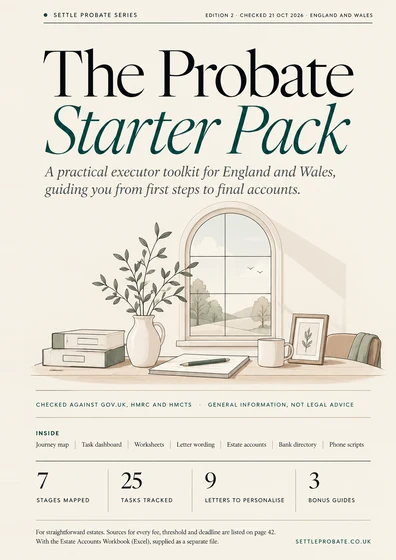
Starter Pack · £4.99 — a 44-page printable executor toolkit with a 25-step checklist, nine letters to personalise and an Excel estate accounts workbook.
See what’s inside →Free
Find out exactly what you need to do
Answer 7 questions and get a free probate assessment. No account needed.
Start free assessment →Secure Workspace · £9.99
Know what comes next, from the first phone call to the final estate accounts
Your own private account with a task list built from your answers, a bank and institution tracker, and estate accounts. Includes the Starter Pack.
See how the Workspace works →