Estate Value Calculator: What Is the Estate Worth?
Their share of a joint home and joint accounts · gifts in the last 7 years · debts and the funeral · gross and net estate · excepted estate check
Rules checked against GOV.UK's "Value the estate of someone who's died" guide on 28 November 2026 (how we check).
Quick answer
Add up everything the person owned on the day they died, at what it would have sold for, plus gifts they made in the 7 years before death and any trust they benefited from. That is the gross estate. Take off debts, including the mortgage and the funeral, to get the net estate. A jointly owned home counts at half if owned with a spouse or civil partner, or an equal share less 10% if owned with anyone else. Below £325,000 the estate is usually "excepted" and HMRC does not need full details.
1. The home
2. Everything else they owned
3. Debts
4. Who inherits
Estimate only. Nothing you type is sent or saved: it stays in this page.
Loading.
How the calculator values the estate
- Values on the day they died. GOV.UK says to value each asset on the date of death. For bank accounts, ISAs and pensions, ask the organisation for an exact figure; for a car or jewellery, use what it would have sold for.
- Joint home. Owned as joint tenants with a spouse or civil partner: divide the value by 2. With other joint tenants, such as siblings: divide by the number of owners, then take 10% off their share. In Scotland, with anyone other than a spouse or civil partner, take £4,000 off the whole value first and then divide. Tenants in common: their share.
- Joint accounts. Divide the balance by the number of account holders, unless the account was in joint names only for convenience; then use what the person actually owned.
- Gifts and trusts. GOV.UK's estimate includes gifts made in the 7 years before death (where a year's gifts went over the £3,000 annual exemption) and trusts the person had a beneficial interest in.
- Gross, then net. GOV.UK says not to take debts off when you estimate the value, which gives the gross figure used for the excepted estate limits. Debts include the mortgage, loans, cards, unpaid bills and funeral expenses; taking them off gives the net estate.
- Excepted or not. Usually excepted below the £325,000 threshold, at £650,000 or less when a late spouse's unused threshold is transferred, or under £3 million when everything goes to a UK spouse, civil partner or charity. Over £3 million, HMRC needs full details even if no tax is due.
Worked examples
1. A widower's half of the family home (the default figures)
| Line | Amount |
|---|---|
| Half of a £400,000 home owned jointly with his wife | £200,000 |
| Bank and savings | £30,000 |
| Shares and ISAs | £20,000 |
| Car and contents | £5,000 |
| Gross estate | £255,000 |
| Less card balances and bills | −£2,000 |
| Less funeral | −£4,500 |
| Net estate | £248,500 |
The gross estate is under £325,000, so it is usually an excepted estate.
2. A house owned by four siblings
| Where | Working | Their share |
|---|---|---|
| England, Wales or Northern Ireland | £200,000 ÷ 4 = £50,000, less 10% (£5,000) | £45,000 |
| Scotland | (£200,000 − £4,000) ÷ 4 | £49,000 |
3. A £1 million estate
A £900,000 house in her sole name and £100,000 in the bank; the funeral cost £5,000. If it all goes to her children with her late husband's threshold transferred, it is over £650,000, so HMRC needs full details and the £995,000 net estate is £345,000 over the £650,000 threshold before any home allowance. If it all goes to her husband instead, it is exempt and, being under £3 million, usually excepted.
What this calculator does not do
- It does not work out Inheritance Tax: use the Inheritance Tax calculator, which handles the home allowance and gifts.
- It checks the value limits only. Gifts over £250,000, foreign assets and some trusts mean full details are needed whatever the value: the excepted estate checker asks about each one.
- Pensions: ask each provider whether to include the pension. Many are paid outside the estate.
Sources
- Value the estate of someone who's died: estimate the estate's value — GOV.UK (read 28 November 2026)
- Value the estate of someone who's died: identify assets and debts — GOV.UK (read 28 November 2026)
- Value the estate of someone who's died: check if you need to send full details — GOV.UK (read 28 November 2026)
- Inheritance Tax — GOV.UK (read 28 November 2026)
Frequently asked questions
How do you work out the value of an estate?
Add up the value on the day they died of everything they owned: property, money, investments, possessions and money owed to them. GOV.UK's estimate also adds gifts made in the 7 years before death and trusts they benefited from. Debts are listed separately: take them off to get the net estate.
How do you value a jointly owned house for probate?
If it was owned as joint tenants with a spouse or civil partner, divide the value by 2. With other joint tenants, divide by the number of owners and take 10% off the person's share. In Scotland, for owners other than a spouse or civil partner, take £4,000 off the whole value before working out the share. Tenants in common use their actual share.
Is the funeral taken off the value of the estate?
Funeral expenses are debts of the estate. GOV.UK lists the funeral director, a headstone or plaque and refreshments among them. Leave them out of the gross estate and take them off to reach the net estate.
What is an excepted estate?
One where HMRC does not need full details. It is usually excepted if it is below the £325,000 threshold, £650,000 or less with a late spouse's unused threshold transferred, or under £3 million and left to a UK spouse, civil partner or charity, and none of the conditions that need full details applies, such as large gifts, some trusts or foreign assets.
Know what the estate is worth?
The next job is collecting it in and keeping records. Pick the level of help that suits you.

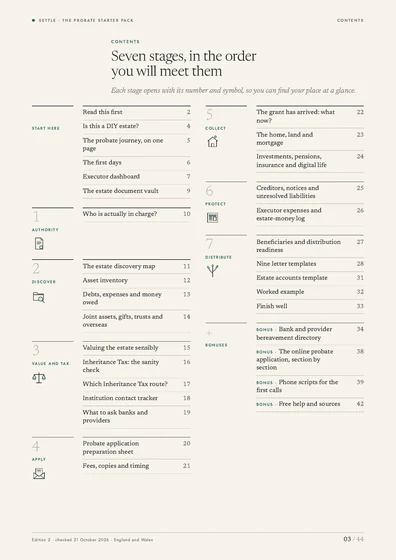
Starter Pack
£4.99
A 44-page printable toolkit to get organised and start probate yourself.
- 25-step executor checklist
- 9 ready-to-personalise letters
- Excel estate accounts workbook
Instant download · 30-day full refund
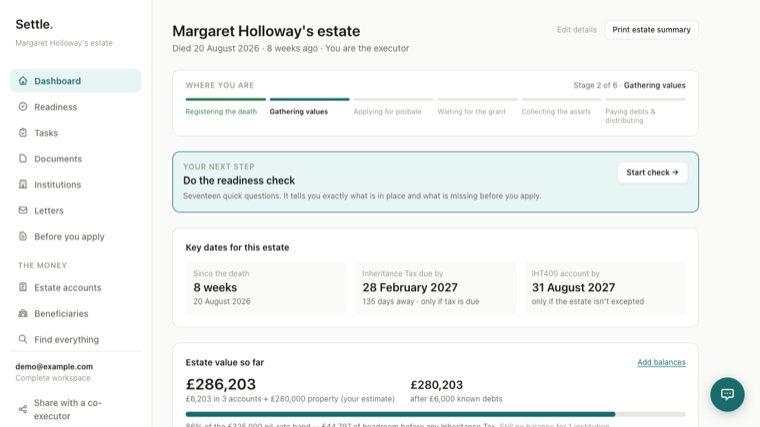
Secure Workspace
£9.99
Keep every probate task, document and deadline organised online.
- Your own secure probate Workspace
- Track tasks, organisations and deadlines
- Starter Pack included
One-off · no subscription · 30-day full refund · not legal advice