Who Inherits Without a Will? Family Tree
Tap the relatives who are still alive. The tree lights up who inherits under the intestacy rules, and the table shows what each receives.
Rules checked against the Administration of Estates Act 1925 on legislation.gov.uk and GOV.UK on 27 November 2026 (how we check).
Quick answer
In England and Wales, a husband, wife or civil partner inherits first. With no children they take everything. With children, they take the personal belongings, the first £322,000 and half of the rest, and the children share the other half. With no spouse or civil partner, the estate goes to the first group with someone alive, in this order: children, parents, brothers and sisters, half brothers and sisters, grandparents, aunts and uncles, then half aunts and uncles. A relative who died first is replaced by their own children. An unmarried partner inherits nothing under these rules.
1. What the estate is worth
Cars, jewellery, furniture and other personal possessions; not money or investments.
Property, savings and investments, less debts and funeral costs. Leave out anything jointly owned that passes to the other owner automatically.
The figures start as an example (£10,000 of belongings and £450,000 of everything else). Replace them with your own; nothing you enter leaves this page.
2. Who is still alive?
3. Who receives what
Scotland or Northern Ireland? The rules are different. Scotland has prior rights and legal rights: see legal rights and prior rights in Scotland. For Northern Ireland see probate in Northern Ireland. The step-by-step checker covers all three.
How the tree works out who inherits
- Spouse or civil partner first. Under section 46 of the Administration of Estates Act 1925, if there are no children or other descendants "the residuary estate shall be held in trust for the surviving spouse or civil partner absolutely". They must outlive the person by 28 days.
- Spouse and children. The spouse or civil partner takes "the personal chattels absolutely", then a fixed net sum with interest, then half of what is left; the other half goes "on the statutory trusts for the issue". The fixed net sum is £322,000 for deaths on or after 26 July 2023 (Administration of Estates Act 1925 (Fixed Net Sum) Order 2023, article 2).
- No spouse or civil partner. The estate goes to the children, or if none, the parents (equally if both are alive), and then "First ... the brothers and sisters of the whole blood ... Secondly ... the brothers and sisters of the half blood ... Thirdly, for the grandparents ... Fourthly ... the uncles and aunts ... (being brothers or sisters of the whole blood of a parent) ... Fifthly ... (being brothers or sisters of the half blood of a parent)".
- Relatives who died first. The statutory trusts let the children of a child, brother, sister, aunt or uncle who died first take that person's share between them. The tree counts each such branch as one share.
- Nobody in those groups. The estate "shall belong to the Crown" as bona vacantia. See when there is no family.
The amounts come from the same rules engine as our step-by-step intestacy checker, so both tools always give the same answer.
Worked examples
Each example uses an estate of £10,000 of personal belongings plus £450,000 of everything else, so £460,000 in total.
| Family | Who inherits | Amount |
|---|---|---|
| Married with two children | Spouse or civil partner | £396,000 |
| Children (and grandchildren in a late child's place) (2 shares of £32,000) | £64,000 | |
| Married, no children, both parents alive | Spouse or civil partner | £460,000 |
| Widowed, one child alive and one who died leaving children | Children (and grandchildren in a late child's place) (2 shares of £230,000) | £460,000 |
| Single, no children, one parent alive | Parents | £460,000 |
| Single, three sisters (one died leaving children) | Brothers and sisters (and nieces and nephews in a late sibling's place) (3 shares of £153,333) | £460,000 |
| Only half brothers and a grandmother | Half brothers and sisters (and their children) (2 shares of £230,000) | £460,000 |
| Only cousins (both aunts died leaving children) | Aunts and uncles (and cousins in a late aunt's or uncle's place) (2 shares of £230,000) | £460,000 |
| Nobody in the qualifying classes | The Crown (bona vacantia) | £460,000 |
In the first example the spouse or civil partner takes £10,000 of belongings, the £322,000 fixed sum and half of the remaining £128,000, so £396,000; the two children share £64,000. In the second, both parents are alive but a spouse with no children takes everything.
Things that catch families out
- Unmarried partners get nothing automatically, however long the relationship. A claim under the Inheritance (Provision for Family and Dependants) Act 1975 may be possible; see what an unmarried partner can claim.
- Stepchildren who were never adopted do not inherit under these rules.
- Jointly owned property held as joint tenants, and joint bank accounts, pass straight to the other owner and are not shared out under these rules.
- Interest on the fixed sum. The £322,000 carries simple interest from the date of death until paid, which this tool leaves out.
- Children under 18 do not receive their share outright: it is held for them until they reach 18 or marry or form a civil partnership before then.
Sources
- Administration of Estates Act 1925, section 46 — legislation.gov.uk (read 27 November 2026)
- The Administration of Estates Act 1925 (Fixed Net Sum) Order 2023 (SI 2023/758) — legislation.gov.uk (read 27 November 2026)
- Check who can apply for probate and inherit if someone dies without a will — GOV.UK (read 27 November 2026)
Frequently asked questions
Who inherits first when there is no will?
A surviving husband, wife or civil partner. If there are no children or other descendants they take the whole estate; if there are, they take the personal possessions, the first £322,000 and half of the rest, and the children share the other half.
Do parents inherit if there is a spouse but no children?
Not in England and Wales. The spouse or civil partner takes everything when there are no descendants, even if parents, brothers or sisters are alive (Administration of Estates Act 1925, s.46).
Do half brothers and sisters inherit?
Only if there are no brothers or sisters of the whole blood (or their children), and no spouse, civil partner, descendants or parents. They come before grandparents.
What happens to the share of a child who died first?
Their own children take it between them in equal shares. The same applies to a brother, sister, aunt or uncle who died first leaving children.
Do cousins inherit if there is no will?
Yes, in the place of an aunt or uncle who died first, but only if nobody closer survives: no spouse or civil partner, descendants, parents, brothers or sisters (or their children), half brothers or sisters, or grandparents.
No will? Here is how to deal with the estate
Letters of administration, the forms and every step after. Pick the level of help that suits you.

Starter Pack
£4.99
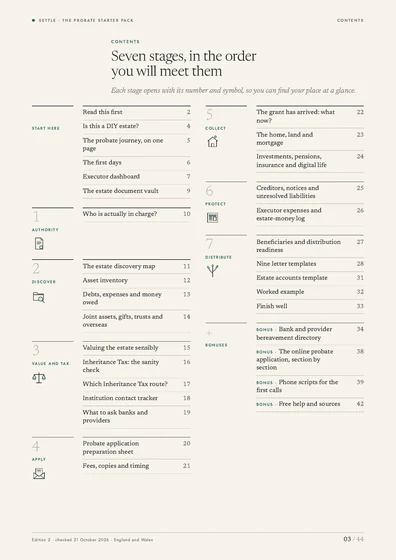
A 44-page printable toolkit to get organised and start probate yourself.
- 25-step executor checklist
- 9 ready-to-personalise letters
- Excel estate accounts workbook
Instant download · 30-day full refund
Secure Workspace
£9.99
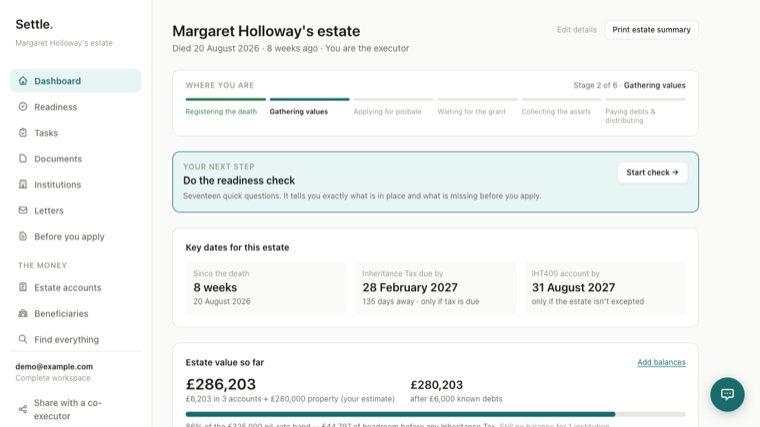
Keep every probate task, document and deadline organised online.
- Your own secure probate Workspace
- Track tasks, organisations and deadlines
- Starter Pack included
One-off · no subscription · 30-day full refund · not legal advice