When a beneficiary is under 18: who holds the inheritance?
With a will or without one · how many trustees · the date the child becomes entitled · income and capital before then
Checked against legislation.gov.uk and GOV.UK on 28 November 2026 (how we check).
Quick answer
A child cannot be paid an inheritance directly. It is held in trust until they are entitled: at 18, or a later age the will sets. If the will leaves the gift to trustees, they hold it. If the will leaves it to the child outright, the executors can appoint a trust corporation or two to four trustees to hold it, and are then discharged. Without a will, a child's share is held on the "statutory trusts" until 18, or earlier marriage or civil partnership. Before then, trustees can use the income for the child's maintenance, education or benefit, and capital up to the child's whole share for trusts arising since 1 October 2014.
1. The estate
2. The child
Nothing you enter leaves this page.
Loading.
How the checker works
- Age of entitlement. Full age is 18 (Family Law Reform Act 1969, section 1). A will can set a later age for a trust, such as 21 or 25. The checker adds that age to the child's date of birth.
- Who holds it. Trustees named in the will; or, for an outright gift with no trust, trustees the executors appoint under section 42 of the Administration of Estates Act 1925 ("a trust corporation or two or more individuals not exceeding four", who can include the executors); or, with no will, the administrators and then trustees on the statutory trusts in section 47.
- Before entitlement. Section 31 of the Trustee Act 1925 lets trustees pay or apply income "for or towards his maintenance, education, or benefit" and save the rest. Section 32 lets them pay capital for the child's "advancement or benefit": up to the whole of their share for trusts created or arising from 1 October 2014, and up to half before then, unless the will says otherwise.
- Inheritance Tax. If the person who died was the child's parent, a trust under their will that gives the child everything at 18, or the statutory trusts on an intestacy, can be a trust for a bereaved minor with no 10-yearly or exit charges (section 71A). A will trust for a bereaved child ending by 25 can be an 18 to 25 trust instead.
- Trust Registration Service. GOV.UK lists a will trust "closed within 2 years of death", and a statutory trust set up by law, among those that need not register unless liable to UK tax.
The three routes side by side
| Situation | Who holds the share | Child entitled at |
|---|---|---|
| Will leaves it to trustees for the child | The trustees named in the will | 18 or the age in the will |
| Will leaves it to the child outright | A trust corporation or 2 to 4 trustees appointed by the executors (s.42) | 18 (a bare trust) |
| No will (intestacy) | Administrators, then trustees on the statutory trusts (s.47) | 18, or earlier marriage or civil partnership |
When a beneficiary is a minor, section 114(2) of the Senior Courts Act 1981 says a grant of letters of administration goes to a trust corporation or "not less than two individuals", unless the court decides one is enough. GOV.UK describes a bare trust as one where the beneficiary "has the right to all of the capital and income of the trust at any time if they're 18 or over (in England and Wales)".
Worked examples
1. A parent's will trust (the default figures)
A mother dies on 1 March 2026. Her will leaves her estate to trustees for her son, born 20 June 2015, at 18. He becomes entitled on 20 June 2033. Until then the trustees can pay for school costs from the income and, if it benefits him, release capital up to his whole share. As a trust under a parent's will ending at 18, it can be a bereaved minor's trust for Inheritance Tax.
2. A grandchild named in the will with no trust
A grandfather leaves £10,000 to a granddaughter aged 9, with no trust clause. The executors cannot pay it to her, or informally to her parents. Under section 42 they can appoint two trustees (one can be an executor) to hold it until she is 18; once they do, the executors are discharged for that gift.
3. No will, two young children
A father dies without a will, leaving no spouse and two children aged 6 and 12. Each child's half is held on the statutory trusts until they reach 18 or marry or form a civil partnership under that age. Letters of administration will normally go to two people or a trust corporation. The intestacy calculator shows how the estate divides when there is also a spouse.
4. A will that says 25
A will leaves a share to a daughter at 25. Under section 31, from 18 the trustees must pay her the income until she becomes entitled to the capital, unless the will says otherwise. If the person who died was her parent, this can be an 18 to 25 trust, where an exit charge may apply to capital paid out between 18 and 25.
Things that catch executors out
- Paying a parent informally. Section 42 discharges the executors only once they appoint trustees. Handing a child's share to a parent informally has no such effect, so use trustees or follow the will.
- Deeds of variation. A child cannot agree to give up part of their inheritance themselves; see our deed of variation guide before changing who inherits.
- Investing the money. Section 42 says the share "may be retained in its existing condition or state of investment, or may be converted into money" and invested in authorised investments.
- Keeping records. Trustees should keep accounts of income used for the child and capital advanced, because section 32 says capital advanced is brought into account against the child's share.
- Payment into court. As a last resort, section 63 of the Trustee Act 1925 lets trustees pay trust money into court.
- Tax on trust income. A trust may have to pay Income Tax and report to HMRC; see our guide to trusts and Inheritance Tax on death and take advice for anything beyond a simple bank account.
Scotland has its own rules: GOV.UK says a bare trust beneficiary can take the assets at 16 in Scotland. Northern Ireland has separate legislation. See confirmation in Scotland and probate in Northern Ireland.
Sources
- Administration of Estates Act 1925, section 42 — legislation.gov.uk (read 28 November 2026)
- Administration of Estates Act 1925, section 47 — legislation.gov.uk (read 28 November 2026)
- Trustee Act 1925, section 31 — legislation.gov.uk (read 28 November 2026)
- Trustee Act 1925, section 32 — legislation.gov.uk (read 28 November 2026)
- Trustee Act 1925, section 63 — legislation.gov.uk (read 28 November 2026)
- Senior Courts Act 1981, section 114 — legislation.gov.uk (read 28 November 2026)
- Family Law Reform Act 1969, section 1 — legislation.gov.uk (read 28 November 2026)
- Inheritance Tax Act 1984, section 71A — legislation.gov.uk (read 28 November 2026)
- Trusts and taxes: types of trust — GOV.UK (read 28 November 2026)
- Trusts and Inheritance Tax — GOV.UK (read 28 November 2026)
- Register a trust as a trustee — GOV.UK (read 28 November 2026)
Frequently asked questions
Can an executor pay an inheritance to a child under 18?
No. The share is held by trustees until the child is entitled. If the will gives it outright with no trust, the executors can appoint a trust corporation or two to four trustees to hold it.
What happens to a child's inheritance if there is no will?
It is held on the statutory trusts until the child is 18, or marries or forms a civil partnership under 18. Trustees can use income and capital for the child before then.
Can trustees use a child's inheritance for school fees?
Yes. Income can be used for the child's maintenance, education or benefit, and capital can be advanced for their benefit: up to the whole share for trusts arising from 1 October 2014.
Does a trust for a child pay Inheritance Tax charges?
A trust under a parent's will that gives the child everything at 18, or the statutory trusts on an intestacy, can be a bereaved minor's trust with no 10-yearly or exit charges.
Sharing out an estate with a child beneficiary?
Keep the trust paperwork, receipts and estate accounts together. Pick the level of help that suits you.

Starter Pack
£4.99
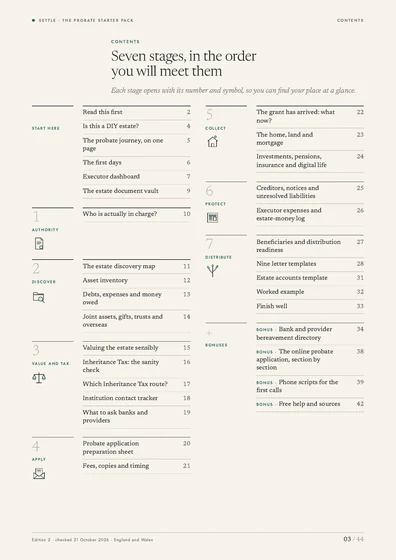
A 44-page printable toolkit to get organised and start probate yourself.
- 25-step executor checklist
- 9 ready-to-personalise letters
- Excel estate accounts workbook
Instant download · 30-day full refund
Secure Workspace
£9.99
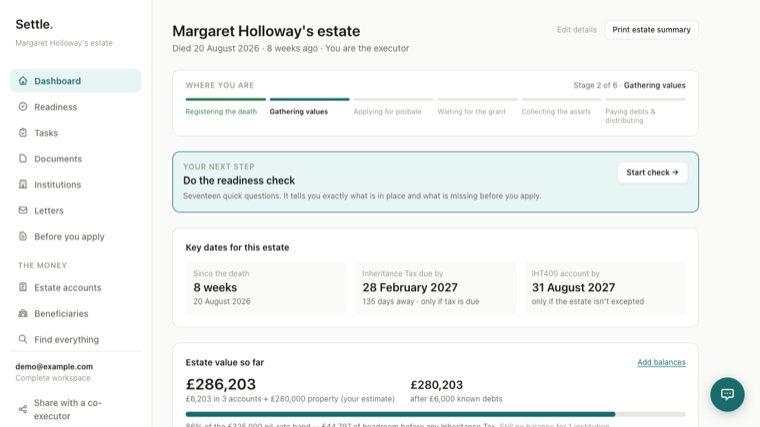
Keep every probate task, document and deadline organised online.
- Your own secure probate Workspace
- Track tasks, organisations and deadlines
- Starter Pack included
One-off · no subscription · 30-day full refund · not legal advice