Closing a Starling Bank Account After Death
Checked against current GOV.UK probate and Inheritance Tax guidance for England & Wales (2026/27).
- Starling Bank has no branches — you begin by phone (020 7930 4450, 24/7), email or post, not at a counter.4
- You will need a certified copy of the death certificate and your own photo ID to open the bereavement case; a Grant of Probate is only needed later, if the balance is above the bank's release limit.2
- The balance at which the bank asks for probate varies by institution and can change without notice — confirm the current figure directly with them rather than relying on any published number.
- A joint account normally passes to the surviving holder by survivorship, so probate is not needed to keep using it — but you still tell the bank so the name is removed.3
Starling Bank is an app-based bank with FSCS-protected deposits. Start the bereavement process by phone or email, send a copy of the death certificate, and the team will freeze the account and work out how the balance is released to the estate.1
Starling Bank is a fully digital bank. It has no branches, and all banking is done through the app or online. If the person who has died held a Starling account, you will need to contact Starling by phone or email to freeze the account, obtain a date-of-death balance, and eventually release the funds to the estate. Starling has a clear bereavement process and handles these cases regularly. Whether a Grant of Probate is required before funds can be released depends on the total balance held with Starling.
How to notify Starling Bank of a death
Starling's bereavement page gives these ways to begin:4
- By phone: 020 7930 4450. Starling says it is there 24/7.4
- By email: help@starlingbank.com.4 Include the full name of the deceased, their date of death, and your role (executor, administrator, or next of kin). Starling will acknowledge the notification, freeze the account, and tell you what documents to provide.
- By post: Bereavement Team, Starling Bank Limited, 5th Floor, London Fruit and Wool Exchange, 1 Duval Square, London E1 6PW.4
Starling does not have physical branches, so there is no option to hand in documents in person. If you notify by phone, follow up by email so you have a written record. Keep copies of all emails throughout the process.
If the deceased held accounts at several banks, the free Death Notification Service (deathnotificationservice.co.uk) can notify its member banks and building societies through a single online form. Starling was not on that member list when we checked its member list on 20 October 2026, so contact Starling directly as well.
Documents you will need
Starling will ask for documents at two stages: first to freeze the account and open the bereavement case, and later to release the funds. Prepare the following:
- Original death certificate or certified copy. Order at least five to ten certified copies when you register the death. Each copy costs around £12.50 from the register office and is far cheaper to obtain upfront than to request later.
- Proof of your identity. A passport or driving licence in your name.
- Proof of your address. A utility bill or bank statement dated within the last three months.
- Grant of Probate or Letters of Administration, if the balance exceeds Starling's probate threshold (see below). You do not need this for the initial notification, only when you come to close the account and release funds above the threshold.
- Small estate declaration, if the balance is below the threshold. Starling may ask you to sign a declaration confirming you are entitled to the funds and will reimburse any valid future claim.
Because Starling has no branches, documents will need to be sent digitally (by email or through an online portal) or by post. Follow Starling's instructions precisely to avoid any delay caused by missing or unclear documentation.
Starling's probate threshold
Starling publishes its limit: if the account balance is more than £30,000, it also needs a grant of probate or letters of administration.4 The limit applies to the total balance across the deceased's Starling account and any Spaces held within it. If the total is below the threshold, Starling will release funds on the basis of the death certificate, your identification, and a small estate declaration. If the total is above the threshold, the account remains frozen until you provide the sealed Grant of Probate.
Note: the £30,000 figure was read on Starling's own bereavement page on 21 October 2026. Limits can change, so confirm with Starling before deciding whether to apply for probate.
For a broader comparison of approximate thresholds at major UK banks, see our guide to bank probate thresholds.
What happens to Spaces
Starling Spaces are sub-accounts within the main Starling account, used to set aside money for different purposes. They are not separate legal accounts but they do hold balances separately from the main account. For the purpose of the probate threshold, the total across the main account and all Spaces is treated as a single Starling balance.
When you request a date-of-death balance from Starling, ask for a breakdown of the main account balance and each Space separately. You will need this detail for the estate valuation and for any probate forms.
What happens to scheduled payments
Starling supports scheduled payments and standing order equivalents within its app. When Starling freezes the account on notification of a death, scheduled payments will stop.
Consider the practical effects:
- Any bills paid via the Starling account, including subscriptions, utilities, and insurance, will no longer be paid. Contact each supplier to inform them of the death and make alternative payment arrangements where necessary.
- Property-related costs are particularly important. If the deceased paid buildings insurance, council tax, or mortgage payments from this account, confirm immediately that these costs are being met from the estate or another source during the administration period.
- Request a statement from Starling showing all scheduled and recurring payments active as at the date of death. This becomes part of the estate records and helps you identify every supplier that needs to be contacted.
Keeping track of every institution, document sent and response received is one of the core things the Settle workspace helps with. Start the free assessment to get your personalised checklist.
Joint accounts
Starling offers joint accounts held between two people. Where the deceased held a joint account, it ordinarily passes to the surviving account holder by right of survivorship. Starling will remove the deceased's name from the account on sight of the death certificate, and the surviving holder retains access to the funds throughout the process.
You still need to notify Starling even if the account is a joint account. The update does not happen automatically. The surviving account holder should call 020 7930 4450 or email help@starlingbank.com, providing the death certificate and their own identification.
The balance in a joint account at the date of death may still be relevant for inheritance tax purposes depending on how the account was funded, but this is a separate matter from the bank notification process.
FSCS protection
Starling Bank is authorised and regulated by the Financial Conduct Authority (FCA) and is a member of the Financial Services Compensation Scheme (FSCS). If the bank were to fail, the FSCS protects eligible deposits up to £120,000 per eligible person, per authorised bank or building society (the limit rose from £85,000 on 1 December 2025). Brands that share one banking licence share a single £120,000 limit. Temporary high balances, such as money received from an estate, can be protected up to £1.4 million for six months. This protection is relevant context when valuing the estate but does not affect the bereavement process itself.
How long does it take
Timescales depend on the balance relative to the probate threshold and how quickly documents are provided and verified:
- Below the threshold: Once Starling has received and verified the required documents, it typically aims to process the release of funds within a few weeks.
- Above the threshold: The account will remain frozen until the sealed Grant of Probate is produced. Obtaining a grant can take several weeks to several months depending on the complexity of the estate and court waiting times. Once Starling receives the sealed grant, they should complete the closure and release funds in a similar timeframe to below-threshold cases.
Because all communication is in writing, it is straightforward to track the progress of the case. If you have not received a response within two weeks of sending documents, follow up by email citing your original correspondence. Keep a log of every email sent and received with dates.
Starling bereavement contact details
- Telephone: 020 7930 4450, 24/7.4
- Email: help@starlingbank.com4
- Post: Bereavement Team, Starling Bank Limited, 5th Floor, London Fruit and Wool Exchange, 1 Duval Square, London E1 6PW.4
- Help page: starlingbank.com bereavement page
There are no branches. Checked on starlingbank.com on 21 October 2026; confirm current contact details on the Starling website before getting in touch.
For the broader process of notifying all institutions and closing accounts, see our guide to closing bank accounts after death. For a comparison of how major banks handle probate thresholds, see bank probate thresholds.
Not sure what you need to do next?
The free assessment gives you a personalised checklist of every step, in the right order.
Start free assessmentCommon mistakes to avoid
- Assuming a published threshold is current. Banks change these limits quietly. Ask the bereavement team what applies to this estate before deciding whether to apply for probate.
- Letting property bills lapse. When the account freezes, buildings insurance or council tax paid by direct debit stops too. Move essential payments so cover does not drop.
- Ordering too few death certificates. Each institution wants its own certified copy. Order several when you register the death — they are far cheaper up front than requested later.
- Waiting for probate before notifying. You notify first; probate (if needed at all) comes later. Freezing the account early protects the estate.1
Frequently asked questions
Do I need probate to close a Starling Bank account?
Only if the balance is above the bank's own release limit. Below it, most banks pay out on the death certificate, your ID and a short estate declaration; above it they hold the money until you produce a sealed Grant of Probate.2
How long does it take to release the money?
For balances under the threshold, usually a few weeks once the paperwork is in. Above the threshold the account stays frozen until probate is granted, which itself is usually within 12 weeks of a complete application, then a short release window after.
What happens to a joint account?
It passes automatically to the surviving account holder by right of survivorship, so it is not frozen and does not need probate. You still notify the bank so the deceased's name is removed.3
Can I use the Death Notification Service instead of calling?
Not for Starling. Starling was not a member of the free Death Notification Service when we checked its member list on 20 October 2026, so tell Starling directly. The service is still worth using for the person's other banks if they are members, such as Barclays, HSBC, Lloyds, NatWest, Nationwide or Santander.
What documents will they ask for?
A certified copy of the death certificate, your photo ID and proof of address, the will if there is one, and — for larger balances — the Grant of Probate or Letters of Administration once you have it.2
Sources & references
The figures and rules in this guide are drawn from the official UK government pages below. Each link opens the relevant GOV.UK page. Always confirm current figures on GOV.UK before you act, as fees and thresholds can change.
- Dealing with the estate of someone who's died — GOV.UK
- Applying for probate — GOV.UK
- What to do when someone dies: step by step — GOV.UK
- Bereavement — Starling Bank
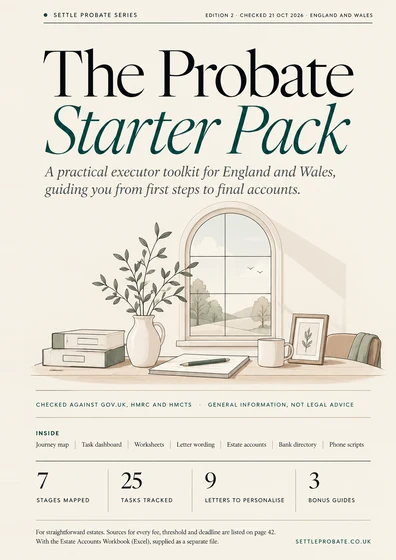
Starter Pack · £4.99 — a 44-page printable executor toolkit with a 25-step checklist, nine letters to personalise and an Excel estate accounts workbook.
See what’s inside →Free
Not sure probate is needed yet?
Answer 7 questions and get a free probate assessment. No account needed.
Start free assessment →Secure Workspace · £9.99
Send the letters, then track every bank
Your Workspace fills in a notification letter for each bank with the estate's details, and keeps a record of who you have contacted, what is still outstanding and each balance at the date of death.
See how the Workspace works →