Executor Expenses: What Can You Claim From the Estate?
Expenses the estate repays · funeral costs that reduce Inheritance Tax · costs HMRC does not allow · your own time
Rules checked against the Trustee Act 2000, the Inheritance Tax Act 1984 and HMRC's manuals on 28 November 2026 (how we check).
Quick answer
Yes. An executor is entitled to be repaid from the estate for expenses properly incurred while acting for it, such as the probate fee, postage, valuations and keeping an empty house insured (Trustee Act 2000, section 31). Reasonable funeral costs, including a headstone, flowers, mourning and refreshments for mourners, also reduce the estate for Inheritance Tax. Travel and hotels for mourners do not count as funeral costs, and a family executor is not paid for their time unless the will allows it. Keep every receipt.
What you have paid
Nothing you type is sent or saved: it stays in this page. Print or note the totals for your records.
Loading.
Each kind of expense at a glance
| Expense | Repaid from the estate? | Funeral cost for Inheritance Tax? | Rule |
|---|---|---|---|
| Funeral director, burial or cremation | Yes | Yes, if reasonable | IHTA 1984 s.172; IHTM10371 |
| Headstone that marks the grave | Yes | Yes | IHTM10373 |
| Memorial plaque, monument or memorial service | Yes, if properly incurred | Not strictly; take advice | IHTM10373, IHTM10374 |
| Refreshments for mourners | Yes | Yes, if reasonable | IHTM10377 |
| Flowers for the church or coffin | Yes | Yes, if reasonable | IHTM10372 |
| Mourning for the family | Yes | Yes, if reasonable | IHTM10375 |
| Bringing the body home from abroad, embalming | Yes | Yes, if reasonable | IHTM10378 |
| Travel and hotels of executors and mourners for the funeral | Check | No | IHTM10379 |
| Probate or confirmation fee | Yes | No | Trustee Act 2000 s.31 |
| Postage, death certificates, phone calls, travel to deal with the estate | Yes | No | Trustee Act 2000 s.31 |
| Insuring, securing or heating the empty home | Yes | No | Trustee Act 2000 s.31 |
| Valuations, tax return and IHT400 fees | Yes | No | Trustee Act 2000 s.31 |
| Pay for a family executor's time | Only if the will allows | No | Trustee Act 2000 ss.28, 29 |
The rules behind the answers
- Repaying the executor. Section 31 of the Trustee Act 2000 says a trustee "is entitled to be reimbursed from the trust funds, or may pay out of the trust funds, expenses properly incurred by him when acting on behalf of the trust". Section 35 applies the Act to personal representatives administering an estate.
- Pay for time. Sections 28 and 29 give a right to payment for services only to trust corporations and to executors acting in a professional capacity, such as a solicitor. A relative acting as executor is repaid expenses, not paid for hours.
- Funeral costs and Inheritance Tax. HMRC's manual says "the deduction of reasonable funeral expenses is specifically allowed under IHTA84/S172". They go on the IHT400 with a breakdown. HMRC questions claims that look "wholly unreasonable or large in relation to the estate as a whole".
- Income Tax on estate income. HMRC lists funeral expenses, probate fees, costs of collecting and preserving the assets and other administration expenses relating to capital as not allowable against the estate's income (TSEM7914).
Worked example (the default figures)
| Expense | Amount | Repaid? | Funeral cost for IHT? |
|---|---|---|---|
| Funeral director and cremation | £4,200 | Yes | Yes |
| Headstone | £1,500 | Yes | Yes |
| Refreshments after the service | £600 | Yes | Yes |
| Hotel for the funeral | £300 | Check | No |
| Probate fee (England and Wales, estate over £5,000) | £526 | Yes | No |
| Postage | £45 | Yes | No |
| Totals | £7,171 | £6,871 repaid, £300 to check | £6,300 |
Sources
- Trustee Act 2000, section 31: trustees' expenses — legislation.gov.uk (read 28 November 2026)
- Trustee Act 2000, section 35: personal representatives — legislation.gov.uk (read 28 November 2026)
- Trustee Act 2000, section 28 — legislation.gov.uk and section 29 (read 28 November 2026)
- IHTM10371: Funeral expenses — HMRC Inheritance Tax Manual, with IHTM10372 to IHTM10379 (read 28 November 2026)
- TSEM7914: Personal representatives' expenses, what expenses are not allowable — HMRC Trusts, Settlements and Estates Manual (read 28 November 2026)
- Applying for probate: fees — GOV.UK (read 28 November 2026)
Frequently asked questions
Can an executor claim expenses from the estate?
Yes. Section 31 of the Trustee Act 2000, which applies to personal representatives under section 35, says a trustee is entitled to be reimbursed from the trust funds for expenses properly incurred when acting on its behalf. Keep receipts and show the payments in the estate accounts.
Can an executor be paid for their time?
Not as an expense. The Trustee Act 2000 gives a right to payment for services only to trust corporations and to executors acting in a professional capacity. A family executor is repaid expenses, not paid for time, unless the will provides for it.
Is a headstone a funeral expense for Inheritance Tax?
Yes. HMRC's manual says to allow as a reasonable funeral expense the cost of a headstone that finishes off, describes and marks the grave. A separate memorial, such as a plaque in a church, is not strictly allowable.
Can travel to the funeral be claimed against Inheritance Tax?
No. HMRC's manual says the travelling expenses of the personal representatives and the accommodation costs of mourners are not allowed as funeral expenses, and the same goes for immediate family.
Keeping track of what you have spent?
Every receipt ends up in the estate accounts. Pick the level of help that suits you.

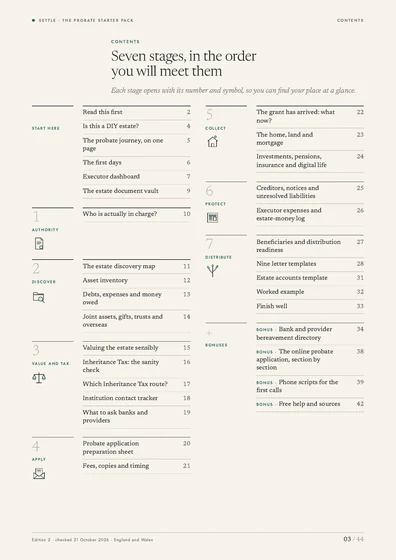
Starter Pack
£4.99
A 44-page printable toolkit to get organised and start probate yourself.
- 25-step executor checklist
- 9 ready-to-personalise letters
- Excel estate accounts workbook
Instant download · 30-day full refund
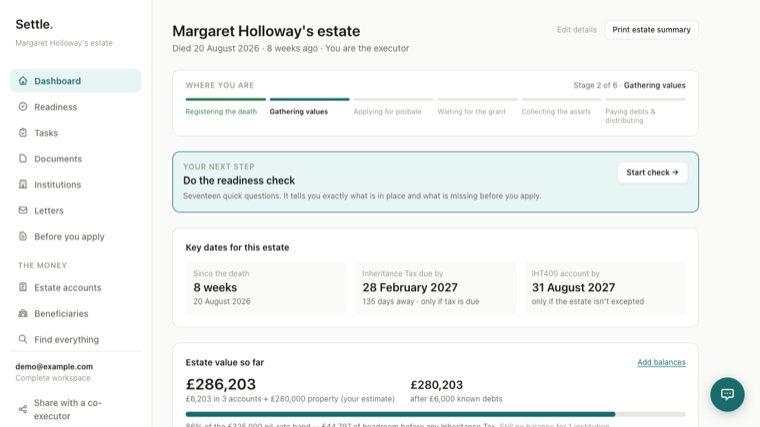
Secure Workspace
£9.99
Keep every probate task, document and deadline organised online.
- Your own secure probate Workspace
- Track tasks, organisations and deadlines
- Starter Pack included
One-off · no subscription · 30-day full refund · not legal advice