Estate Deadlines Calculator
Register the death · Bereavement Support Payment · Inheritance Tax due date · IHT400 · executor's year · 6 months from the grant
Dates checked against GOV.UK, HMRC and legislation.gov.uk on 26 November 2026 (how we check).
Quick answer
The fixed dates after a death in England and Wales are: register it within 5 days of the cause being confirmed; pay any Inheritance Tax by the end of the sixth month after the month of death; send an IHT400, if one is needed, within a year; and, once probate is granted, allow 6 months for family claims under the Inheritance Act 1975. There is no deadline to apply for probate itself. Enter your dates below to see all of them in order.
1. Dates you know
2. About the estate
Estimate only. Nothing you enter leaves this page.
Loading.
How the calculator works
It takes the date of death and works out each date from the rule that sets it:
- Registering the death. GOV.UK: within 5 days of getting the confirmation of the cause of death, including weekends and bank holidays (8 days in Scotland). The calculator counts from the date of death as a guide.
- Bereavement Support Payment. Claim within 3 months of the death to get the one-off payment and all 18 monthly payments; after 21 months you usually cannot get any.
- Inheritance Tax. Due by the end of the sixth month after the person died: a January death means 31 July. Interest runs from the next day.
- IHT400. If tax is due or full details are needed, report within one year of the death, and before applying for probate.
- Executor's year. Section 44 of the Administration of Estates Act 1925 says executors are not bound to distribute before a year from the death.
- Loss relief. Shares sold within 12 months of the death for less than their probate value (form IHT35), land or buildings within 3 years, and some within 4 years (form IHT38).
- Capital Gains Tax. The estate's annual allowance lasts for the tax year of death and the next two. A UK home sold with tax to pay needs a report within 60 days of completion.
- From the grant. Inheritance Act claims (section 4) and applications to rectify a will (section 20 of the Administration of Justice Act 1982) are both 6 months from the grant. The Class F council tax exemption for an empty home ends once six months have passed since the grant.
- Funeral Expenses Payment. Within 6 months of the funeral.
Worked examples
1. A January death (the default figures)
Death on 14 January 2026. Register by about 19 January. Inheritance Tax is due by 31 July 2026, with interest from 1 August. An IHT400, if needed, by 14 January 2027, which is also the end of the executor's year and the last day to sell shares at a loss for relief. The estate's Capital Gains Tax allowance runs out after 5 April 2028.
2. Adding the grant
If probate is granted on 20 July 2026, Inheritance Act claims need the court's permission after 20 January 2027, and the council tax exemption on an empty home ends on the same date. Many executors keep back enough to meet a possible claim until then before making the final payment.
3. A month-end death
Death on 31 August 2026: Inheritance Tax is due by 28 February 2027, the last day of the sixth month after August.
Things the calculator cannot know
- When the cause of death was confirmed. The 5 days run from that, not from the death. If a coroner is involved, the register office will tell you what to do.
- Whether the estate is excepted. If it is, there is no IHT400. Use the excepted estate checker.
- Instalments. Tax on property can be paid in 10 yearly instalments, with different interest rules.
- Scotland and Northern Ireland. Registration, confirmation and council tax rules differ. See confirmation in Scotland and probate in Northern Ireland.
- The last day. Courts and HMRC count periods carefully. Treat each date as the latest safe day, not a target.
Sources
- What to do after someone dies — GOV.UK (read 26 November 2026)
- Bereavement Support Payment: what you'll get — GOV.UK (read 26 November 2026)
- Funeral Expenses Payment: how to claim — GOV.UK (read 26 November 2026)
- Pay your Inheritance Tax bill — GOV.UK (read 26 November 2026)
- Valuing the estate: tell HMRC the estate's value — GOV.UK (read 26 November 2026)
- Administration of Estates Act 1925, section 44 — legislation.gov.uk (read 26 November 2026)
- Inheritance Tax: loss on sale of shares (IHT35) — GOV.UK (read 26 November 2026)
- Inheritance Tax: loss on sale of land (IHT38) — GOV.UK (read 26 November 2026)
- HS282 Death, personal representatives and legatees (2026) — HMRC, GOV.UK (read 26 November 2026)
- Report and pay Capital Gains Tax on UK property — GOV.UK (read 26 November 2026)
- Inheritance (Provision for Family and Dependants) Act 1975, section 4 — legislation.gov.uk (read 26 November 2026)
- Administration of Justice Act 1982, section 20 — legislation.gov.uk (read 26 November 2026)
- Council Tax (Exempt Dwellings) Order 1992, article 3 (Class F) — legislation.gov.uk (read 26 November 2026)
Frequently asked questions
Is there a deadline to apply for probate?
No fixed deadline in England and Wales. But Inheritance Tax is due by the end of the sixth month after the month of death, with interest after that, and an IHT400 (if one is needed) must be sent within a year and before you apply.
When is Inheritance Tax due after a death?
By the end of the sixth month after the person died. GOV.UK gives the example that for a death in January, tax is due by 31 July (GOV.UK).
How long do people have to make a claim against an estate?
A claim under the Inheritance (Provision for Family and Dependants) Act 1975 needs the court's permission if it is made more than six months after the grant (section 4). It can be made before the grant.
How long does an executor have to distribute the estate?
There is no fixed deadline, but section 44 of the Administration of Estates Act 1925 says executors are not bound to distribute before a year from the death, which is why people talk about the executor's year.
Turn the dates into a plan
Once you know the dates and figures, the next job is organising the estate. Pick the level of help that suits you.

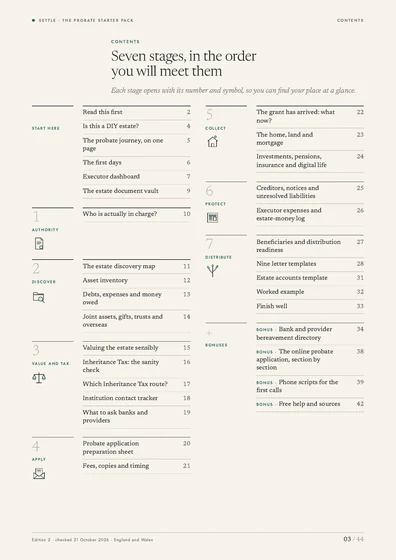
Starter Pack
£4.99
A 44-page printable toolkit to get organised and start probate yourself.
- 25-step executor checklist
- 9 ready-to-personalise letters
- Excel estate accounts workbook
Instant download · 30-day full refund
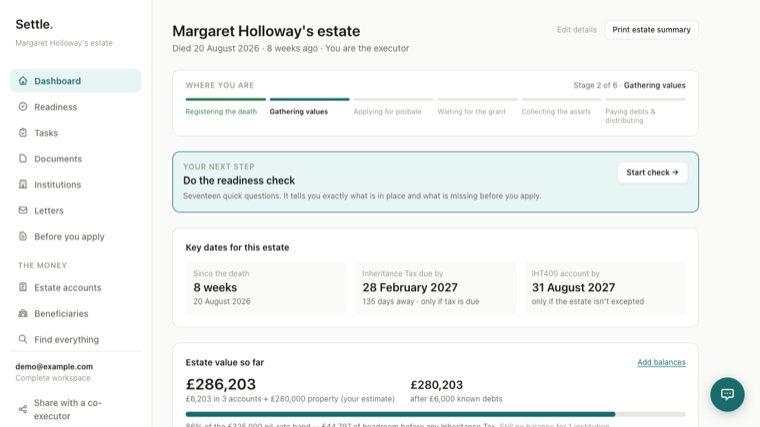
Secure Workspace
£9.99
Keep every probate task, document and deadline organised online.
- Your own secure probate Workspace
- Track tasks, organisations and deadlines
- Starter Pack included
One-off · no subscription · 30-day full refund · not legal advice